
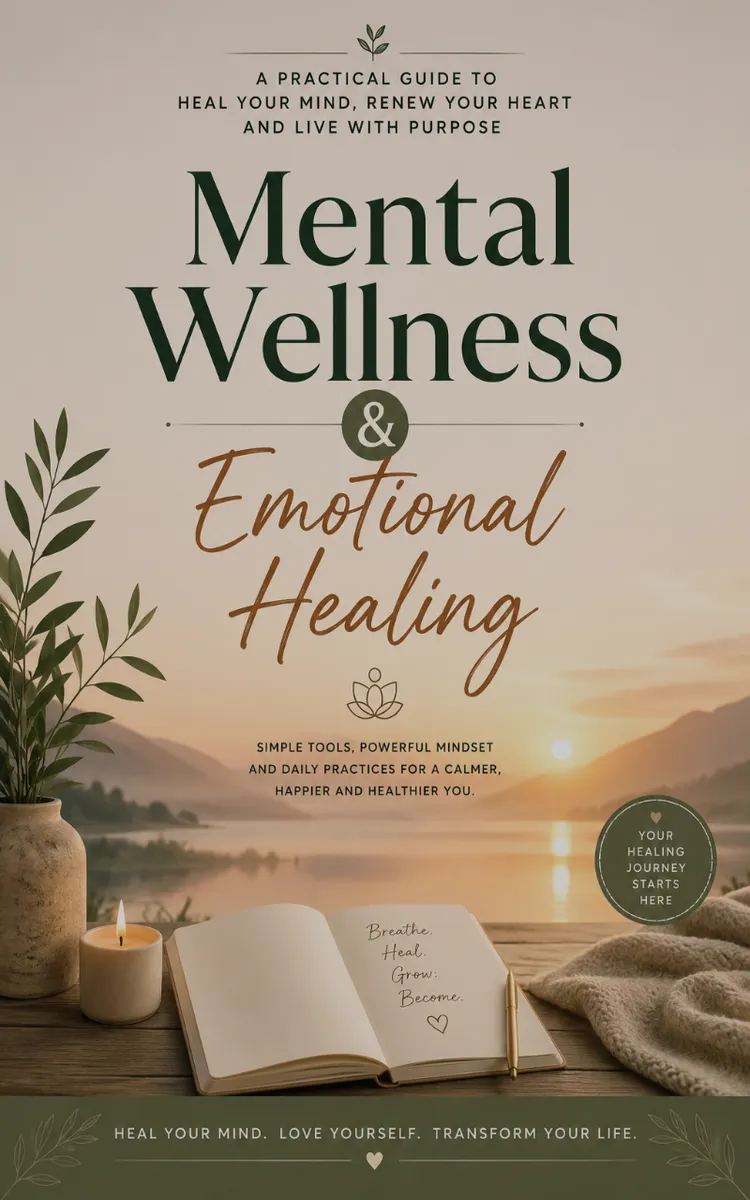
Read the first chapter
The whole of chapter one, free. About 5 min. Turn the pages with the arrows, your keyboard, or a swipe.
Chapter 1
Days 1-6: Build Anxiety Awareness
Ever had your mind run a “what-if” movie so many times that your body starts reacting like the danger is real-even when nothing is happening? That’s anxiety doing its job a little too well. It grabs your attention, predicts threats, and turns uncertainty into urgency.
For the next six days, you’re going to map what’s going on inside you. Not by forcing positive thoughts, and not by fighting every worry. You’ll learn to notice the pattern-mind and body together-so you can start interrupting it on purpose. Nadia, a 34-year-old customer support lead, is our example in this chapter because her anxiety shows up in a very normal, very daily way: messages, deadlines, and the pressure to get it right.
---
Day 1: Name What’s Moving You
Tip of the Day: When anxiety hits, it rarely feels like “a thought.” It feels like a fact. Your heart speeds up, your stomach tightens, and suddenly your brain acts like it has evidence. The first step is getting specific about what you’re actually experiencing-so it stops hiding behind vague feelings.
Use the Anxiety Map Framework today to label what’s happening in you. Anxiety Map is simple: you’re tracking three things-what your mind is saying, what your body is doing, and what you end up doing next. Nadia noticed that her “I’m going to mess up” thought didn’t stay a thought. It made her reread every ticket, talk faster in her responses, and then spiral when nobody answered right away. Naming the loop gave her something to hold onto.
Today's Action: Write down one anxious moment from today and label it as: Thought (what your mind said) + Body (what you felt) + Behavior (what you did next).
---
Day 2: Find Your Personal Triggers (Not Generic Ones)
Tip of the Day: Triggers aren’t just “bad events.” A trigger can be a sound, a delay, a certain kind of message, or even the time of day your energy is lower. If you only look for big triggers, you’ll miss the small ones that quietly stack the anxiety.
Today you’re hunting for patterns using your own real life. Nadia’s trigger wasn’t “work stress” in general. It was the silence after she sent a customer follow-up-her brain treated it like rejection or a problem she’d caused. That’s why the body kicked in. Once she knew her trigger was the delay, she could prepare for it instead of being surprised every time.
Today's Action: Create a “Trigger List” in your notes with 5 items from this week (example format: Trigger → What your mind predicts → Body response).
---
Day 3: Spot the Loop Start (The Moment It Gains Control)
Tip of the Day: Anxiety loves the middle part-when you’re already inside it. But the real power is finding the start. Usually it’s a small moment: a single thought, a glance at your phone, a vague feeling of “uh-oh,” or a sentence that lands wrong.
Look for the first “click” in the loop. For Nadia, it was the instant she noticed a customer message “seen” without a reply. Her thought jumped to worst-case outcomes, then her behavior followed (checking, rewriting, overexplaining). The loop didn’t grow because she was careless-it grew because the start was fast and automatic.
Today's Action: Replay one recent loop and write the earliest point you noticed it starting (the first Thought/Body/Behavior moment). Keep it to one paragraph.
---
Day 4: Check Your Body Signals Like a Weather Report
Tip of the Day: Your body isn’t just reacting-it’s sending signals. Anxiety shows up in patterns: tight chest, buzzing legs, headaches, nausea, jaw clenching, shaky hands, shallow breathing. When you treat those signals like “proof something is wrong,” you feed the panic. When you treat them like weather, you can stay in charge.
Try this: don’t argue with the feeling. Observe it. Nadia used to think, “If I feel this, something must be happening.” Then she started asking, “What is my body doing right now?” She’d notice her shoulders up near her ears, her breathing getting short, and her mind speeding up to find answers. That awareness didn’t erase anxiety instantly-but it stopped the automatic fear of the fear.
Today's Action: Do a 60-second body scan and write down three signals you notice (for example: chest tightness, jaw tension, fast heartbeat). Then rate intensity 0-10.
---
Day 5: Interrupt the Next Step (Choose a Different Behavior)
Tip of the Day: Here’s the part people miss: anxiety doesn’t only live in your thoughts. It lives in the next action you take. If your next step is checking again, rereading again, googling again, texting again, avoiding again-your brain learns that the alarm is real.
Today you’ll interrupt the next step without needing to “solve” the worry. Nadia couldn’t stop thinking “what if they’re mad?” on command. But she could stop the automatic behavior. When her trigger delay hit, she used a tiny delay of her own: a planned pause before she responded or checked. That pause gave her brain a new message-“We can handle this.”
Today's Action: Pick one anxiety behavior you did today (like rereading, refreshing, texting, avoiding). Do the same situation again tomorrow, but add a 10-minute delay before that behavior.
---
Day 6: Make a Simple Map Entry (Mind + Body + Pattern)
Tip of the Day: By now you’ve probably noticed something: your anxiety isn’t random. It has a route. Thought shows up, body follows, then behavior locks you in. The Anxiety Map Framework is your “route finder.” When you can see the route, you’re less likely to get bullied by it.
Nadia’s map looked like this on her hardest days: Trigger (customer silence) → Thought (“they’re upset / I messed up”) → Body (tight chest, faster breathing) → Behavior (rewriting replies, checking again and again). Once she wrote it out, she stopped pretending she was failing. She was just following a pattern she could change.
Today's Action: Write one full Anxiety Map entry for today using this exact structure: Trigger → Thought → Body signals → Urge to do → New behavior you’ll try.
---
You’re building a skill more than a “mood”: awareness that cuts through the fog. Next, we’ll start turning that awareness into calmer responses-so anxiety can be noticed without being obeyed, and your days don’t have to run on autopilot.
End of chapter one. 4 more chapters in the full book.
Swipe or use the arrows to turn the page
What's inside: 5 chapters
- 1. Days 1-6: Build Anxiety Awareness
- 2. Days 7-12: Rewire Overthinking Patterns
- 3. Days 13-18: Stabilize Body and Mind
- 4. Days 19-24: Journal, Ground, and Heal
- 5. Days 25-30: Boundaries, Confidence, Recovery
About this book
"30-Day Anxiety Recovery Challenge" is a day challenge book by Anonymous with 5 chapters and approximately 5,127 words. A 30-day program for managing anxiety and overthinking.
This book was created using Inkfluence AI, an AI-powered book generation platform that helps authors write, design, and publish complete books.
Frequently Asked Questions
What is "30-Day Anxiety Recovery Challenge" about?
A 30-day program for managing anxiety and overthinking
How many chapters are in "30-Day Anxiety Recovery Challenge"?
The book contains 5 chapters and approximately 5,127 words. Topics covered include Days 1-6: Build Anxiety Awareness, Days 7-12: Rewire Overthinking Patterns, Days 13-18: Stabilize Body and Mind, Days 19-24: Journal, Ground, and Heal, and more.
Who wrote "30-Day Anxiety Recovery Challenge"?
This book was written by Anonymous and created using Inkfluence AI, an AI book generation platform that helps authors write, design, and publish books.
Write your own day challenge book with AI
Describe your idea and Inkfluence writes the whole thing. Free to start.
Start writingCreated with Inkfluence AI


