
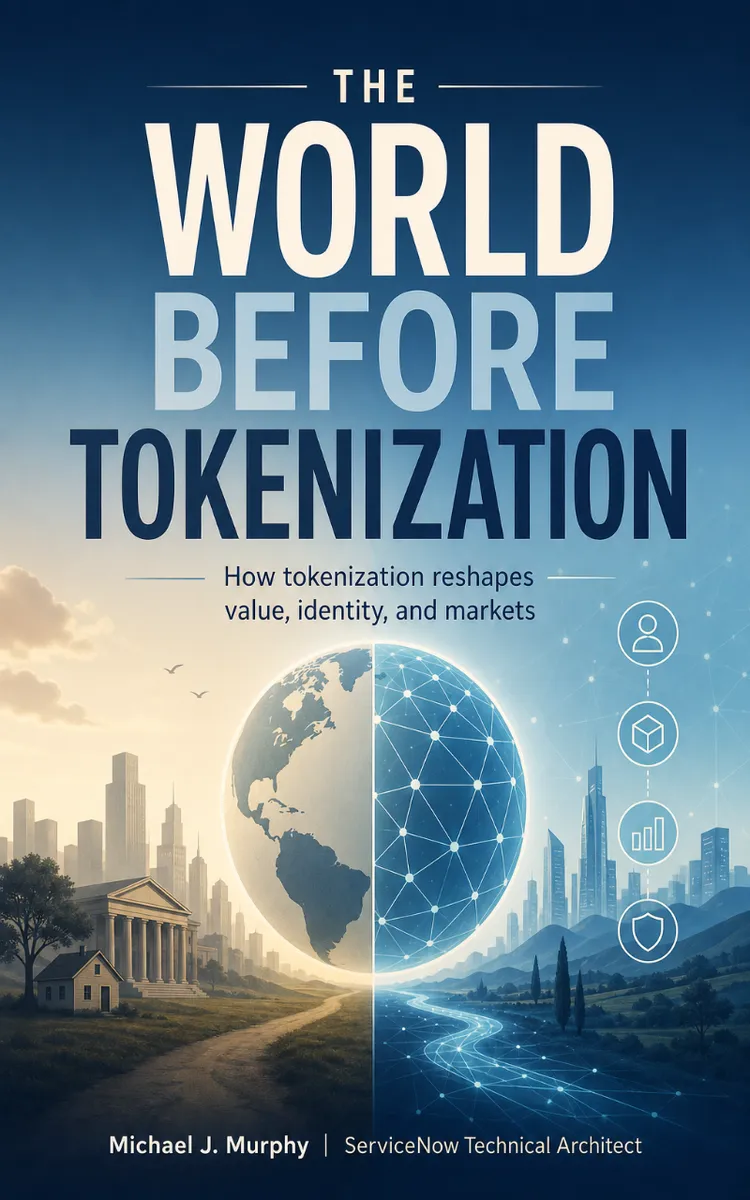
The World Before And After Tokenization
Created with Inkfluence AI
By the time you finish this book, you will understand what tokenization changes, why it changes it, and where the real impact shows up in finance, data, and society. You will learn how tokens turn uncertain records into inspectable objects, and how that affects reconciliation, trust, and the costs of getting to agreement. You will also see how tokenization reframes ownership as programmable slices, making transfers clearer and partial rights easier to manage. Instead of abstract jargon, the ideas are grounded in lived moments and characters that make the mechanics feel intuitive. If you are curious and want a clear story behind the hype, this is your guided path from the ledger before it was shared to the world before and after tokenization.
Table of Contents
- 1. Why Tokens Feel Like Magic
- 2. The Ledger Before It Was Shared
- 3. Atomic Ownership in Pieces
- 4. Smart Contracts: Promises That Execute
- 5. The Data That Can’t Be Unseen
- 6. Liquidity Moves Like Weather
- 7. The Risk Nobody Prices Correctly
- 8. From Trust to Programmable Society
Preview: Why Tokens Feel Like Magic
A short excerpt from “Why Tokens Feel Like Magic”. The full book contains 8 chapters and 15,993 words.
The Magic Mirror Test: When Money and Data Start Reflecting Each Other
A few years ago, a payment app could tell you your balance in seconds, but it still treated your money like a black box: it moved, it settled, it disappeared into the rails. Tokens flip that feeling. Instead of money being only something you use, tokens make money look like something you can inspect - and, at the same time, make data feel like something you can carry.
That’s the everyday surprise at the heart of tokenization: it doesn’t just change how value transfers. It changes what people expect value and information to be. Money has always been a social promise backed by systems - banks, ledgers, courts, trust. Data has always been a technical thing backed by software and access. Tokens blur that boundary, and the blur is where the “magic” sensation comes from.
In this chapter, we’ll follow that blur from a practical, lived moment - told through Lena, 34, a rideshare dispatcher - to the deeper idea underneath: when a token stands in for something, the token can start behaving like a mirror for the thing it represents. That mirror doesn’t show you reality in a perfect way; it shows you what the system is willing to treat as real.
So why does a simple digital token make money and data feel like they’ve learned to talk to each other?
How Tokens Turn Promises Into Inspectable Objects
Start with the simplest mental model of money. Most of the time, you don’t “see” money itself - you see accounting. Your paycheck becomes a number in a ledger, your rent becomes a number leaving one ledger and arriving in another, and the world mostly agrees that those numbers correspond to real purchasing power. For centuries, that agreement has depended on institutions and processes: coinage, bills of exchange, bank clearing, settlement rules, and legal enforceability. The ledger matters, but it’s usually hidden behind trusted intermediaries.
Now compare that with what happens when people say “token.” In everyday speech, the word can mean a token of appreciation, a small proof, a collectible. In technology, the word borrows that same intuition: a token is a stand-in - a compact unit that can be moved, counted, and recognized. The “stand-in” can represent a currency unit, a share in something, a right to receive revenue, or access to a service. The key is that the token is not just a label. It’s an object with rules attached.
Those rules show up wherever the token lives - often on a blockchain, sometimes in other token systems. Blockchains maintain a shared record of what tokens exist and who holds them. That record is designed to be verifiable without needing the same kind of trust you’d place in a single bank’s internal books. In other words, tokenization takes something that used to be a mostly internal bookkeeping promise and turns part of it into an externally visible representation.
A useful historical anchor is the long arc of ledgers becoming more programmable. The first financial systems were physical ledgers: paper books, stamped instruments, clerks reconciling columns. Over time, finance moved into electronic records. But even then, the ledger was often still “owned” by a particular institution. Tokenization pushes further: it aims to make the ledger rules travel with the representation. That shift is why tokens can feel like objects rather than paperwork.
To see why that matters socially, it helps to remember what money and data have in common. Both are abstractions. Money is abstraction backed by law and economics. Data is abstraction backed by measurement and computation. When you store them in separate places - bank systems for money, software systems for data - you can treat them as separate worlds. Tokenization asks what it would mean if they started sharing the same world.
Lena and the Dispatch Board: When Value Meets Workflow
Picture Lena’s job for a moment - not as a sci-fi scenario, but as a real kind of work many people already do. A rideshare dispatcher’s day is a chain of small decisions: matching riders and drivers, managing demand surges, handling cancellations, keeping wait times from spiraling, and making sure the platform’s promises land on time. The dispatcher doesn’t “own” the platform’s internal systems, but the dispatcher lives inside their consequences.
In a typical dispatch environment, there’s always a question: what counts as real? Is it the app’s status messages? The driver’s GPS ping? The system’s estimated arrival time? The platform’s internal credit and incentive rules? The dispatcher watches the interfaces that turn messy reality into structured outcomes. That interface is a kind of mirror: it reflects the system’s understanding of the world, and it shapes what the dispatcher does next.
...
About this book
"The World Before And After Tokenization" is a curiosity book by Michael Murphy with 8 chapters and approximately 15,993 words. By the time you finish this book, you will understand what tokenization changes, why it changes it, and where the real impact shows up in finance, data, and society. You will learn how tokens turn uncertain records into inspectable objects, and how that affects reconciliation, trust, and the costs of getting to agreement.
This book was created using Inkfluence AI, an AI-powered book generation platform that helps authors write, design, and publish complete books.
Frequently Asked Questions
What is "The World Before And After Tokenization" about?
By the time you finish this book, you will understand what tokenization changes, why it changes it, and where the real impact shows up in finance, data, and society. You will learn how tokens turn uncertain records into inspectable objects, and how that affects reconciliation, trust, and the costs of getting to agreement. You will also see how tokenization reframes ownership as programmable slices, making transfers clearer and partial rights easier to manage. Instead of abstract jargon, the ideas are grounded in lived moments and characters that make the mechanics feel intuitive. If you are curious and want a clear story behind the hype, this is your guided path from the ledger before it was shared to the world before and after tokenization.
How many chapters are in "The World Before And After Tokenization"?
The book contains 8 chapters and approximately 15,993 words. Topics covered include Why Tokens Feel Like Magic, The Ledger Before It Was Shared, Atomic Ownership in Pieces, Smart Contracts: Promises That Execute, and more.
Who wrote "The World Before And After Tokenization"?
This book was written by Michael Murphy and created using Inkfluence AI, an AI book generation platform that helps authors write, design, and publish books.
Write your own curiosity book with AI
Describe your idea and Inkfluence writes the whole thing. Free to start.
Start writingCreated with Inkfluence AI


