
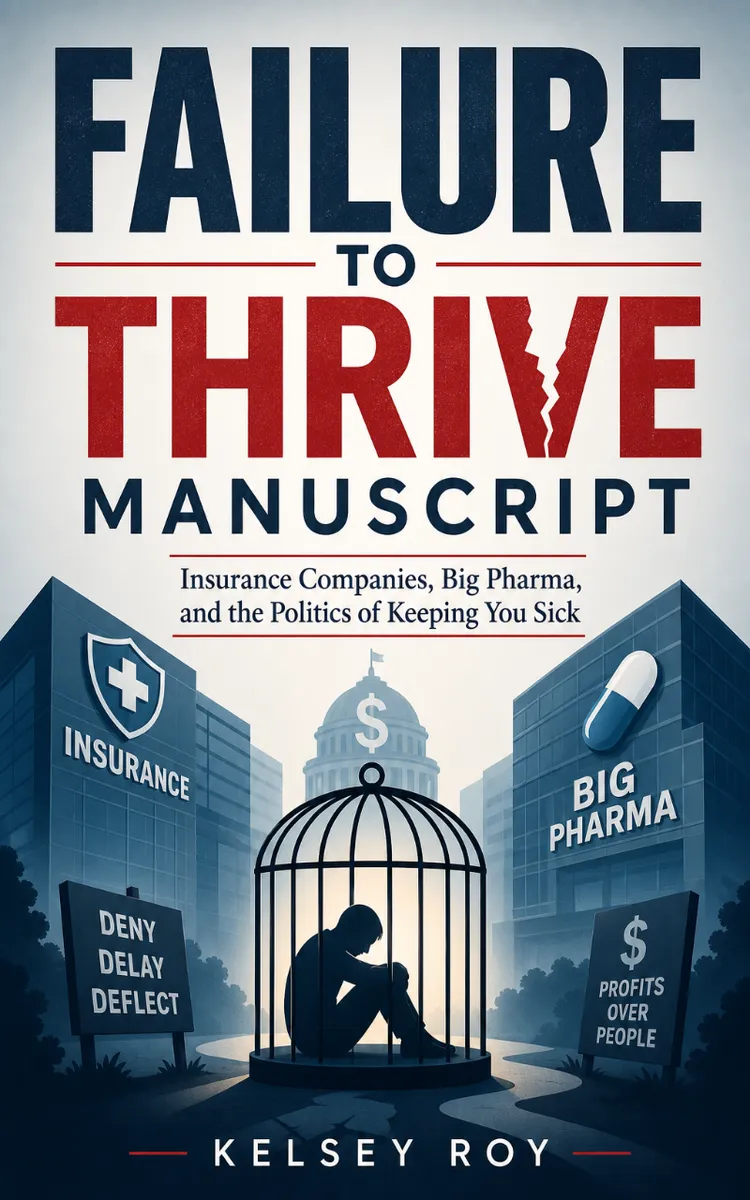
Failure to Thrive Manuscript
Created with Inkfluence AI
Table of Contents
- 1. Act One • Chapter One
- 2. Act One • Chapter Two
- 3. Act One • Chapter Three
- 4. Act Two • Chapter Four
- 5. Act Two • Chapter Five
- 6. Act Two • Chapter Six
- 7. Act Two • Chapter Seven
- 8. Interlude
- 9. Act Two • Chapter Eight
- 10. Act Three • Chapter Nine
- 11. Act Three • Chapter Ten
- 12. Act Three • Chapter Eleven
- 13. Act Four • Chapter Twelve
- 14. Act Four • Chapter Thirteen
- 15. Act Four • Chapter Fourteen
Preview: Act One • Chapter One
A short excerpt from “Act One • Chapter One”. The full book contains 15 chapters and 78,517 words.
The Call
In which we meet Maya, follow her into the machine, and learn what the word “denied” actually means
Telehealth emerged during the COVID-19 pandemic as the most significant expansion of behavioral health access in a generation - and immediately became the next battleground in the fight over who controls that access.
Before the pandemic, insurance coverage for telehealth behavioral health services was inconsistent, restricted by state laws requiring in-person initial evaluations, and reimbursed at lower rates than in-person care in many markets. The pandemic’s emergency declarations waived many of these restrictions. Telehealth utilization for behavioral health services increased by more than 7,000 percent between January and April 2020. Providers who had never delivered care remotely built telehealth practices in weeks. Patients who had been unable to access in-person care - because of transportation barriers, geographic isolation, disability, childcare demands, or simple scheduling constraints - found themselves able to access care from home.
The outcomes were measurably good. Research published during and after the pandemic consistently showed that telehealth behavioral health care produced outcomes comparable to in-person care for most conditions, with particular advantages for patients with anxiety disorders - for whom traveling to an office was itself sometimes a symptom-triggering experience - and for patients in rural areas where in-person providers were not available. Patient satisfaction with telehealth was high. Provider satisfaction, freed from the overhead costs of office space and the geographic constraints of in-person practice, was also generally positive.
What happened next was predictable to anyone who had been watching the insurance industry’s response to access-expanding developments. As the pandemic emergency declarations ended and the temporary waivers began to expire, the insurance industry began the process of re-imposing restrictions on telehealth coverage. Some states made the pandemic-era expansions permanent through legislation; others allowed them to lapse. Some insurers began requiring in-person visits as a condition of continued telehealth coverage. Some reimposed reimbursement differentials that paid less for telehealth than for equivalent in-person services, recreating the financial incentive for providers to limit their telehealth offerings.
The prior authorization requirement - which had been waived for many telehealth services during the emergency - returned. The network adequacy standards - which telehealth had effectively expanded by allowing providers to serve patients across geographic distances - were not updated to reflect the new delivery model. A provider licensed in one state could, during the pandemic, serve patients in multiple states through telehealth. The post-pandemic regulatory environment began reasserting state licensing requirements that reimposed geographic limits on telehealth practice.
Maya could have seen a therapist via telehealth in 2020. She might have gotten an appointment sooner. The provider might have been in a different state but licensed to practice in hers. The prior authorization requirement might have been waived. She might not have needed to call eleven providers and wait seven weeks.
The system’s response to telehealth is a microcosm of its response to every access-expanding development: permit it during a crisis, then manage it back toward restriction as the crisis recedes. The permanent expansion of telehealth access - with consistent coverage, equivalent reimbursement, and updated network adequacy standards that reflect the new delivery model - is one of the most immediately actionable reforms available. It requires political will to make permanent what the emergency demonstrated was possible.
Let me be specific about what hold music costs - not emotionally, but economically - because the aggregate cost of the American healthcare system’s administrative friction is one of the most poorly understood dimensions of its dysfunction.
A 2022 study published in Health Affairs estimated that Americans spend approximately 35 million hours per year on hold with their health insurers. Thirty-five million hours. At the median American hourly wage, that is approximately $600 million in lost productivity annually - and that estimate covers only time spent on hold, not time spent navigating directories, filling out forms, waiting for callbacks, or managing the administrative aftermath of a denial. The full economic cost of the American healthcare administrative burden on patients - the unpaid time they spend navigating the system on their own behalf - has been estimated at several billion dollars annually.
This cost is not distributed equally. It falls heaviest on people who can least afford it. A patient with flexible professional employment can make insurance calls during work hours with minimal income consequence....
About this book
"Failure to Thrive Manuscript" is a curiosity book by Kelsey Roy with 15 chapters and approximately 78,517 words. It covers key insights and practical takeaways on the topic.
This book was created using Inkfluence AI, an AI-powered book generation platform that helps authors write, design, and publish complete books.
Frequently Asked Questions
What is "Failure to Thrive Manuscript" about?
"Failure to Thrive Manuscript" is a curiosity book by Kelsey Roy covering key insights and practical takeaways on the topic.
How many chapters are in "Failure to Thrive Manuscript"?
The book contains 15 chapters and approximately 78,517 words. Topics covered include Act One • Chapter One, Act One • Chapter Two, Act One • Chapter Three, Act Two • Chapter Four, and more.
Who wrote "Failure to Thrive Manuscript"?
This book was written by Kelsey Roy and created using Inkfluence AI, an AI book generation platform that helps authors write, design, and publish books.
Write your own curiosity book with AI
Describe your idea and Inkfluence writes the whole thing. Free to start.
Start writingCreated with Inkfluence AI


