
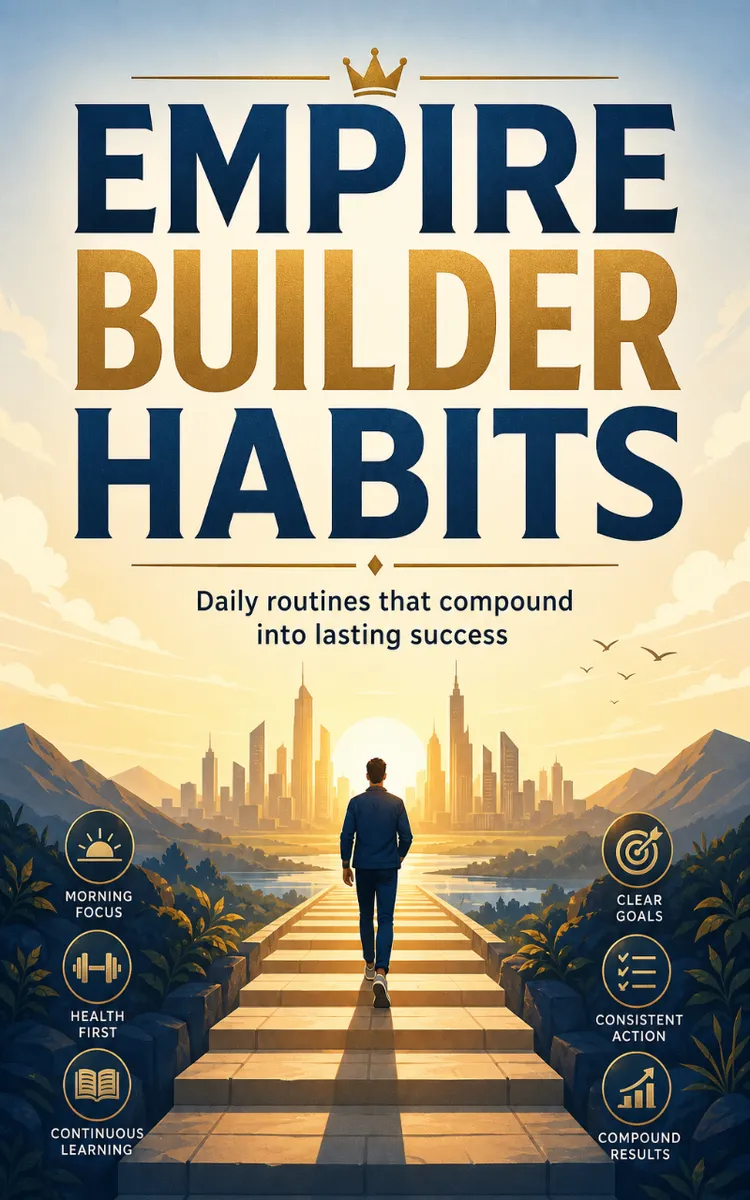
Empire Builder Habits
Created with Inkfluence AI
Mental, financial, execution, leadership, and personal habit building
Table of Contents
- 1. Build Empires Through Invisible Habits
- 2. Choose Identity Over Motivation
- 3. Program Your Attention Like a CEO
- 4. Read Daily to Upgrade Your Thinking
- 5. Turn Problems Into Opportunities
- 6. Think Long-Term With Decision Rules
- 7. Protect Your Mind From Negativity
- 8. Track Money Daily Without Drama
- 9. Reinvest First, Spend Second
- 10. Build Assets That Outlive You
- 11. Delay Lifestyle Inflation With Guardrails
- 12. Study Cash Flows for Hidden Leverage
- 13. Prioritize High-Impact Work Daily
- 14. Finish What You Start With Commitments
- 15. Build Consistency Through Systems
- 16. Review Performance to Accelerate Learning
- 17. Take Calculated Risks With Boundaries
- 18. Keep Your Word to Build Trust
- 19. Communicate Clearly Under Pressure
- 20. Lead People and Sustain the Mission
Preview: Build Empires Through Invisible Habits
A short excerpt from “Build Empires Through Invisible Habits”. The full book contains 20 chapters and 26,906 words.
“Success isn’t loud. It’s consistent.” That line sounds like it belongs on a wall-until you watch what actually builds wealth in the real world: the same few choices, made again and again, while everyone else is chasing the next dramatic moment.
Ravi, 34, startup founder, didn’t become “Ravi the unstoppable” because one brilliant pitch landed. He got traction because he kept shipping-quietly-long after the excitement of launch wore off. When a big partnership fell through, his competitors treated it like a referendum on their future. Ravi treated it like a data point. That difference didn’t show up on day one. It showed up in month six, when his product kept improving, his team kept trusting the process, and his runway didn’t evaporate.
That’s the core of the Compounding Habit Thesis: empires form when your routines compound, not when your life gets lucky at the perfect time.
The Pattern
Here’s the pattern you’ll recognize fast. You feel urgency like a fire alarm-something breaks, a customer churns, a competitor announces a feature, cash looks tighter than you want. Your brain responds the same way it always does: “We need a big fix.” So you scramble for a dramatic move-one more push, one more strategy doc, one more late-night sprint, one more “reset.” And for a few days, you get momentum. You even feel proud. Then the adrenaline fades, the operational load stays, and the big move you hoped would carry you… doesn’t. You’re back where you started, except now you’re a little more tired and a little more skeptical.
Ravi lived this cycle too-early on. After a launch, he went all-in on a single growth lever for weeks. It didn’t deliver the step-change he wanted. Instead of going back to routines, he tried to “solve” it with intensity: longer hours, more meetings, more experiments, fewer reviews. The result? His team got busy but not clearer. Metrics bounced around because decisions weren’t anchored to a consistent check. Revenue didn’t collapse, but it also didn’t build. Then something shifted: Ravi stopped asking, “How do we create a breakthrough?” and started asking, “How do we make the next week predictable?” He rebuilt his calendar around small, repeatable actions-consistent shipping, consistent customer follow-up, consistent performance review. No fireworks. Just compounding.
If you’ve been caught in the cycle of chasing dramatic fixes, then feeling disappointed when the momentum dies-do you recognize this in yourself?
A New Perspective
What if the breakthrough you’re hunting isn’t the thing that builds empire-your routines are?
Try that question on for size. Most entrepreneurs treat dramatic events like the engine: the perfect hire, the viral post, the major contract, the funding round, the “one big idea.” But those are sparks. Empires are built by smoldering heat-your repeatable habits that keep producing value even when the environment isn’t cooperating.
Ravi’s before-and-after wasn’t glamorous. Before: he’d set goals, then react when outcomes missed. If churn spiked, he’d overhaul messaging. If signups slowed, he’d change pricing or promise new features too soon. After: he tightened the loop. He picked a small set of daily and weekly behaviors that controlled inputs-how fast product learned, how quickly customer pain got surfaced, how often the team reviewed what worked and what didn’t. When partnership talks stalled, he didn’t panic-reinvent. He updated the offer based on customer language and kept the shipping rhythm steady. When a sales process failed, he didn’t spiral into more effort-he reviewed performance and adjusted the system behind it.
Here’s the real change in perspective: dramatic events are unpredictable. Routines are programmable. You can’t force luck. But you can control the frequency of learning, the quality of execution, and the credibility you build with your people and customers. That’s why compounding routines beat dramatic events for sustainable wealth, influence, and leadership-because they don’t require the world to cooperate. They make you stronger regardless of what happens next.
So ask yourself the uncomfortable question: are you building a routine that can survive the next setback, or are you building a plan that only works when everything goes right?
Breaking It Down
1. When you chase a dramatic event (“we need a big fix right now”), you spike effort and disrupt normal work.
2. You feel short-term relief because you’re doing something intense, and intensity feels like progress.
3. So you keep making high-velocity changes instead of repeating the behaviors that reliably produce learning and results.
4. Which leads to inconsistent outcomes-because your inputs keep changing faster than your organization can adapt.
Now the alternative chain-this is the Compounding Habit Thesis in motion:
1. When you commit to compounding routines (small, repeatable actions you can keep doing), you reduce chaos in how work gets done.
2....
About this book
"Empire Builder Habits" is a self-help book by Dr.Ir.N.A.Ahmed BUREGEYA with 20 chapters and approximately 26,906 words. Mental, financial, execution, leadership, and personal habit building.
This book was created using Inkfluence AI, an AI-powered book generation platform that helps authors write, design, and publish complete books. It was made with the AI Self-Help Book Writer.
Frequently Asked Questions
What is "Empire Builder Habits" about?
Mental, financial, execution, leadership, and personal habit building
How many chapters are in "Empire Builder Habits"?
The book contains 20 chapters and approximately 26,906 words. Topics covered include Build Empires Through Invisible Habits, Choose Identity Over Motivation, Program Your Attention Like a CEO, Read Daily to Upgrade Your Thinking, and more.
Who wrote "Empire Builder Habits"?
This book was written by Dr.Ir.N.A.Ahmed BUREGEYA and created using Inkfluence AI, an AI book generation platform that helps authors write, design, and publish books.
How can I create a similar self-help book?
You can create your own self-help book using Inkfluence AI. Describe your idea, choose your style, and the AI writes the full book for you. It's free to start.
Write your own self-help book with AI
Describe your idea and Inkfluence writes the whole thing. Free to start.
Start writingCreated with Inkfluence AI


