
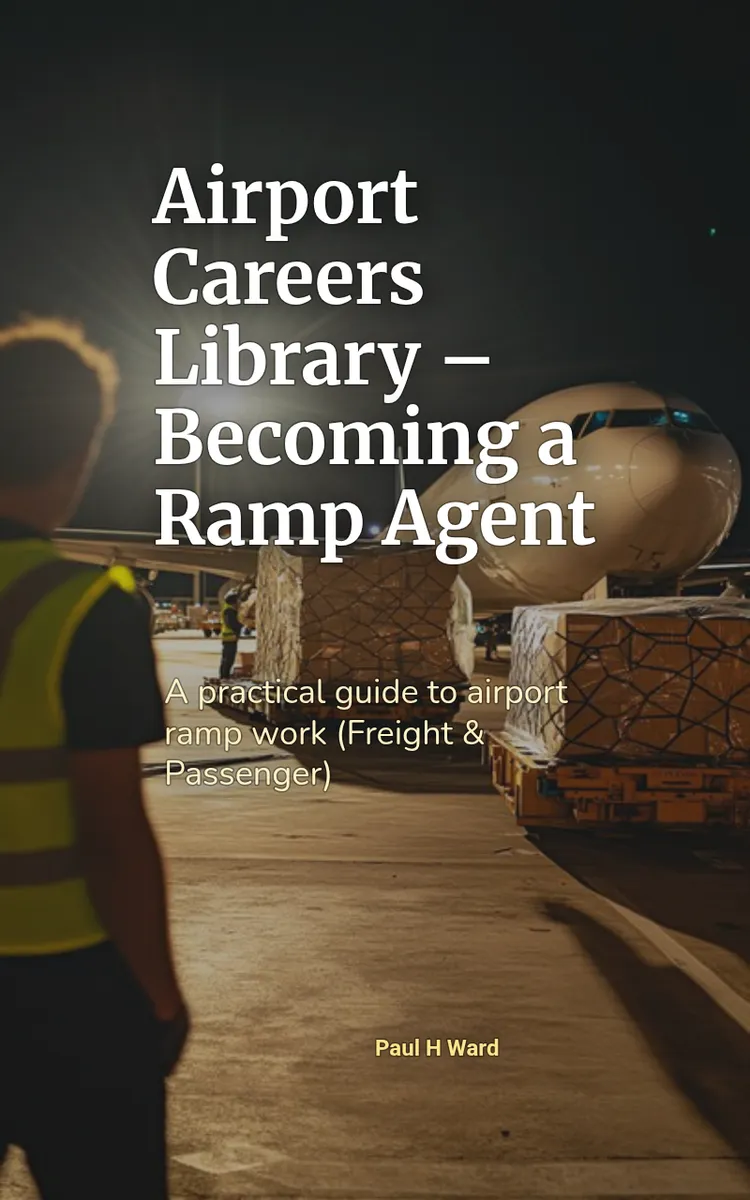
Becoming A Ramp Agent
Created with Inkfluence AI
Training, responsibilities, safety, equipment, and career path for ramp agents
Table of Contents
- 1. Ramp Agent Role and Boundaries
- 2. Airport Layouts, Zones, and Routes
- 3. Personal Protective Equipment Standards
- 4. Vehicle Safety and Marshalling Signals
- 5. Chocks, Cones, and Securing Aircraft
- 6. Ground Handling Equipment Basics
- 7. Turnaround Workflow and Communication
- 8. Incident Reporting and Career Progression
Preview: Ramp Agent Role and Boundaries
A short excerpt from “Ramp Agent Role and Boundaries”. The full book contains 8 chapters and 15,844 words.
A tug driver once told me the most dangerous words on the ramp sound harmless: “I’ll just move it a bit.” One “bit” turns into a wingtip scrape, a damaged brake line, or a delayed aircraft turnaround - because the driver didn’t know who owned the move, who had asked for it, and what boundaries they must not cross. Ramp work looks practical and physical, but it runs on clear roles and hard limits.
Dylan, 19, your first-day energy is great - but the ramp doesn’t care how keen you feel. It cares whether you can tell the difference between your job and someone else’s job, whether you can follow the correct procedure, and whether you can stop yourself before you make a change you weren’t authorised to make. This chapter gives you that control: you will learn what ramp agents do, what you must never do, and how your responsibilities fit with airlines and the rest of the airport team.
When you finish this chapter, you will be able to answer four questions without guessing: What is a ramp agent role in real terms? Why do boundaries protect you and the aircraft? How do you work inside the system - airline, airport, and contractors - without stepping over lines? What does a ramp agent need to know before they touch equipment, vehicles, or aircraft? That’s what we’re building here: role clarity you can use on shift.
What is this: The Role Clarity Compass for ramp boundaries and responsibilities
Every ramp team runs on handoffs. An airline needs a plane ready; the airport needs safe movement; ground handlers need work done correctly; and ramp agents need to know exactly where they fit. If you don’t know your lane, you’ll either wait too long (and cause delays) or act too fast (and cause safety problems). That’s why we use the Role Clarity Compass: a simple way to decide what you can do, what you must not do, and who you must talk to before you move.
Think of the Compass like three checks you repeat every time you face a task. First, you confirm the task ownership: who requested it, and which team owns the activity. Second, you confirm the action boundary: what you can touch and what you must leave alone. Third, you confirm the communication boundary: who you must inform before and after you act. You don’t need fancy theory - just repeat the checks like a routine.
Here’s how the Role Clarity Compass works in plain terms, with concrete examples:
1. Check task ownership (who asked for it?).
Ask for the work instruction and read it exactly. If your supervisor gives you a clear task - like “load baggage at Stand 12, Door 2, from Bay C” - you own the execution. If you hear an informal request (“move that cart closer”), you do not treat it as instruction; you ask who authorised the move and where it must go.
Why: wrong ownership leads to wrong work, and wrong work blocks the next team.
2. Check action boundary (what can you physically do?).
You’re allowed to do your authorised ground tasks: connect and disconnect approved service items, move equipment you’re trained and signed off to move, and handle baggage/cargo within your company’s limits. You must not do “aircraft-side” actions that belong to maintenance or the airline’s technical team.
Why: aircraft systems can look simple but still carry major risk - especially hydraulics, fuel areas, and safety-critical checks.
3. Check communication boundary (who must know?).
You confirm with the right person before you start and you report completion in the correct channel - usually your supervisor and the relevant airline contact or dispatch point.
Why: ramp work happens in parallel. If you finish and nobody knows, another team may start the next step on top of your work.
4. Use the “stop rule” when roles feel unclear.
If you can’t answer ownership, boundary, and communication, you stop and ask. You don’t “guess and go.”
Why: guessing is how small jobs become big incidents.
Now anchor this to what ramp agents actually do day to day. You handle the visible work: loading and unloading baggage and cargo, positioning aircraft service equipment, marshalling equipment where required, and keeping your area safe and clear. You also do the less visible work that keeps the operation stable: following aircraft stand rules, maintaining correct tool and equipment use, and reporting defects before they grow.
Practical takeaway / reflection prompt: The next time you get a task, pause for ten seconds and run the Role Clarity Compass: ownership, action boundary, communication boundary. If you can’t answer one of them, ask before you move.
Why it matters: Safety, turnaround flow, and “must never do” boundaries
Boundaries matter because ramp operations mix heavy equipment, tight space, fast schedules, and aircraft that arrive with strict constraints. If you step outside your role, you break the safety chain and you break the timing chain. Safety and speed aren’t separate here - they depend on each other.
...
About this book
"Becoming A Ramp Agent" is a how-to guide book by Paul H Ward with 8 chapters and approximately 15,844 words. Training, responsibilities, safety, equipment, and career path for ramp agents.
This book was created using Inkfluence AI, an AI-powered book generation platform that helps authors write, design, and publish complete books. It was made with the AI Ebook Generator.
Frequently Asked Questions
What is "Becoming A Ramp Agent" about?
Training, responsibilities, safety, equipment, and career path for ramp agents
How many chapters are in "Becoming A Ramp Agent"?
The book contains 8 chapters and approximately 15,844 words. Topics covered include Ramp Agent Role and Boundaries, Airport Layouts, Zones, and Routes, Personal Protective Equipment Standards, Vehicle Safety and Marshalling Signals, and more.
Who wrote "Becoming A Ramp Agent"?
This book was written by Paul H Ward and created using Inkfluence AI, an AI book generation platform that helps authors write, design, and publish books.
How can I create a similar how-to guide book?
You can create your own how-to guide book using Inkfluence AI. Describe your idea, choose your style, and the AI writes the full book for you. It's free to start.
Write your own how-to guide book with AI
Describe your idea and Inkfluence writes the whole thing. Free to start.
Start writingCreated with Inkfluence AI


