
Read the first chapter
The whole of chapter one, free. About 10 min. Turn the pages with the arrows, your keyboard, or a swipe.
Chapter 1
Week 1: Clarifying Your Core Values
Overview
This chapter, Week 1: Clarifying Your Core Values, helps you identify what truly matters to you and shows how burnout often grows when your daily life and work drift away from those values. Over the next several exercises and reflections you will:
• define your personal core values in clear, actionable language; - map how your current job, relationships, and routines align (or misalign) with those values; - identify specific situations that have created emotional exhaustion by violating what you care about most; - create a short list of 3–5 priority values to guide decisions and reduce future burnout.
Practical structure: three timed activities, two reflection worksheets, and a 10-minute mapping task. Each activity includes exact instructions, materials, time estimates, and measurable completion criteria so you know when you’re done.
Before you dive in: have a notebook or document, a pen, and a quiet 40–60 minute block. If you’re short on time, split the session: Activity A (25 minutes) + Activity B (15 minutes) now, Activity C (20 minutes) later. Completion criteria are included with every activity.
Also note where this chapter fits in the program: Week 2: Setting Healthy Boundaries - learn to say no, protect your time and energy. Week 3: Creating Your Dream Life Vision - visualize the balanced life and career you want. Week 4: Goal Setting That Actually Works - move from overwhelming to-do lists to meaningful, flexible goals. Week 5: Building Sustainable Habits - create small, realistic daily routines that stick. Week 6: Accountability, Review & Celebration - review progress, adjust, and celebrate wins without self-criticism.
Core Content
Why values matter (and why burnout follows when they’re ignored) Values are the internal compass that tell you what “good” looks like for your life. They’re not to-do items; they’re principles that shape choices, boundaries, and energy allocation. Burnout happens when you keep acting in ways that contradict these principles — often for months or years — until the emotional and physical cost becomes impossible to ignore.
Example: imagine your core value is "meaningful contribution." If your daily work is repetitive, low-impact tasks that keep you from projects that matter to you, you’ll slowly feel depleted, resentful, and hollowed out even if you appear successful externally. That misalignment, sustained over time, is a common path to burnout.
Activity A — Core Values Draft (Time: 25 minutes) Purpose: Produce a working list of 12–20 potential core values and narrow them to a short list of 6.
Materials: notebook or document, pen, printed list of 60 value prompts (optional — you can use the provided starter list below).
Starter value prompts (use these to speed your list creation): autonomy, mastery, connection, security, creativity, recognition, balance, integrity, learning, compassion, competence, family, leadership, health, adventure, stability, honesty, financial independence, service, growth, curiosity, respect, legacy, play, spirituality, efficiency, influence, rigor, self-care, freedom, teamwork, fairness, innovation, reliability, privacy, contribution, prestige, mentorship, adaptability, joy, structure, authenticity, boundaries, courage, empathy, community, simplification, continuity, competence, rest, achievement, rootedness, resourcefulness, clarity, accountability, sustainability, trust, optimism, presence, humor.
Instructions: 1. Set a timer for 8 minutes. Rapidly write any and all values that resonate from the starter prompts or that come to mind. Aim for 12–20 items. Completion criterion: you have at least 12 items written down. 2. For each item, write one sentence explaining why it matters to you right now (max 15 words each). Completion criterion: each value has a corresponding sentence. 3. Set a second timer for 10 minutes. Circle the 6 values that feel most non-negotiable — the ones you would defend even if putting them first felt risky. Completion criterion: 6 circled values. 4. From the six, pick 3 that create the most tension with your current life (where you notice the biggest energy drain). Write one short example of that tension for each. Completion criterion: 3 tensions recorded.
Outcome: a prioritized working set of 6 values, with 3 high-conflict items identified for immediate attention.
Reflection Prompt A (Time: 10 minutes) Write a short paragraph (3–5 sentences) answering: Which of the 3 high-conflict values, if honored more consistently over the next month, would most reduce your stress and why? Completion criterion: one paragraph that names the value and explains a clear mechanism (for example, “If I honor boundaries, I will decline two low-value meetings per week, freeing six hours monthly for restorative activities.”).
Activity B — Values Alignment Map (Time: 20 minutes) Purpose: Map specific areas of your life against your top 6 values to see alignment gaps.
Materials: a two-column page or table in your notebook/document labeled “Domain” and “Alignment Notes.” Domains: Work Role, Team/Culture, Home Life, Relationships, Daily Routine, Self-Care.
Instructions: 1. For each of the six values, write a short indicator of alignment for every domain. Use this scale: A = aligned, M = mixed, N = not aligned. Completion criterion: a filled grid that assigns A/M/N for each value-domain pairing (6 values × 6 domains = 36 entries). 2. Next to any M or N entry, write one concrete example (no more than 10 words) that shows why it earned that rating. Completion criterion: each M or N has an example. 3. Score alignment numerically: A = 2, M = 1, N = 0. Add up the total for each value across domains (max 12). Completion criterion: a numeric alignment score for each value.
Interpreting your scores: - 10–12: strong alignment — these values are supported across life. - 6–9: moderate alignment — some domains support the value, others don’t. - 0–5: low alignment — the value is consistently neglected and likely a driver of burnout.
Exercise B Outcome: a clear, numbered priority list of values ranked by alignment score, showing where change will reduce mismatch and energy drain.
Example (short): Value: Autonomy — Work Role: N (micromanaged); Team: M (some freedom); Home: A (manages own schedule) — score 2+1+2+... = 7 (moderate).
Activity C — Getting Specific: The Value Repair Plan (Time: 20–30 minutes) Purpose: Create measurable actions that increase alignment for the top 2 values with the lowest scores.
Materials: your alignment map, a new page for “Repair Plans.”
Instructions: 1. Identify the two values with the lowest alignment scores (tie-breaker: choose the ones that produce the most distress). Completion criterion: values named. 2. For each value, write one measurable objective you’d like to reach in 30 days. The objective must be specific, time-bound, and measurable. Example format: “By [date], reduce meetings that violate Autonomy by X/month” or “Within 30 days, add one 30-minute creative block twice weekly.” Completion criterion: one objective per value, each with a target and date. 3. For each objective, create a 3-step action plan with owners and time estimates. Example: - Action 1: Track current baseline for 1 week (owner: you; time: 10 min/day). - Action 2: Make a one-page request or proposal to manager (owner: you; time: 90 minutes). - Action 3: Implement a new boundary and evaluate after two weeks (owner: you; time: 10 min/day). Completion criterion: each objective has three actions with owners and times.
4. Define one measurable success metric for each objective (what will count as “done”): e.g., “Two fewer meetings per week for four consecutive weeks” or “Complete four creative sessions in 30 days.” Completion criterion: a clear metric for success.
5. Set two check-in dates: one at 7 days and one at 30 days. Note quick evaluation questions for each check-in (see templates below). Completion criterion: two calendar entries with evaluation prompts.
Check-in templates: - Day 7 quick check: Did I follow Action 1? Baseline numbers: ___. Any immediate changes? Yes/No. Next step for week 2: _. - Day 30 evaluation: Metric achieved? Yes/No. What worked? What blocked progress? Next iteration: ___.
Outcome: two concrete 30-day experiments aimed at repairing alignment and reducing burnout drivers.
Reflection Prompt B (Time: 10 minutes) Write a brief plan for communicating one of these objectives to a stakeholder (manager, partner, or team). Include: - Who you’ll speak to, - One clear sentence about the change you want, - One sentence about why this matters (tie to a value), - One ask (what you want them to do or agree to), - A proposed timeline.
Completion criterion: a composed script of at most 6 sentences ready to use for that conversation.
Mini Self-Assessment — Values Clarity Scale (Time: 5 minutes) Rate yourself on these four statements from 1 (strongly disagree) to 5 (strongly agree). Total score range: 4–20. Completion criterion: all items rated.
1. I can name my top 3 core values without prompting. 2. I can give an example from the past month where I acted in alignment with at least one top value. 3. My current job supports at least two of my top values. 4. I have at least one specific plan to increase alignment for a neglected value.
Interpretation: - 16–20: High clarity — move to Week 2: Setting Healthy Boundaries - learn to say no, protect your time and energy. - 11–15: Moderate clarity — complete Activity C and set firm check-ins. - 4–10: Low clarity — repeat Activity A and consider asking a friend or coach to help.
Common patterns you’ll see (and how to spot them) - The “Busyness Over Values” pattern: You keep saying “yes” to urgent tasks that don’t match your values. Signal: alignment map shows many N’s in Work Role and Team. Fix: use the Repair Plan to reduce commitments that score N. - The “Hidden Sacrifice” pattern: You prioritize others’ comfort over your need for rest or autonomy. Signal: Home Life aligned A for family but Self-Care is N. Fix: make a measurable boundary (e.g., one evening/week for uninterrupted rest). - The “Achievement Without Meaning” pattern: You gain external markers (promotion, title) but score low for meaning-related values. Signal: Recognition or Prestige is A, but Contribution or Meaningful Contribution is N. Fix: create a project or role tweak that increases impact.
Language for conversations (three scripts) Use these short templates to have value-focused conversations without defensiveness.
To a manager (one sentence opener): “I’d like to discuss one change that would help me contribute more sustainably; it ties to how I work best.” Follow with your Reflection Prompt B script.
To a partner (personal): “I need to try something different for 30 days that aligns with important values — can I share the plan and ask for support?” Follow with the specific ask.
To yourself (internal mantra): “Honor X this week by doing Y — it’s not indulgence, it’s how I stay effective.”
Troubleshooting resistance If you notice internal resistance (guilt, fear, or worry about consequences) when you try to prioritize values, pause and name the fear. Write it down in one line (e.g., “I fear my boss will think I’m less committed”). Then counter with a short reality-check sentence (e.g., “I can present this change as a way to increase focused output and reduce context switching”). If fear remains high, convert your Repair Plan into a shorter pilot (14 days) with a neutral framing: “I’m experimenting to find the best workflow.”
Measuring progress beyond feelings Because burnout is often subjective, anchor your value changes to concrete metrics you can track. Examples: - Hours freed per week by saying no to meetings. - Number of creative sessions completed in 30 days. - Number of evenings protected for sleep/rest. - Percentage of weekly tasks that align to a top value (count tasks aligned vs. total tasks).
Set a simple tracker (spreadsheet or journal) and use it during your Day 7 and Day 30 check-ins.
Safety note If burnout symptoms include persistent physical issues (palpitations, severe sleep disruption, suicidal thoughts, or incapacity to function), please consult a healthcare professional. This workbook is a behavioral tool, not medical treatment.
Completion checklist (end of chapter) Mark each item when done: - Activity A: Generated 12–20 values and circled 6 (yes/no). - Reflection Prompt A: Wrote a 3–5 sentence paragraph (yes/no). - Activity B: Completed alignment grid (36 entries) and scored values (yes/no). - Activity C: Wrote two 30-day objectives with 3 actions each and set check-ins (yes/no). - Reflection Prompt B: Composed stakeholder script (yes/no). - Mini Self-Assessment completed (yes/no).
When all boxes are checked, you have finished Week 1: Clarifying Your Core Values and are ready to proceed to Week 2: Setting Healthy Boundaries - learn to say no, protect your time and energy.
Summary
This week’s work transforms blurry ideals into practical levers. You now have a prioritized list of values, a mapped view of where they’re honored and neglected, and two targeted 30-day Repair Plans with measurable success criteria. Remember: burnout often grows when values are sidelined. By naming what matters and testing small, specific repairs, you reduce emotional friction and reclaim energy for meaningful work and life.
Next step: take your top repair plan into a short conversation using your Reflection Prompt B script and prepare for Week 2: Setting Healthy Boundaries - learn to say no, protect your time and energy.
End of chapter one. 4 more chapters in the full book.
Swipe or use the arrows to turn the page
What's inside: 5 chapters
- 1. Week 1: Clarifying Your Core Values
- 2. Week 2: Setting Healthy Boundaries
- 3. Week 3: Creating Your Dream Life Vision
- 4. Week 4: Goal Setting That Actually Works
- 5. Week 5: Building Sustainable Habits
About this book
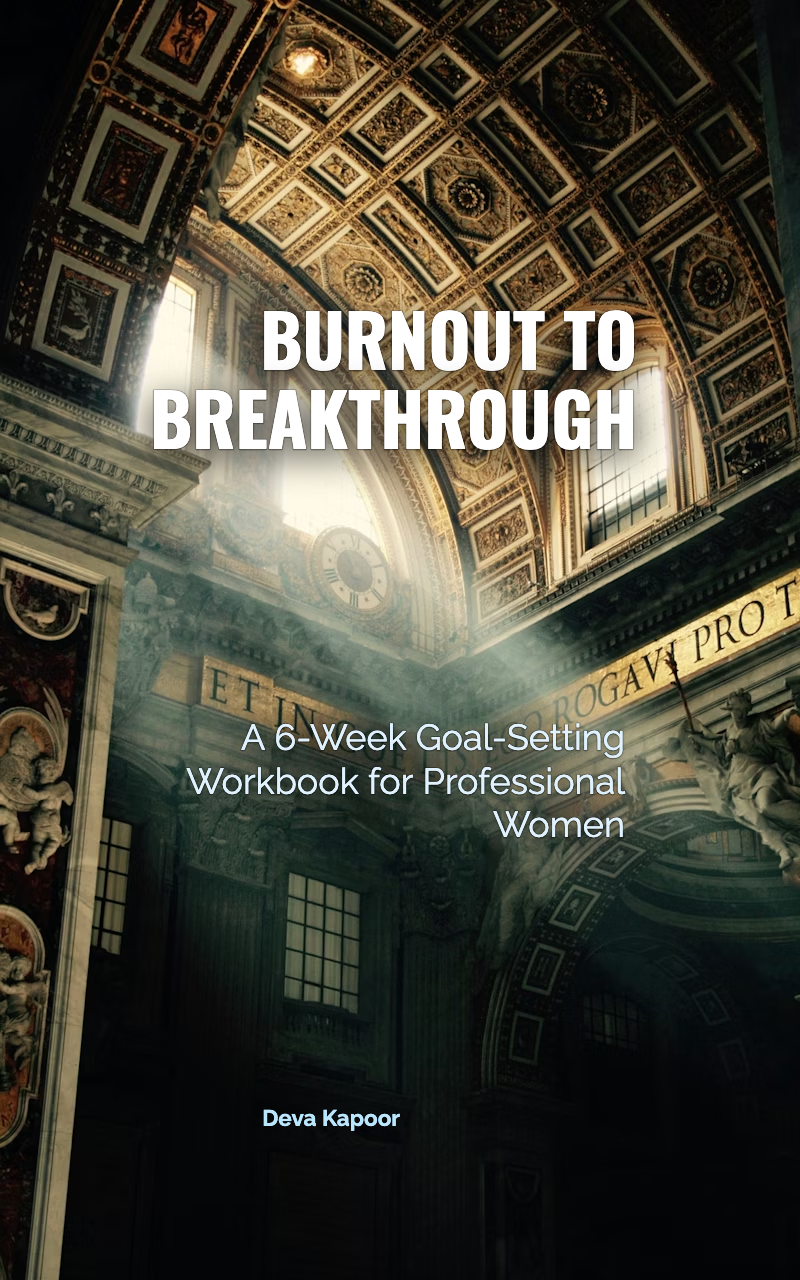
"Burnout To Breakthrough" is a workbook by Deva Kapoor with 5 chapters and approximately 10,925 words. Goal-setting and burnout recovery workbook for professional women.
This book was created using Inkfluence AI, an AI-powered book generation platform that helps authors write, design, and publish complete books. It was made with the Workbook Generator.
Frequently Asked Questions
What is "Burnout To Breakthrough" about?
Goal-setting and burnout recovery workbook for professional women
How many chapters are in "Burnout To Breakthrough"?
The book contains 5 chapters and approximately 10,925 words. Topics covered include Week 1: Clarifying Your Core Values, Week 2: Setting Healthy Boundaries, Week 3: Creating Your Dream Life Vision, Week 4: Goal Setting That Actually Works, and more.
Who wrote "Burnout To Breakthrough"?
This book was written by Deva Kapoor and created using Inkfluence AI, an AI book generation platform that helps authors write, design, and publish books.
How can I create a similar workbook?
You can create your own workbook using Inkfluence AI. Describe your idea, choose your style, and the AI writes the full book for you. It's free to start.
Write your own workbook with AI
Describe your idea and Inkfluence writes the whole thing. Free to start.
Start writingCreated with Inkfluence AI


