
Read the first chapter
The whole of chapter one, free. About 8 min. Turn the pages with the arrows, your keyboard, or a swipe.
Chapter 1
The Map That Lied by Renaming
The Opening
A person can stand on the bank of a river, point at the water, and give it a name that has lived in their family for generations-then open a government map and watch that name quietly vanish. The paradox is that the map isn’t lying with malicious intent. It’s just doing what official cartography is built to do: standardise, simplify, and decide which label counts.
In practice, the replacement often happens without anyone in the community choosing it. A river might be surveyed once, rendered in ink, then carried forward into school atlases and road signs until the older name feels like a rumour. The result is a kind of slow amnesia: not about the river itself, but about the words people used to hold it in place.
Today, those vanished river names can still be found in field notes, church records, local land deeds, and the half-forgotten vocabulary of older residents. Tracing how they were overwritten by official labels is less about dramatic conspiracy and more about how institutions, tools, and habits shape what we believe we live beside.
What if the name you trust most-the one printed at the “official” scale-was the one most likely to erase something true?
The Deep Dive
The label changes didn’t start with maps being “wrong.” They started with maps being useful. In the era when governments began producing consistent topographic coverage, the priority was clarity for administration: borders, taxation, engineering, navigation, and communication across distances. Rivers are natural lines, but names are messy. They shift by dialect, spelling, and pronunciation; they differ from village to village; they live in oral memory long after the ink runs out.
That mismatch-between a moving human language and a fixed bureaucratic product-is where older river names tend to disappear. A cartographer might receive several spellings from different sources. A surveyor might hear a local name and write it down phonetically, only to have it standardised later. A publisher might choose one version because it fits neatly into a legend, because it matches a national language policy, or because it avoids characters that won’t print cleanly.
A useful way to see the process is as a chain of switches rather than a single decision. Once a river’s label is chosen in an early, authoritative document-say, a survey sheet or a national atlas-that label becomes the reference point for later maps. Each new map inherits the name, even if it isn’t the most locally accurate. The river isn’t renamed in the moment you notice. It’s renamed through repetition.
Surveying, spelling, and the power of “first ink”
Official mapping has long relied on fieldwork and transcription. Surveyors use instruments to fix positions-angles, bearings, and distances-and then they compile place names from what they can record. But recording a name is always a translation problem. Local pronunciation arrives in an accent; local variants compete; older forms might be archaic even to the people who still use them.
One reason this matters is that cartography is built on standard spelling. Once a form is standardised, it becomes harder to challenge. A local name that is “almost” the same can be treated as a different place. Or the reverse: two different local names can be merged under one standard label because the map-makers assume the river is the same continuous feature. This is how a community’s vocabulary can shrink: not by banning it, but by fitting it into the map’s categories.
Even the technology nudges outcomes. If a map is produced for a national audience, it may prefer names that align with the dominant language. That isn’t unique to any one country; it’s a common pattern wherever administrative borders and cultural borders overlap. The river still runs the same course, but the label begins to follow the paperwork.
How “scale” decides which name survives
Cartography isn’t one map. It’s a hierarchy of scales, each with its own selection rules. At a regional scale, cartographers can afford many labels. At a smaller, more general scale-think national overview maps-labels compete for space. When space is tight, something gets dropped.
That’s when older river names are most vulnerable. Local names that are widely used in one valley might not appear on a national map. Meanwhile, a different name-often tied to a larger settlement, a navigational route, or a historical record-gets promoted. The process is subtle: a river might keep its label in one atlas edition and lose it in another, simply because the publisher reorganised the layout or changed the naming convention.
A single example shows how strongly this can reshape perception. In many European contexts, older river names appear in medieval documents, then shift in later centuries as national languages and spelling norms consolidate. The river’s identity stays continuous, but its label becomes the one that fits the new standard. People may still say the older name in daily life, yet the printed map becomes the one that children study, the one officials cite, and the one that outsiders trust.
The Label-Flip Chain
The Label-Flip Chain is a practical way to describe how official cartography replaces older names without announcing a replacement. It looks like this: an older river name is recorded locally, then one authoritative source chooses a standard label; later sources copy the standard; the standard becomes “the name” because it appears on the maps people rely on.
The “flip” happens when the community’s internal map and the official map diverge. Often, the divergence begins with a single publication-an early survey, a newly published atlas, a revised national gazetteer. Once that label is embedded, it travels through education and signage. Road maps, then driving directions, then emergency services, then online map tools built from those same datasets. The label becomes part of the infrastructure of daily life, even for people who never think about naming at all.
The chain can be surprisingly long. A river name that disappears from printed maps may linger in local speech for decades, sometimes longer. But when the official label becomes easier to find-on paper, on screens, on signposts-the older name starts to feel redundant. People may still use it, yet they also begin to hedge: “That’s what we call it,” followed by the name from the map.
When science enters and still doesn’t settle the name
It would be comforting to think that scientific mapping would end the debate. Surveying is systematic; coordinates are objective. But place names are not coordinates. They are cultural tags attached to landforms, and they sit at the intersection of language, identity, and administration.
Topographic mapping often works with established databases of place names. Those databases are compiled from earlier sources, and earlier sources reflect the politics and priorities of their time. Even if a new survey measures the river’s course with modern precision, the label might still be inherited from the database unless there’s a formal process to update it.
This is where the “map that lied” becomes a useful phrase. The map didn’t lie about the river’s position. It lied about what the community called it-because “what the community called it” wasn’t treated as the final authority. The map’s authority came from being official, not necessarily from being local.
What You Did Not Expect
A counterintuitive finding in this whole naming story is that the replacement of river names is often not driven by deliberate erasure. It’s driven by the boring mechanics of publication and reuse. Once a label is selected in an authoritative dataset, later maps can keep reproducing it for generations, even when local historians and residents continue to use the older name.
That matters because it changes what “accuracy” means. A map can be geometrically accurate and culturally careless at the same time. When you view naming as a chain of copying rather than a one-time verdict, the disappearance of older names becomes less like a vanishing act and more like a slow shift in which sources people treat as default.
It also changes how we read the landscape. A river name on a map is not just information about the river; it’s evidence about institutions-about what they chose to standardise, what they assumed was stable, and what they didn’t think needed verifying against local memory.
The Human Story
Consider Inez, a public archivist in a regional office where paper arrives from every direction: land records, old survey reports, and the kind of correspondence that never makes it into glossy history books. Her work is mostly about preservation, but names pull her in. When someone walks in holding a deed or a family reference-“the river near the old mill”-Inez has to translate between what the document says and what people say now.
In the archive, she encounters multiple river names mapped onto the same stretch of water. Older land deeds use one local label. Church records use another spelling. A nineteenth-century survey report might note the local name, then introduce a different one that becomes the standard in later publications. When she checks the national atlas, the river appears under the later label, with the local variant missing or demoted to a footnote in older editions.
What makes the story feel real is that these aren’t abstract differences. They affect how residents find places, how they interpret boundaries, and how confidently they tell their children where “home” is. Inez has seen family members come in certain they’ll confirm an old name only to discover it doesn’t appear on the map they’ve trusted for years. She doesn’t treat that as a mystery of memory so much as a mystery of documentation: which document became the reference, and when.
Her archive work connects directly to the Label-Flip Chain. In her files, she can see the moment when one label begins to dominate-when a survey’s choice becomes an atlas’s choice, and the atlas’s choice becomes the default for everyone else. The river is the same, the watercourse is the same, but the label changes the way people organise their stories around the land.
What This Tells Us
The quiet power of official cartography lies in how it trains attention. Once a label is printed, it becomes a shortcut for understanding the world; people stop questioning it because questioning costs effort. The replacement of river names shows a broader human pattern: we trust systems that look stable, even when stability is partly a product of selection.
There’s also a gentler truth underneath the loss. Older river names didn’t vanish because they were meaningless; they vanished because they weren’t repeated in the places where repetition becomes authority. In that sense, the story of renamed rivers is a story about how societies decide what counts as “real”-and how easily the real can shift when ink and databases take over from memory.
And if a name can disappear from official maps without anyone announcing it, what else in our everyday understanding is being quietly overwritten-one label at a time-while the landscape stays exactly where it was?
End of chapter one. 7 more chapters in the full book.
Swipe or use the arrows to turn the page


What's inside: 8 chapters
- 1. The Map That Lied by Renaming
- 2. Who Benefits When Names Disappear
- 3. The Naming Ceremony That Replaced Memory
- 4. When Rivers Switch Names in Translation
- 5. The Lost Archive Problem No One Solves
- 6. Hydrology’s Quiet Role in Renaming
- 7. The Community Nickname That Won’t Die
- 8. Why Forgetting Feels Like Progress
About this book
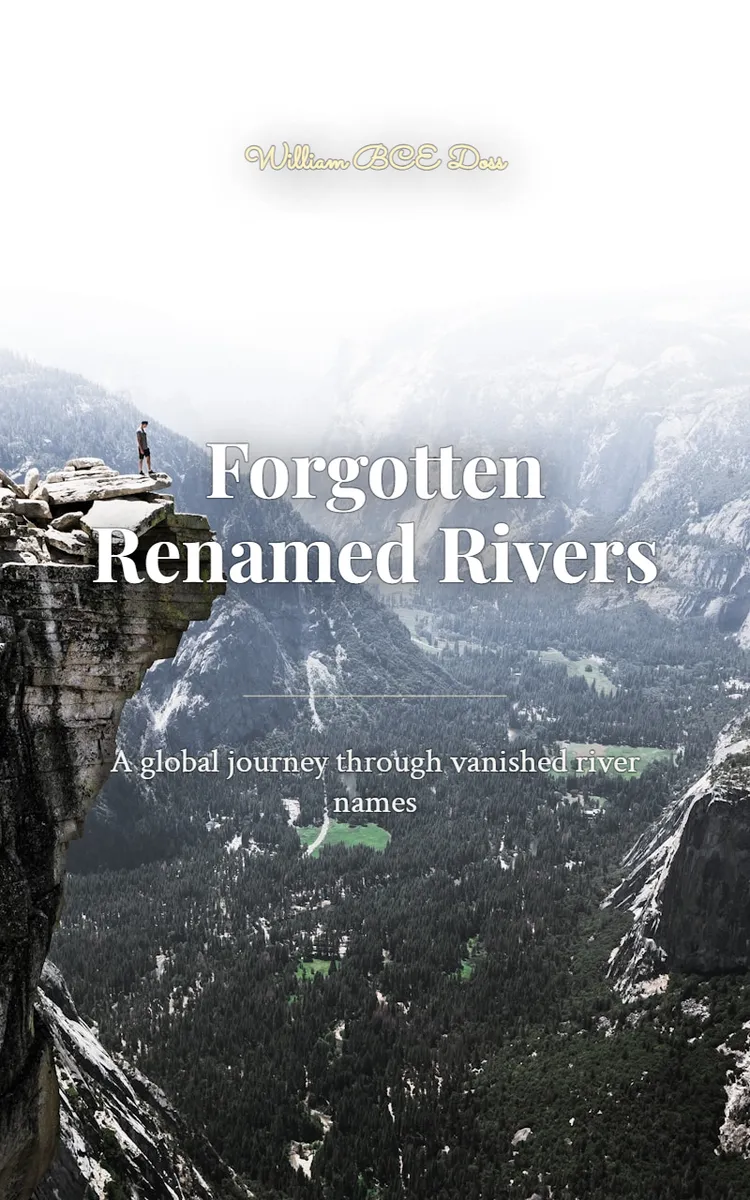
"Forgotten Renamed Rivers" is a curiosity book by William BCE Doss with 8 chapters and approximately 13,414 words. Renamed ancient rivers worldwide and why their names faded.
This book was created using Inkfluence AI, an AI-powered book generation platform that helps authors write, design, and publish complete books.
Frequently Asked Questions
What is "Forgotten Renamed Rivers" about?
Renamed ancient rivers worldwide and why their names faded
How many chapters are in "Forgotten Renamed Rivers"?
The book contains 8 chapters and approximately 13,414 words. Topics covered include The Map That Lied by Renaming, Who Benefits When Names Disappear, The Naming Ceremony That Replaced Memory, When Rivers Switch Names in Translation, and more.
Who wrote "Forgotten Renamed Rivers"?
This book was written by William BCE Doss and created using Inkfluence AI, an AI book generation platform that helps authors write, design, and publish books.
Write your own curiosity book with AI
Describe your idea and Inkfluence writes the whole thing. Free to start.
Start writingCreated with Inkfluence AI


