

Read the first chapter
The whole of chapter one, free. About 8 min. Turn the pages with the arrows, your keyboard, or a swipe.
Chapter 1
Awake and Watch: Recognizing the Season (Trust in God’s Word)
Scripture Focus
Mark 13:33 (ESV)
“Be on guard, keep awake. For you do not know when the time will come.”
Prophecy isn’t a fog machine for fear - it’s Jesus calling you to stay alert so God’s truth can keep shaping your faith.
Jesus doesn’t tell us to “panic and scroll.” He tells us to stay awake - not just physically, but spiritually. In Mark 13, His words come right in the middle of end-times teaching. He’s describing a season, yes, but the point isn’t to build an anxious guessing game. The point is posture: be on guard, keep awake. That posture is the start of any healthy study of end-times prophecy, because it keeps you anchored to Christ instead of chasing every headline like it’s the final trumpet.
And notice how Jesus ties watchfulness to uncertainty. “You do not know when the time will come.” That line matters. It means our job isn’t to predict the date like we’re running a calendar app. Our job is to live in a way that’s ready - watchful, steady, and responsive to God’s Word when the world starts shaking.
Reflection
When people hear “watchfulness,” they sometimes picture constant dread: doom on repeat, trying to decode every sign with trembling hands. But Jesus’ command in Mark 13 is paired with a deeper purpose - watchfulness that produces obedience, not hysteria. If prophecy is meant to shape faith, then being awake means letting Scripture correct your instincts. It means you don’t let fear drive you, you focus on God.
Think about what tends to steal attention day after day.
Work deadlines.
Family needs.
Social media noise.
Even good things can crowd out what’s essential.
In that kind of schedule, it’s easy to treat the Bible like a “someday” task.
But Jesus speaks to that exact drift. “Keep awake” is a direct challenge to spiritual drowsiness - the slow habit of reading Scripture without being changed by it, or hearing warnings without letting them produce repentance and steadiness.
The New Testament repeatedly connects end-times teaching with practical holiness. For example, Paul describes the believers’ “day” mindset in a way that’s not vague or abstract: you’re not in the dark; you’re not asleep.
He writes, “The night is far gone; the day is at hand. Let us therefore cast off the works of darkness…” (Romans 13:12).
That’s watchfulness in action: you notice the pattern of darkness, you turn away from it, and you put on the “armor” of living with God in view (see also Ephesians 6:10-18). In other words, prophecy should make you more awake to sin, more alive to obedience, and more thankful for God’s mercy.
Here’s the key takeaway that governs how we interpret prophecy:
Jesus’ warnings are meant to produce readiness, not panic.
That readiness shows up in ordinary routines: how you handle money, how you speak when you’re frustrated, whether you forgive quickly, whether you keep praying when nothing “big” seems to be happening. If your end-times study doesn’t affect those areas, it’s not doing what Jesus intended it to do.
And it’s not just individual habits. Watchfulness also means learning to interpret signs with Scripture - not with speculation.
There’s a difference between noticing patterns and building a timeline out of guesses. Jesus warns against being misled (Mark 13:5). He also gives a framework for understanding: many things can happen in a fallen world, but the call to watchfulness is steady. It’s like having a compass. A compass doesn’t tell you every detail of the road, but it keeps you oriented toward where truth is pointing.
So how do you stay oriented? Start with what Jesus actually says. Mark 13 doesn’t begin with charts; it begins with a command: “Be on guard, keep awake.” That’s foundational. Before you interpret specific “signs,” you interpret your own heart. You ask, “Am I staying alert to God’s Word? Am I letting Scripture correct my fears? Am I using prophecy to deepen my trust in God, or to fuel restless guessing?” That’s the beginning of wisdom.
Practice for Today
• Do a 7-minute “awake check” with Scripture in one place
Pick one spot in your day - morning coffee, lunch break, or right after work. Set a timer for 7 minutes. Read Mark 13:33 slowly, then write two sentences:
• “Right now, I tend to drift into spiritual sleep when…”
• “Today, I’m choosing alertness by…”
Guidance: don’t write a motivational slogan - write the real habit. If your phone pulls you under, say that. If you skip prayer when you’re tired, say that. Watchfulness starts with honesty.
• Journal one prayerful decision (use the “ready, not reckless” filter)
In your journal, answer this prompt:
“What does ‘keeping awake’ look like for me in the next 24 hours?”
Then choose one concrete decision that matches it - something you can do without waiting for perfect conditions.
Example prompts to spark your thinking:
• If you’ve been quick to argue, your “awake” choice might be to pause and pray before responding.
• If you’ve been numb to God, your “awake” choice might be reading a short portion of Scripture and asking one question: “What is God correcting in me?”
• A service challenge tied to watchfulness
Choose one act of care that requires attentiveness, not just emotion. Do it today - something small but real.
Examples: checking on a neighbor who’s been quiet, bringing a meal, helping someone carry something heavy, or offering a practical favor without expecting anything back.
Afterward, write one sentence: “How did serving keep my heart awake to God’s presence?” Watchfulness isn’t only inward; it shows up outward.
Closing Prayer
Lord Jesus, keep me awake. When my mind slips into fear or distraction, steady me with Your Word. Teach me to study prophecy in a way that strengthens my faith, not my panic. Make me ready - today - in the small choices that prove I trust You. Help me Lord to commit my attention to You, everyday.
Amen.
Scripture Focus
Matthew 24:42-44 (ESV)
“Therefore, stay awake, for you do not know on what day your Lord is coming. But know this, that if the master of the house had known in what part of the night the thief was coming, he would have stayed awake and would not have let his house be broken into. Therefore you also must be ready, for the Son of Man is coming at an hour you do not expect.”
Jesus calls readiness not to fuel our worry about timelines but to deepen our love and devotion - ready hearts lean into Him, not into fear.
Reflection
These verses push us to a posture: readiness born from relationship. When Jesus speaks about staying awake, He’s expecting a people whose primary response to uncertainty is loving devotion, not anxious calculation. The image of the master of the house is helpful: a homeowner who genuinely loves his family keeps the house safe because he cares, not because he’s trying to be the first to spot danger. In the same way, watching for the Lord should grow out of cherishing Jesus - wanting to be present with Him - rather than obsessing over charts or headlines.
Practically, that means when you read prophecy, let your first question be, “Does this draw me closer to Jesus?” If the answer is no, set it aside and come back with prayer. Love is the soil in which faithful watchfulness takes root. Paul puts it bluntly: prophecy, knowledge, and zeal mean little without love (1 Corinthians 13). So the healthiest scan of the news or study of signs is one that ends in a renewed affection for Christ and a commitment to love others better today - more patience at home, clearer mercy at work, sacrificial time for someone lonely.
A love-based readiness changes how you live hour by hour. Instead of living on the edge of fear, you practice small, faithful rhythms: praying first when you hear troubling reports, forgiving quickly when offended, giving intentionally even when the future seems uncertain. These habits won’t give you a date on a calendar, but they will form a life that would be ready whenever Jesus comes - because it is already walking close to Him.
Practice for Today
• Set a 10-minute “love check” before bed. Read Matthew 24:42-44 slowly, then write one sentence about one person you’ll love more tomorrow and one small concrete act you’ll do to show it (call, forgive, sit with, bring a meal). Keep it specific - “call Mom at 8 p.m.” or “pray two minutes before answering my child’s frustration.”
• Timed prayer: Spend 5 minutes praying only for your desire to know Jesus, not for answers about the future. Use a simple sentence like, “Jesus, make me love You more,” and let that be your whole prayer. If your mind wanders, gently bring it back to that one request. You’ve got this - this trains the heart.
• Service focus: Pick one practical, watchful task today - notice someone overlooked at work or church and do a small kindness (bring coffee, offer to help with a task, send an encouraging text). Afterward, jot one line in your journal: “How did serving help me stay awake to Jesus?”
Journal prompt guidance/example: Write one paragraph answering, “How does loving Jesus change how I respond to news, fear, or uncertainty?” Example start: “When I love Jesus first, I find my first response is prayer instead of worry…”
Closing Prayer
Lord Jesus, grow my love for You so that my watching becomes worship. Teach me to meet uncertainty with open hands and a steady heart, choosing mercy and obedience over fear. Help me to love others today in ways that show I am ready because I am with You. Amen.
Study for this chapter: Read Matthew 24 and 1 Corinthians 13. Reflect in your journal for 10 minutes on one verse from each passage that shifts your focus from fear to love.
End of chapter one. 4 more chapters in the full book.
Swipe or use the arrows to turn the page
What's inside: 5 chapters
- 1. Awake and Watch: Recognizing the Season (Trust in God’s Word)
- 2. Signs in the World: Lawlessness, Deception, and Moral Drift (Discernment Through Prayer)
- 3. The Church in the Middle: Persecution, Faithfulness, and Hope (Holding On)
- 4. The Great Turning: God’s Sovereignty, Judgment, and Mercy (Surrender to God’s Will)
- 5. Come, Lord Jesus: Readiness, Watchfulness, and Living in Hope (Faith to the End)
About this book
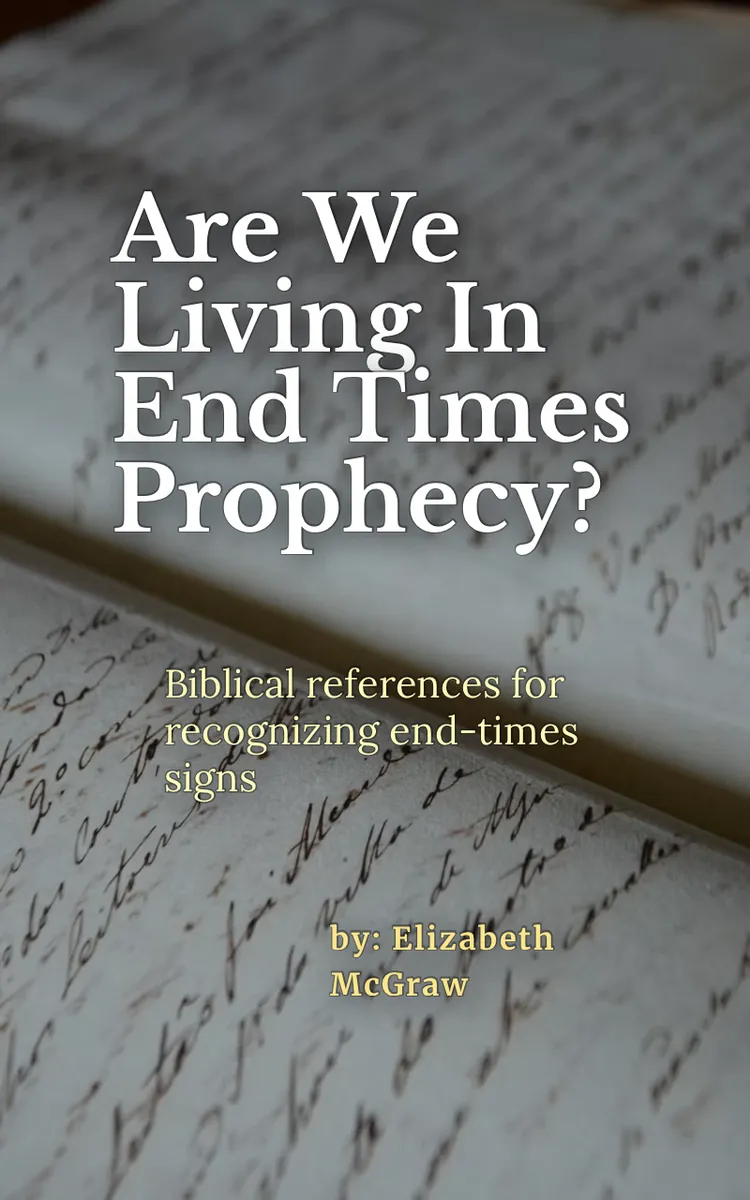
"End Times Prophecy Study" is a religious devotional book by by: Elizabeth McGraw with 5 chapters and approximately 5,897 words. In-depth study of end-times prophecy using Biblical references.
This book was created using Inkfluence AI, an AI-powered book generation platform that helps authors write, design, and publish complete books.
Frequently Asked Questions
What is "End Times Prophecy Study" about?
In-depth study of end-times prophecy using Biblical references
How many chapters are in "End Times Prophecy Study"?
The book contains 5 chapters and approximately 5,897 words. Topics covered include Awake and Watch: Recognizing the Season (Trust in God’s Word), Signs in the World: Lawlessness, Deception, and Moral Drift (Discernment Through Prayer), The Church in the Middle: Persecution, Faithfulness, and Hope (Holding On), The Great Turning: God’s Sovereignty, Judgment, and Mercy (Surrender to God’s Will), and more.
Who wrote "End Times Prophecy Study"?
This book was written by by: Elizabeth McGraw and created using Inkfluence AI, an AI book generation platform that helps authors write, design, and publish books.
Write your own religious devotional book with AI
Describe your idea and Inkfluence writes the whole thing. Free to start.
Start writingCreated with Inkfluence AI


