
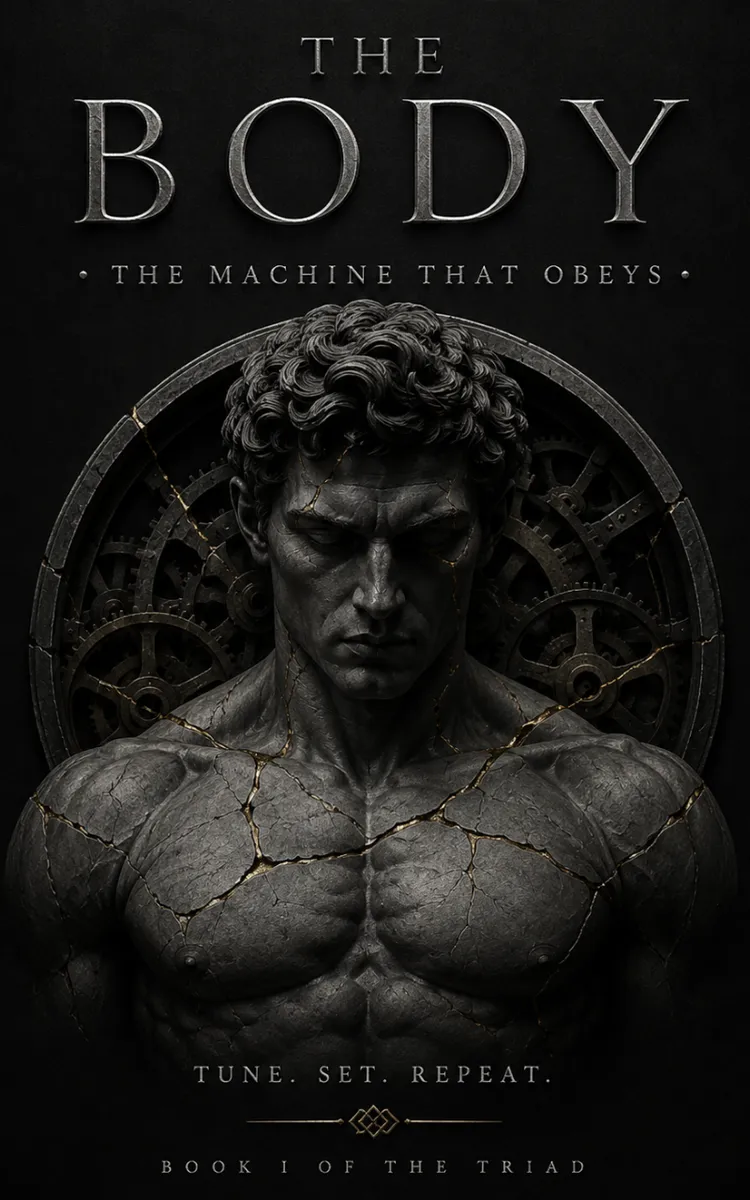
Tune, Set, Repeat
Created with Inkfluence AI
A three-layer framework linking sleep, identity, and habit automation
Table of Contents
- 1. Your Body Is a Machine, Not a Judge
- 2. Your Work Isn't Failing. Your Nervous System Is.
- 3. The "It Worked Yesterday" Problem
- 4. The Habit Loop
- 5. Your Body Obeys the Room More Than the Plan
Preview: Your Body Is a Machine, Not a Judge
A short excerpt from “Your Body Is a Machine, Not a Judge”. The full book contains 5 chapters and 4,838 words.
The body does what it's told. This book is about who's telling it.INTRODUCTION. Your Body Is a Machine, Not a JudgeYour body never really decides anything. It just obeys. So when your body won't move, won't train, won't wake up, won't stop scrolling, the problem is almost never the body. It's the two things above it: your mind (what you believe) and your spirit (where your energy comes from).
Think of yourself as three layers.
Spirit is the fuel. Why you even bother. (Book 3)
Mind is the driver. Who you think you are. (Book 2)
Body is the car. The machine that carries out the instructions. (This book)
A parked car isn't a broken car. Before you scream "just be disciplined" at the engine, you check two things. Is there gas (spirit), and is someone driving (mind)? Most "discipline problems" are really an empty tank or an absent driver.
This book owns the car. But it will keep sending you upstairs, to the driver and the fuel, because a machine can't fix itself.
Our method: Tune, Set, RepeatEvery chapter builds on these three steps, in this order.
TUNE. Get the machine running right (sleep, calm nerves, energy). This is what Body actually owns.
SET. Decide who's driving. A habit only sticks if it matches your self image. This happens in the Mind, Book 2.
REPEAT. Make the good action easy and run it until it's automatic.
Most people skip straight to Repeat and wonder why nothing lasts. You won't.
Two tools you'll use in every chapter (learn them once, here)1. The Double Breath. When your body is tense, wired, or bracing, send it a fast "we're safe" signal. Breathe in twice through your nose (a normal breath, then a second short sip of air on top), then breathe out slowly through your mouth. It calms you in seconds. (Backed by Stanford research. It's the fastest known way to settle your nervous system in real time.) Every time this book says "double breath," this is what it means.
2. Your brain's filter (the RAS). At the base of your brain sits a filter that decides what you notice out of the millions of things around you. It shows you whatever matches your beliefs. Believe "phone is part of waking up," and your eyes find the phone before your willpower even wakes up. Believe "I'm someone who trains," and you start noticing the open gym slot, the healthy option, the chance to move. Every time this book says "your filter" or "the RAS," this is it. Change the belief, change what you notice, change what you do.
Now let's tune the machine.
PART 1. TUNECHAPTER 1. Poor Sleep, Hidden Damage: What Happens After One "Bad Night"(Tune, Step 1 of 3)
One bad night can feel like a small inconvenience, until you notice you're snapping at people, your focus is gone, and your "I'll start tomorrow" energy turns into "I'll start never." You don't wake up thinking your mood, focus, and hormones are falling apart. You just think, what's wrong with me?
Tanya, 31, a nurse on rotating shifts, learned this the hard way. After a stretch of late shifts, she started training again. Nothing intense, just consistency. But by day three, her body felt heavy, her mind felt foggy, and she couldn't stay on task long enough to finish her workouts. She blamed motivation. She blamed willpower. She even blamed her program. But the real culprit was the thing she ignored every time: sleep. Not the total hours. What was missing was rest mode doing its repair work.
Are you calling it "lack of motivation" when it's actually your body refusing to repair?
The master switch: rest fixes what training breaksOld belief. Training makes you stronger, so if you're not progressing, train harder and try more.
New reality. Training breaks you down. Sleep and rest build you back up. So if you're stuck, you might be blocking the repair switch, not the effort.
Your body has two modes.
Go mode (fight or flight) is alert, strong, ready. It's great for training and hard work.
Rest mode (rest and repair) is calm and busy behind the scenes, rebuilding what training broke. Stay stuck in Go mode too long and you don't just feel tired. Your brain and body start acting like they're in a constant emergency.
Tanya noticed it in real time. She could force herself through a workout, but she wasn't recovering. Her mood got brittle. Her patience dropped. Her memory got unreliable. She'd walk into a room and forget why. Then the next shift came and the cycle tightened. She wasn't failing. Her sleep was refusing to flip the switch that repairs training damage.
Sleep scientist Matthew Walker and neuroscientist Andrew Huberman point to the same hard truth. Bad sleep doesn't just make you tired. It damages muscle, mood, memory, focus, and your hormones, including testosterone. That's not a feeling. That's your body's repair crew showing up understaffed.
Here's the move to steal from Tanya. After a late shift she stopped trying to make up for it with extra coffee and longer workouts....
About this book
"Tune, Set, Repeat" is a self-help book by Anonymous with 5 chapters and approximately 4,838 words. A three-layer framework linking sleep, identity, and habit automation.
This book was created using Inkfluence AI, an AI-powered book generation platform that helps authors write, design, and publish complete books. It was made with the AI Self-Help Book Writer.
Frequently Asked Questions
What is "Tune, Set, Repeat" about?
A three-layer framework linking sleep, identity, and habit automation
How many chapters are in "Tune, Set, Repeat"?
The book contains 5 chapters and approximately 4,838 words. Topics covered include Your Body Is a Machine, Not a Judge, Your Work Isn't Failing. Your Nervous System Is., The "It Worked Yesterday" Problem, The Habit Loop, and more.
Who wrote "Tune, Set, Repeat"?
This book was written by Anonymous and created using Inkfluence AI, an AI book generation platform that helps authors write, design, and publish books.
How can I create a similar self-help book?
You can create your own self-help book using Inkfluence AI. Describe your idea, choose your style, and the AI writes the full book for you. It's free to start.
Write your own self-help book with AI
Describe your idea and Inkfluence writes the whole thing. Free to start.
Start writingCreated with Inkfluence AI


