
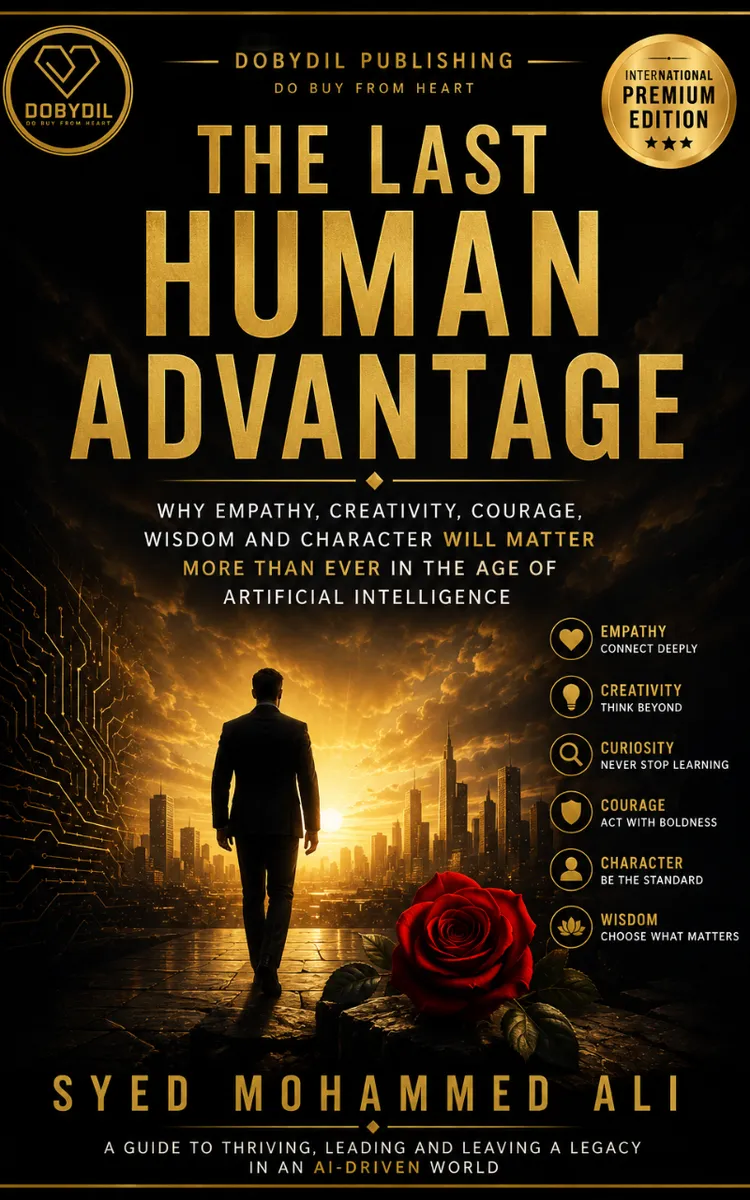
The Last Human Advantage
Created with Inkfluence AI
Human strengths—empathy, creativity, courage, wisdom—amid AI disruption
Table of Contents
- 1. Chapter 1: The Day Everything Changed
- 2. Chapter 2: The New Industrial Revolution
- 3. Chapter 3: Why Intelligence Is Becoming Cheap
- 4. Chapter 4: The End of Average Work
- 5. Chapter 5: Empathy
- 6. Chapter 6: Creativity
- 7. Chapter 7: Curiosity
- 8. Chapter 8: Courage
- 9. Chapter 9: Character
- 10. Chapter 10: Wisdom
- 11. Chapter 11: Learning Faster
- 12. Chapter 12: Thinking Better
- 13. Chapter 13: Relationship Capital
- 14. Chapter 14: Adaptability
- 15. Chapter 15: Leadership
- 16. Chapter 16: The Next Fifty Years
- 17. Chapter 17: Building a Meaningful Life
- 18. Chapter 18: The Human Advantage Manifesto
Preview: Chapter 1: The Day Everything Changed
A short excerpt from “Chapter 1: The Day Everything Changed”. The full book contains 18 chapters and 34,183 words.
The Morning the Limits Moved
At 3:32 a.m., a machine began typing. Not in a lab, not in a movie set - on a mainstream laptop, in a plain office-like setting - turning prompts into paragraphs at a speed that used to belong to human typing, not human thinking. What made that moment feel unreal wasn’t that the output was perfect. It was that the bottleneck had vanished. For most of modern life, “thinking” was something you scheduled: you saved time, hired people, paid for expertise, waited for drafts, and reviewed the result. Then the draft itself started arriving instantly, and the review step suddenly became the new bottleneck.
That shift - knowledge and routine reasoning becoming abundant - runs deeper than convenience. It changes what people value, what businesses pay for, and what kind of work feels meaningful. The core thesis of this book is simple and stubborn: As artificial intelligence makes knowledge, content creation, analysis, and routine thinking increasingly abundant, the qualities that make us uniquely human become more valuable. The day everything changed wasn’t the day AI got smarter in a quiet, technical sense. It was the day the old map stopped matching the terrain.
A few years earlier, most discussions of AI sounded like a debate about intelligence. Now the debate was about usefulness: what can be produced quickly, what can be summarized, what can be generated, what can be optimized. In that new landscape, “advantage” stopped being a synonym for information. It became something else - something harder to automate because it wasn’t only in the mind. It was in the relationship between minds.
From “Copying Facts” to “Producing Meaning”
The first wave of automation felt literal. Machines replaced muscle. Then machines replaced repetitive motion. Later, they replaced some repetitive paperwork - forms, sorting, basic checks. Each step made the same promise: remove cost and reduce delay. But even the early software era left a clear boundary: human judgment still decided what mattered.
AI blurred that boundary by producing not just answers, but polished language. It didn’t merely point to information; it shaped it into something that looked like a finished thought. That mattered because humans don’t only consume data. We consume interpretation. We ask questions like, “What does this imply?” and “Who is this for?” and “Does this fit with what we already know?” When a system can draft the words that usually sit between raw facts and a human decision, the center of gravity moves.
This is where empathy enters - not as a warm idea, but as a practical filter. Empathy is the human ability to sense what another person experiences and needs, and to respond in a way that respects that reality. When AI can generate countless versions of a message, the real scarcity becomes not “content,” but the ability to understand the person reading it. A business can mass-produce newsletters, but only a person who understands customers’ lives can decide what to say, what to omit, and what to avoid.
The same principle shows up in creativity. Creativity isn’t just novelty; it’s the ability to connect ideas in ways that feel surprising yet coherent - ways that reveal a new angle on a familiar problem. AI can recombine patterns. Humans still choose which patterns deserve to exist. They decide what question is worth asking, what constraint is real, and what tradeoff is acceptable. Without those choices, output becomes noise.
And then there is courage, which is less about grand gestures and more about staying with uncertainty long enough to learn what’s true. When AI makes answers cheap, human courage becomes the willingness to act without perfect certainty - because the stakes are human stakes, not just technical ones.
The Old Value Chain Broke Quietly
Long before people talked about AI, the economy had already been reorganizing around speed and scale. The difference now is that the “speed” isn’t only in manufacturing or logistics. It’s in the creation of words, plans, and analyses. That changes the value chain for students, professionals, managers, executives, entrepreneurs, parents, teachers, leaders - everyone whose work depends on turning information into decisions.
In the old model, a good writer or analyst bought time. They could turn ambiguity into a structured draft. They could translate complexity into something usable. In the new model, drafts can be generated quickly, and complexity can be summarized in seconds. The part that used to be valuable - the first draft - gets cheaper. The part that stays expensive is the human part: clarifying intent, understanding consequences, and taking responsibility for the outcome.
This is why character matters at exactly the moment it becomes tempting to hide behind automation. Character is the steady integrity that guides choices when no one is watching, when there’s no immediate feedback, and when shortcuts are available....
About this book
"The Last Human Advantage" is a curiosity book by Syed Mohammed Ali with 18 chapters and approximately 34,183 words. Human strengths—empathy, creativity, courage, wisdom—amid AI disruption.
This book was created using Inkfluence AI, an AI-powered book generation platform that helps authors write, design, and publish complete books.
Frequently Asked Questions
What is "The Last Human Advantage" about?
Human strengths—empathy, creativity, courage, wisdom—amid AI disruption
How many chapters are in "The Last Human Advantage"?
The book contains 18 chapters and approximately 34,183 words. Topics covered include Chapter 1: The Day Everything Changed, Chapter 2: The New Industrial Revolution, Chapter 3: Why Intelligence Is Becoming Cheap, Chapter 4: The End of Average Work, and more.
Who wrote "The Last Human Advantage"?
This book was written by Syed Mohammed Ali and created using Inkfluence AI, an AI book generation platform that helps authors write, design, and publish books.
Write your own curiosity book with AI
Describe your idea and Inkfluence writes the whole thing. Free to start.
Start writingCreated with Inkfluence AI


