
Read the first chapter
The whole of chapter one, free. About 14 min. Turn the pages with the arrows, your keyboard, or a swipe.
Chapter 1
Chapter 1 - The Missed Bus
The bus doors hissed shut like they were offended by her indecision.
Emma sprinted up the last few meters with her tote bag slapping her hip, the sound of it too loud in the chaos - shouts, engine grumbles, a radio somewhere trying to remember the right song. Her phone screen flashed 7:12 in bright, smug digits. The bus station in Chile smelled like diesel and roasted nuts and wet concrete that had never quite dried from the morning.
“No, no, no - ” she gasped, fumbling for the ticket again like paper could change physics.
A man in a red vest - conductor, driver, something between - looked at her as if she’d personally broken the schedule. He jabbed a finger toward the bus, then toward the road, then toward her, a whole sentence made of gestures. Emma understood exactly none of it. She offered the universal apology smile she’d been using since her divorce: practiced, polite, barely holding together.
The bus lurched forward.
Her foot hit the curb a little wrong and she stumbled, catching herself on the metal railing. For a second she thought she might actually jump onto the step, thought about how ridiculous she would look, thought about the way she’d promised herself she wouldn’t be the kind of person who begged for things.
Then the bus pulled fully away, swallowed by traffic and dust, and the railing went cold under her palm.
Emma leaned her forehead against the metal for half a heartbeat, breathing in diesel and stale coffee, trying not to taste panic. She wasn’t supposed to be late. She wasn’t supposed to be the woman who missed the bus because her brain got stuck on the word divorce like it was a language she couldn’t speak fluently.
When she straightened, the station was still moving around her - people weaving through lines, suitcases thumping over cracks, a child laughing too loudly at something small. Her phone buzzed with no signal, just that stubborn spinning circle as if it, too, refused to help.
She scrolled anyway, thumb slick with sweat. The next connection: three hours. Three hours in a place where her Spanish was a museum exhibit she’d never entered properly.
A voice behind her said something sharp and quick in Spanish. Emma turned, already bracing to nod and smile and fail.
The man she met had dark hair that looked like it had been rained on and then decided to cooperate, and a suitcase with the kind of scuff marks you got from travel that wasn’t planned around comfort. He was watching the bus disappear with a face that matched hers a second ago - frustration, disbelief, then a quick, controlled retreat into humorless acceptance.
He held up his own phone, tapping at the screen with frantic precision. Then he pointed at her direction, then at the empty stretch of road, as if that would clarify the situation for both of them.
Emma blinked. “I - sorry,” she said, because sorry was the only word that always worked. “I missed it.”
His eyebrows lifted, like he’d been waiting for someone to confirm the universe had, in fact, made a mistake. He looked down at his phone again and spoke into it, then held it out toward her like a peace offering.
The translator app opened on his screen, bright and helpful and completely wrong.
He said something - fast, clipped - and the app displayed a sentence in English. Emma leaned in to read it.
“You are beautiful. I am hungry.”
Emma stared at the words, then at him.
He stared at her staring, and a laugh escaped him - short, surprised, a little relieved. “No,” he said, shaking his head at the phone like it was a mischievous child. “No. It is… not that.”
Emma’s laugh burst out before she could stop it. It sounded wrong in the station noise, too bright, like she’d forgotten how to make her body do anything except brace for impact. She wiped at her eyes with the back of her hand, suddenly embarrassed by her own reaction.
“It said you’re hungry,” she managed. “And beautiful. Which is… flattering. Terribly suspicious, but flattering.”
He smiled, and the smile was warm enough to make the diesel smell feel less like punishment. “It is always like this,” he said, then paused as if realizing she couldn’t understand him without the app.
He tapped the phone again. “Okay. We try again.” He leaned closer, careful with his volume, and spoke slowly - like that would help the translator be less creative.
The app flickered, translated, and offered another English line.
“I like old people. Please do not leave.”
Emma made a sound halfway between a cough and a laugh. People nearby glanced over, probably assuming she was arguing with someone. She’d always been good at making her discomfort look like entertainment.
“Old people,” she repeated, because repeating it kept her from thinking about how her divorce had made her feel like she was suddenly older everywhere she went. “Why old people?”
He looked genuinely perplexed, and then his face lit up with recognition of the problem. “No. I said - ” He stopped, searching for the right Spanish word, then gave up and gestured at his own chest. “I said… I like to hike.”
Emma’s laughter softened into something else. “Hiking,” she said, like she could taste it now. “Not… old people.”
He nodded emphatically. “Not old people.”
A bus revved somewhere farther down the terminal, and the vibration traveled through the concrete under Emma’s shoes. Her phone still showed the same three-hour gap, and she could feel the weight of it pressing into her chest - three hours with nothing but waiting and a language she couldn’t trust.
She glanced at him, and for the first time she noticed the way he held himself: not like a man waiting for help, but like someone who had learned how to carry his disappointment without dropping it. Like he’d practiced.
“What’s your name?” she asked, and then, because she’d already learned the hard way that English didn’t travel well, she added, “Emma.”
He blinked at the sudden clarity, then answered quickly. “Noa.”
The translator didn’t even need to be involved for that part. His name sounded like it belonged somewhere between waves and architecture.
Emma held out her hand, and he hesitated for a fraction of a second before shaking it. His palm was warm, dry. His grip was firm without being aggressive. The contact was brief, but it grounded her in the moment - proof that she was still a person with a body and choices and not just a woman standing in the wrong place at the wrong time.
“I’m Emma,” she said again, like she needed to hear it in her own voice. “I missed - ” She pointed at the road. “The bus.”
Noa’s smile faded into something more honest. “Me too.”
The simplicity of it - both of them, same station, same missed departure, different languages - should have felt like coincidence. It felt more like the universe had shrugged and said, fine, since you can’t fix it, at least be human about it.
He looked around, then pointed to a row of benches under a flickering sign. “Wait. There. It is… better.” He said it with his hands, sketching an invisible map of where they could sit, how they could survive the gap.
Emma’s instinct was to go it alone. To disappear into her own plans, her own timeline, her own quiet grief. But she was tired of being the only person in her head.
“Okay,” she said. “We wait. Together.” She didn’t know if he would understand the “together” part, but he watched her face closely, like her tone mattered more than the words.
He nodded, and they moved toward the benches amid the churn of people. Emma kept her tote bag hugged to her side, as if it could protect her from being bumped. Noa pulled a corner of his jacket off the suitcase handle and dragged it slightly, like he was adjusting for comfort he didn’t fully believe he deserved.
A vendor passed, calling out something about coffee. The smell of it - burnt and sweet - hit Emma like a memory she hadn’t asked for. She rubbed her thumb over the edge of her phone case and looked at Noa.
He raised his eyebrows, and she realized he was asking the same thing she was. Coffee? Water? Something to keep the hours from swallowing them.
She said, “Yes,” and then, because the vendor was Spanish and Emma’s Spanish was basically a lost cause, she turned to Noa. “You ask.”
Noa opened his mouth to answer the vendor and stopped halfway, glancing at the phone translator. Emma could see the calculation in his eyes: if he used the app, it might turn his request into a confession or an insult. If he didn’t, he might say something he couldn’t take back.
He spoke to the vendor in Spanish anyway - confident, smooth - like he’d done it a hundred times in Buenos Aires.
The vendor replied. Noa’s expression tightened, and Emma watched the translator app on his phone light up, as if it wanted to get involved even when it wasn’t invited.
He held the phone toward Emma.
“He says: you are missing a bus because you dislike friendship.”
Emma laughed again, helpless this time. “That’s… not - ”
Noa winced. “It’s not true.” He turned to the vendor, gestured at himself and Emma, and added a sentence with more patience than he probably felt. The vendor shook his head, then pointed somewhere behind the counter.
Noa returned his gaze to Emma, and the translator app, predictably, offered another English line when he spoke to it.
“He says: you are both architects.”
Emma blinked. “Architects?”
Noa’s shoulders lifted in a shrug that looked like defeat dressed up as charm. “I am an architect,” he said, then hesitated. “It is… correct. I think.”
Emma’s laugh turned into a breathy sound she couldn’t quite control. “I’m not. Unless you count HR as architecture.”
Noa’s grin sharpened. “Human resources. Yes. It is… designing people.”
Emma lifted her chin, pretending to consider it. “Designing people to stop quitting.”
Noa’s eyes crinkled. “Yes.”
They reached the counter and received two paper cups of something hot and brown, purchased at the cost of both of their dignity and the vendor’s patience. Emma took a sip and nearly burned her tongue. The heat spread through her mouth, forcing her to focus on the present instead of the empty seat she’d left on the bus.
Noa tried his drink more carefully, then made a face like he’d tasted smoke and victory. “Too hot,” he said, and English slipped out of him like a borrowed tool he didn’t trust.
Emma took another sip, slower. “I’m sorry,” she said, then frowned. “No, I’m not. I mean - sorry for… everything.”
Noa looked at her, and the translator sat between them on his phone, quiet now like it was waiting for a new mistake. Emma realized she wasn’t actually apologizing for the missed bus. She was apologizing for the way her divorce had made her flinch at the idea of needing anyone.
Noa set his cup down carefully on the bench. “Why are you sorry?” he asked.
Emma stared at her hands. The paper cup felt temporary, like everything did lately. “Because,” she said, and her voice came out smaller than she intended, “I don’t like… being stranded.”
Noa didn’t interrupt. He just watched her, and it made her feel both exposed and, weirdly, safe.
“I planned everything,” she continued, anger creeping in at the edges. “My ticket. My timing. My - ” She stopped herself before she said “my life,” because saying it felt too close to begging.
Noa’s mouth twitched. “I planned.” He tapped his suitcase with one knuckle. “Apartment. Work. Routine.” He paused, the air between them shifting as if he’d stepped too close to something painful. “Then she left.”
Emma’s stomach tightened. She didn’t ask who. She didn’t need to. One year after her own divorce, she’d learned that the word left could mean a thousand things, and most of them hurt.
Noa swallowed, his gaze dropping to his cup. “I didn’t want to be in the empty apartment,” he said, slower this time. His Spanish words would have been smoother, but he spoke in English now with the translator as a quiet threat he didn’t want to feed. “So I… travel.”
Emma nodded. The word travel sounded like running and healing at the same time. “I did the same,” she admitted. “I thought it would - ” She almost said fix her. She almost said make her feel like she hadn’t lost anything. Instead she said, “I thought it would make me less… stuck.”
Noa looked up, and something in his expression softened. “You missed a bus,” he said, like it was proof of being human, not proof of failing.
Emma groaned. “Yes. I missed a bus.”
Noa’s smile returned, smaller now but real. “Maybe the bus was not for you.”
Emma stared at him, caught between laughing and wanting to believe in something that wasn’t her own control. “That is a terrible reason,” she said. “The bus was for me. It had my name on it.”
Noa tilted his head. “How do you know?”
Emma pointed at her phone, at the ticket confirmation screenshot still saved there like evidence. “Because I paid for it.”
Noa’s laugh rumbled out of him, warm and unguarded. “Okay. Then the bus was for you.” He paused, eyes flicking to her tote bag, then back to her face. “But maybe I was also for you.”
Emma choked on her coffee. The sound that came out of her wasn’t graceful; it was startled and a little panicked. People glanced over again, and Emma hated that - hated being seen, hated being a spectacle of her own mess.
Noa looked immediately apologetic, palms up. “I mean - ” He stopped, frustration flashing. He reached for his phone translator like a lifeline.
Emma grabbed his wrist gently, stopping him before he could feed the app another sentence. His skin was warm under her fingers. The contact made her realize how often she’d kept herself at arm’s length since her divorce, how carefully she’d controlled distance like it was a safety plan.
“Don’t,” she said, and surprised herself with how clear her voice was. “Not yet.”
Noa stared at her hand on his wrist, then slowly looked up. His eyes were dark, focused. For a second, the noise of the station fell away - not completely, but enough that Emma could hear the tiny clink of his cup against the bench when he adjusted his grip.
“I like you,” Noa said, but he didn’t say it with the translator. He said it like he was giving her a brick instead of a joke. Then he added, softer, “Not in Spanish. Just… you.”
Emma’s throat went tight. She didn’t want to want anything. Wanting was dangerous. Wanting had consequences. Wanting had once ended with divorce papers and a quiet apartment and a future that didn’t include her.
And yet his voice had none of the usual defensiveness she’d heard from men who were afraid of vulnerability. It had something else - honesty wrapped in awkwardness. Like he’d missed the bus too and didn’t know what to do with the extra space.
Emma let her hand fall. “I like you too,” she said, and it felt like stepping onto a moving sidewalk. “But - ” She gestured at the phone translator. “That app is… not helping.”
Noa’s laugh turned into a wince. “It makes me say wrong things.”
“It makes you say beautiful,” Emma said, and her mouth curved despite herself. “And hungry. And old people.”
Noa’s eyes widened. “It is a lie.”
“It’s a creative lie,” Emma corrected, then took another sip and burned her tongue again because life had a sense of humor. “Okay. We wait. We figure out the next bus.”
Noa nodded, then looked up at the departures board. The letters blurred for a moment as the sun hit it, making the station feel brighter than it deserved to be. He pointed at a line of text Emma couldn’t read fast enough.
Emma leaned in beside him, and because she couldn’t translate, she did the only thing she could - she watched his face, watched his hands, watched how quickly he moved when he finally understood something.
Noa spoke, English this time just to see if it would land. “Next bus… to - ” He squinted. “I think it is to Santiago. Later.”
Emma’s heart kicked. Santiago wasn’t where she’d planned to go first, but it was still a direction. Still movement. Still proof she could survive a missed connection.
She exhaled. “Santiago,” she echoed, tasting the word like it might become a life.
Noa offered his phone to her. The translator app still waited, innocent and dangerous. Emma didn’t touch it. She just looked at him, and this time when their smiles met, it didn’t feel like an accident.
The departures board clicked. A new time blinked into clarity, and Noa’s shoulders loosened as if he’d been holding his breath for hours.
“Okay,” Emma said, standing up. The bench creaked under her. Her legs felt shaky, like she’d been running even while sitting. “We go to Santiago.”
Noa rose too, pulling his suitcase handle free with a grunt. The motion reminded her of how much strength it took to move forward without knowing what waited on the other side.
They started walking together through the station, shoulder to shoulder, the air warm with diesel and roasted nuts and the faint sweetness of coffee. Emma didn’t know the Spanish for reassurance. Noa didn’t know the English for calm.
But for the first time since her divorce, she didn’t feel completely alone in her wrong language.
Behind them, the missed bus idled somewhere in the distance, already becoming a memory. Ahead of them, the station swallowed their footsteps - still noisy, still confusing, but no longer impossible.
And when Noa glanced at her, as if checking that she was real, Emma glanced back and made a promise with her expression instead of her words.
No translator needed. Not yet.
End of chapter one. 4 more chapters in the full book.
Swipe or use the arrows to turn the page
What's inside: 5 chapters
- 1. Chapter 1 - The Missed Bus
- 2. Chapter 2 - Google Translate Disaster
- 3. Chapter 3 - Coffee and Confusion
- 4. Chapter 4 - The Wrong Hotel Reservation
- 5. Chapter 5 - Lost Passport, Found Friend
About this book
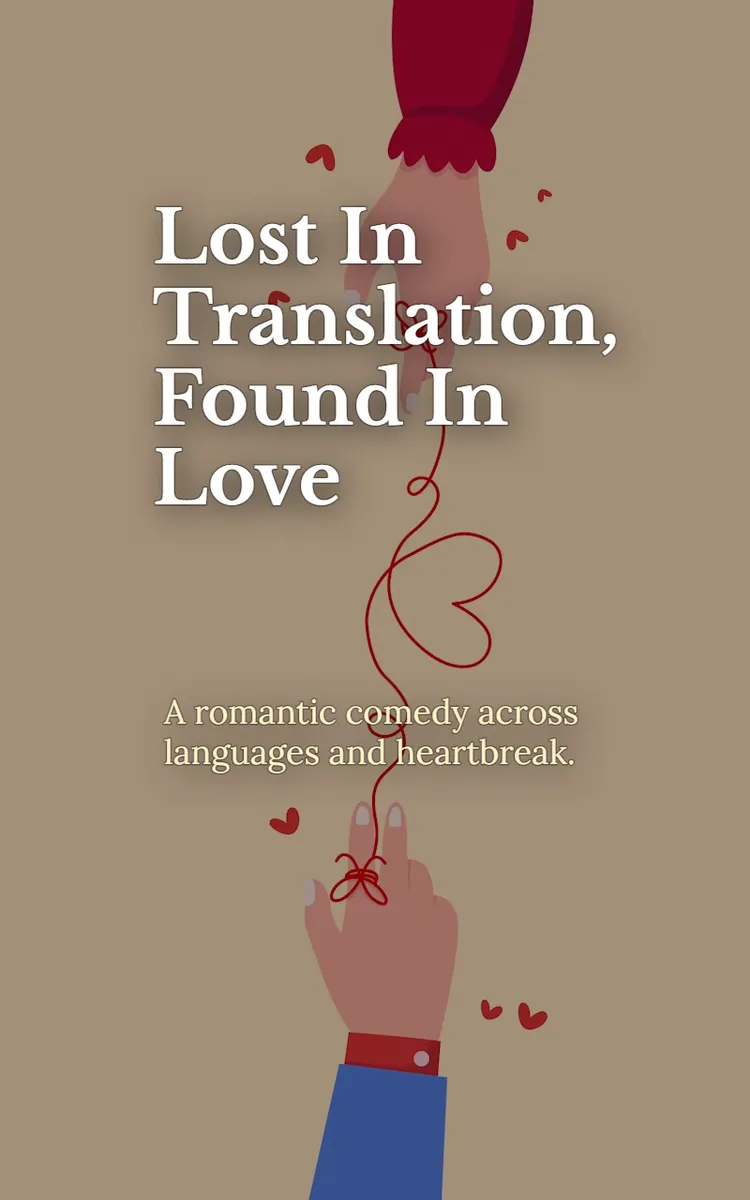
"Lost In Translation, Found In Love" is a romance book by Anonymous with 5 chapters and approximately 14,638 words. Two divorced travelers fall in love despite language barriers..
This book was created using Inkfluence AI, an AI-powered book generation platform that helps authors write, design, and publish complete books. It was made with the AI Romance Novel Writer.
Frequently Asked Questions
What is "Lost In Translation, Found In Love" about?
Two divorced travelers fall in love despite language barriers.
How many chapters are in "Lost In Translation, Found In Love"?
The book contains 5 chapters and approximately 14,638 words. Topics covered include Chapter 1 - The Missed Bus, Chapter 2 - Google Translate Disaster, Chapter 3 - Coffee and Confusion, Chapter 4 - The Wrong Hotel Reservation, and more.
Who wrote "Lost In Translation, Found In Love"?
This book was written by Anonymous and created using Inkfluence AI, an AI book generation platform that helps authors write, design, and publish books.
How can I create a similar romance book?
You can create your own romance book using Inkfluence AI. Describe your idea, choose your style, and the AI writes the full book for you. It's free to start.
Write your own romance book with AI
Describe your idea and Inkfluence writes the whole thing. Free to start.
Start writingCreated with Inkfluence AI


