
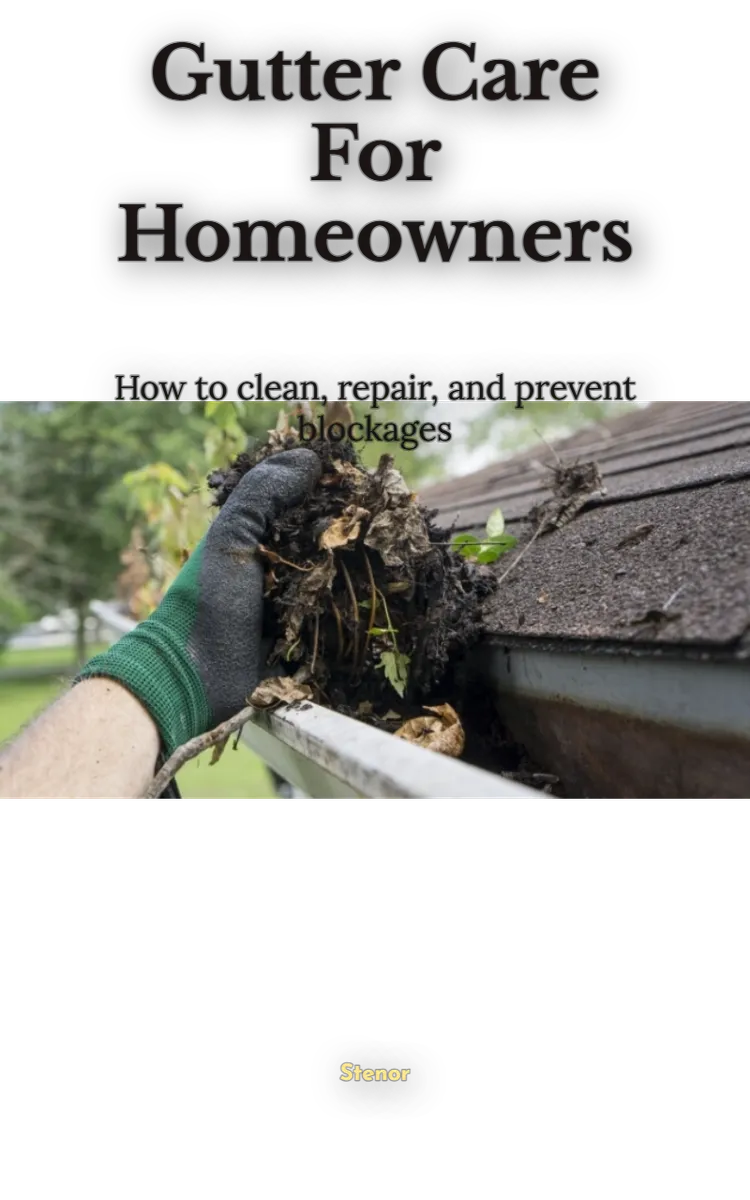
Gutter Care For Homeowners
Created with Inkfluence AI
Cleaning, repairing, and maintaining home gutter systems
Table of Contents
- 1. Gutter Anatomy and Common Failures
- 2. Safe Ladder Setup and Cleaning Prep
- 3. Clog Removal and Flush Testing
- 4. Fixing Leaks, Seams, and Hangs
- 5. Downspout Repairs and Gutter Maintenance Plan
Preview: Gutter Anatomy and Common Failures
A short excerpt from “Gutter Anatomy and Common Failures”. The full book contains 5 chapters and 10,053 words.
Why Gutters Fail Quietly (And Why You Should Learn Their Weak Spots)
Have you ever seen water run behind the gutter instead of into it, then dried out before you could figure out why? That “almost leak” is usually your clue that the gutter system isn’t doing its job in that exact spot.
Gutters don’t fail all at once. They sag a little, seams open a hair, joints separate, or downspouts get half-blocked. Each problem starts small - then turns into stains on siding, wet fascia boards, basement seepage, or ice dams along the roof edge. This chapter helps you understand how gutters move water, so you can spot the most common failure points early and fix them before you chase bigger damage.
After you learn the basics here, you’ll be able to look at your gutter line and answer three questions: Where should the water go? What part controls that path? And what specific signs tell you that part already failed?
Practical outcome: you’ll know what to check from the roof edge to the downspout outlet, and you’ll recognize the failure patterns that cause leaks - so you can clean, repair, or call for help at the right time.
---
How Gutters Work: The Path Water Takes (So You Know What Broke)
Gutters work like a shallow channel that collects roof runoff and sends it to downspouts. For water to move the way it’s supposed to, three things must line up: the roof edge must drip into the gutter opening, the gutter must hold water and slope toward the downspout, and the downspout must carry that water away without backing it up.
The gutter system also depends on correct connections. A typical setup includes:
- Gutter sections that join end-to-end along the roof edge
- Brackets or hangers that hold the gutter at the right slope
- Seams and end caps that close the channel
- Downspouts that connect through elbows and cleanouts (when present)
- Flashing at the roof edge (often called drip edge when installed) that guides water so it won’t slip behind the gutter
Here’s the key idea to keep in your head: water always finds the lowest escape route. If any part of the gutter line slopes the wrong way, gaps form at seams, or the downspout can’t take the flow, water will overflow - or worse, it will climb up and push outward through a weak joint.
Ask yourself while you look: “If I poured a cup of water into this gutter spot, where would it go next?” When you can predict the path, you can spot failures faster.
Use your “Gutter Map Diagnostic” to trace the water path
The Gutter Map Diagnostic is a simple way to break your gutter line into sections and match what you see to the part of the system that controls the flow. You don’t need fancy tools - just a careful visual check and a way to mark spots.
1. Pick one downspout and treat everything upstream as its “run.”
Start at the downspout and work backward along the gutter line. This matters because most leaks come from the run that can’t move water fast enough or has a connection problem.
2. Mark three checkpoints along the run: near the roof drip line, at mid-run, and near the downspout connection.
Use painter’s tape or a marker on the gutter (temporary is fine). This helps you compare what’s happening in the most common trouble zones: where water first lands, where it pools, and where it dumps into the downspout.
3. Check the gutter slope by watching how water behaves during a controlled test.
If you can safely do a hose test, aim a gentle stream into a checkpoint and watch where the water travels. You want steady movement toward the downspout - not sitting in a shallow pocket.
4. Inspect every joint that interrupts the channel: seams, corners, end caps, and the downspout outlet.
Seams and joints control where water can squeeze through. If you find fresh rust streaks, a widened gap, or a loose bracket near a joint, you’ve found your likely leak path.
Practical takeaway: When you can map a run and predict where water should go, you stop guessing. You start spotting failures where the gutter system actually controls flow.
---
The Most Common Gutter Failures (And What They Look Like)
Many homeowner repairs fail because people fix the symptom, not the failure point. A stain on siding doesn’t always mean the gutter above it is the only problem - it might come from a joint farther up the run where water backed up and overflowed.
Below are the frequent failure types you can find with a flashlight and a steady look from the ladder. Look for the specific signs, then connect them to the part of the system that controls the water path.
1) Sagging or wrong-slope gutter sections
A sagged section creates a “pooling spot.” Water sits there, overflows during heavier rain, and then works its way behind the gutter through gaps or loose seams.
What you’ll notice:
- Water stains or mildew marks in a narrow band
- Leaves packed in one spot repeatedly
- Overflow marks on the fascia during storms
...
About this book
"Gutter Care For Homeowners" is a how-to guide book by Stenor with 5 chapters and approximately 10,053 words. Cleaning, repairing, and maintaining home gutter systems.
This book was created using Inkfluence AI, an AI-powered book generation platform that helps authors write, design, and publish complete books. It was made with the AI Ebook Generator.
Frequently Asked Questions
What is "Gutter Care For Homeowners" about?
Cleaning, repairing, and maintaining home gutter systems
How many chapters are in "Gutter Care For Homeowners"?
The book contains 5 chapters and approximately 10,053 words. Topics covered include Gutter Anatomy and Common Failures, Safe Ladder Setup and Cleaning Prep, Clog Removal and Flush Testing, Fixing Leaks, Seams, and Hangs, and more.
Who wrote "Gutter Care For Homeowners"?
This book was written by Stenor and created using Inkfluence AI, an AI book generation platform that helps authors write, design, and publish books.
How can I create a similar how-to guide book?
You can create your own how-to guide book using Inkfluence AI. Describe your idea, choose your style, and the AI writes the full book for you. It's free to start.
Write your own how-to guide book with AI
Describe your idea and Inkfluence writes the whole thing. Free to start.
Start writingCreated with Inkfluence AI


