
Read the first chapter
The whole of chapter one, free. About 9 min. Turn the pages with the arrows, your keyboard, or a swipe.
Chapter 1
Choosing a Profitable Niche
Why Your Next Customers Don’t Care What You “Want to Sell” What would happen if you picked a niche today and still couldn’t explain why anyone would pay you for it? You’d spend months building a business that sounds good to you, then you’d fight for every sale because the market never actually asked for your offer.
That’s the problem this chapter solves. You will learn how to validate demand, assess competition, and choose a niche you can profit from quickly - without guessing, without copying what “worked for someone else,” and without betting the business on hope. By the end, you’ll have a clear niche shortlist, a simple way to score each option using real evidence, and a next-step plan you can run this week.
If you’ve ever launched a service, posted content, or tested products and thought, “People liked it, but they didn’t buy,” you’re already halfway to the answer. The missing piece usually isn’t your effort. It’s your niche fit - whether your target customers have a real need, whether they already spend money to solve it, and whether you can reach them without burning cash.
The Niche Fit Scorecard: Validate Demand and Pick a Niche That Can Pay Fast Let’s talk about the reader avatar I’m writing for: a small business owner or operator who wants growth, but you don’t have time for endless experiments. You might run a café like Talia, 31, who already understands customers and timing - you just want to add a direction that makes money instead of more “maybe someday” ideas.
Talia’s pain is common: she sees opportunities everywhere, but she needs one path that earns quickly. You probably feel the same pressure. You need a niche where demand exists now, not in theory. You need competition you can beat or out-position, not competition that eats your margins. And you need a niche that matches how you sell - because your marketing and delivery matter as much as your product.
Here’s the transformation promise: you’ll stop treating niche selection like a creative exercise and start treating it like a business decision. You’ll validate demand with direct signals, you’ll assess competition with practical visibility checks, and you’ll score your options with the Niche Fit Scorecard so you can pick the most profitable niche faster.
I built this approach because I’ve watched business owners do the same loop: they pick a niche based on what they enjoy, then they “market harder” when sales don’t show up. The fix wasn’t more effort. The fix was better inputs - clear signals about who buys, what triggers buying, and whether you can reach those people without losing to bigger players.
The Niche Fit Scorecard gives you a structured way to answer four questions: 1) Do people already spend money on this problem? 2) Can you reach the buyers with your current channels? 3) Can you differentiate enough to win deals? 4) Can you deliver profitably without constant discounts?
Now you’ll use it to build a shortlist and pick one niche with momentum.
How to Validate Demand, Assess Competition, and Score Niches (Without Guessing) You validate demand and competition by looking for proof, not opinions. “People might want this” doesn’t help you. “People already buy this” does. “You can see active offers and active buyers” does. Your goal is to collect enough evidence to score each niche and choose confidently.
Use this framework, and score each niche from 1 to 5 on every line. A score of 5 means you have strong proof. A score of 1 means you have almost no proof.
1. Existing Money (Demand Proof) Check whether people pay for solutions like yours right now. Look for active offers, repeat purchases, and people asking for it in plain language. Score higher if you find multiple vendors and clear “before/after” outcomes buyers want.
2. Urgency and Trigger (Demand Timing) Demand sticks when something pushes buyers to act: a deadline, a seasonal problem, a recurring need, or a pain that gets worse. Score higher if buyers feel the problem soon and you can tie your offer to that trigger.
3. Reachability (Can You Get In Front of Them?) Decide whether you can reach the buyers using channels you can run consistently. Score higher if you can find them where they already pay attention: local searches, community groups, supplier networks, trade platforms, or repeatable outreach lists.
4. Competitive Shape (Competition You Can Handle) Competition isn’t automatically bad. What matters is how crowded the niche is and how easy it is to stand out. Score higher if competitors feel generic, expensive, slow, or hard to deal with - then you can win with clarity, speed, or a tighter offer.
5. Differentiation Lever (Why You Win a Deal) You need one sharp advantage that shows up in the buying decision. Examples: faster turnaround, simpler package, specialized outcome, better service, or an easier process. Score higher if you can name your advantage in one sentence and prove it with delivery.
6. Profit Path (Pricing and Delivery Fit) Validate whether you can deliver without killing your margin. Score higher if your niche supports straightforward pricing (packages, tiers, or a clear unit cost) and doesn’t require constant custom work.
Once you score, you don’t “average your feelings.” You rank niches by total score and pick the top one to test - then you test with a short plan that produces evidence fast.
Here’s a practical example using Talia’s café mindset. She’s thinking about branching out from drinks and pastries. She hears ideas like “make meal prep,” “sell merch,” or “start catering.” Those are not niches yet. They’re categories. She would convert each idea into a niche by defining: the customer, the problem, the outcome, and the buying trigger.
For example: - “Meal prep” could become “weekday lunch boxes for office teams within 2 miles, delivered by 11 a.m.” - “Catering” could become “morning meeting catering for small teams that need setup-free coffee and breakfast.”
That clarity matters because it changes what you can validate. You can’t measure demand for “catering.” You can measure demand for “setup-free morning meeting catering for small teams.”
Putting the Niche Fit Scorecard to Work Follow this scenario-style walkthrough based on Talia’s situation so you can copy the process for your own business.
Step-by-step scenario: Talia scores three possible niches Talia runs a café and wants a faster profit path than adding random new items. She picks three niche directions to score: A) Lunch boxes for office teams B) Setup-free morning meeting catering C) Weekend “family bundles” (pre-planned meals)
She then runs a 3-day evidence sprint.
1. Define the buyer for each niche She writes one sentence per niche: “I sell X to Y who need Z by time T.” Expected outcome: each niche becomes measurable. No vague “everyone.”
2. Collect demand proof in 60 minutes per niche She searches local listings, reads recent posts, and notes how many active sellers appear. She also checks whether people ask for the service using specific wording (like “delivered by 11,” “no setup,” “for small teams”). Expected outcome: she can tell if buyers already spend money for this.
3. Check urgency and trigger with real signals She looks for language that shows timing pressure: “need this tomorrow,” “weekly,” “meeting next week,” “deadline,” “seasonal.” Expected outcome: she can explain why a buyer acts now.
4. Score reachability using her real channels Talia knows her customer flow: local foot traffic, regulars, and community bulletin boards. She checks which niche buyers overlap with those channels. Expected outcome: she knows whether she can reach the buyer without building a whole new marketing machine.
5. Assess competition with “deal friction” She chooses 5 competitors per niche and notes what looks generic, slow, or hard: confusing menus, long lead times, unclear pricing, or complicated ordering. Expected outcome: she identifies a differentiation lever she can actually use.
6. Score profit path based on delivery effort She estimates packaging time, delivery logistics, and whether orders require custom work every time. Expected outcome: she avoids niches that look good but eat her margins.
7. Add up scores and pick the top niche She doesn’t overthink it. She uses the score totals as her decision rule. Expected outcome: she chooses one niche to validate with a paid test.
Quick checklist - Write a one-sentence niche definition (buyer + problem + outcome + timing) - Gather demand proof: count active offers and capture buyer wording - Identify urgency signals: find timing language buyers use - Rate reachability: confirm your channel can hit the buyer consistently - Scan competitors for deal friction and generic positioning - Estimate delivery effort: check whether you can price without constant custom work - Score 1-5 on each line, then rank niches by total score
Common Mistakes That Kill Niche Selection (and How to Fix Them) Even smart business owners get tripped up here. These mistakes waste weeks because you can’t “outwork” a weak niche fit.
Scoring based on what you like If you score niches by your personal interest, you’ll pick something that feels exciting but doesn’t convert. You’ll notice this when your validation steps don’t produce buyer language or active demand signals. Do this: Score only what you can prove: active offers, buyer wording, reachability, and delivery fit. Not this: “I like meal prep, so it should score high.”
Confusing a product category with a buying niche “Catering,” “coaching,” and “apparel” sound like niches, but they don’t tell you who buys, what triggers buying, or why you win. Without that, your validation checks become vague. Do this: Rewrite each option into a niche statement with timing and outcome. Not this: “I want to sell more food.”
Ignoring deal friction in competition Competition becomes a problem when buyers face friction: unclear pricing, long lead times, hard ordering, or generic service. If you ignore friction, you’ll compete on price when you should compete on clarity or speed. Do this: Look for what customers complain about or what feels hard to buy from competitors. Turn that into your differentiation lever. Not this: “There are other businesses here, so it’s hopeless.”
Your Niche Decision Roadmap for the Next 7 Days You need a timeline that produces answers quickly. The goal of this week is not to “build the niche.” It’s to validate enough demand and fit to choose one direction you can profit from.
1) Day 1: Create a shortlist of 3 niche options Write one-sentence niche definitions for each. Keep them tight and measurable.
2) Day 2-3: Validate demand proof and urgency Collect buyer wording and active offer signals. Score each niche with the Niche Fit Scorecard.
3) Day 4: Assess competition and differentiation levers Scan competitors for deal friction. Decide what you can do better in one sentence.
4) Day 5-6: Check profit path and delivery fit Estimate time, packaging, delivery/logistics, and how you’ll price. Adjust your niche definition if delivery doesn’t match the margin.
5) Day 7: Pick one niche and plan a paid test Choose the top score niche and design a simple test offer tied to the buying trigger you found.
At the end of the week, you should be able to answer three questions out loud: - Who buys this from me, and what problem do they want solved now? - What proof shows demand exists right here, right now? - Why would they choose my offer over the other options?
When you can answer those cleanly, you stop guessing and start building a business that earns.
Final Takeaway: Choose the Niche You Can Prove, Not the Niche You Hope Pick a niche like you run a test: you gather evidence, you score it, and you move forward with the option that shows the best chance to earn quickly. If you treat niche selection like a research sprint, you reduce risk and speed up progress.
Your action for today is simple: write down three niche options you’re considering, then score them from 1 to 5 using the Niche Fit Scorecard lines (Existing Money, Urgency and Trigger, Reachability, Competitive Shape, Differentiation Lever, Profit Path). Don’t polish the wording yet - just get raw clarity on where the demand proof exists.
That’s the foundation for everything that comes next: once you know what niche you can profit from, you can build an offer and validate it without wasting time.
End of chapter one. 4 more chapters in the full book.
Swipe or use the arrows to turn the page
What's inside: 5 chapters
- 1. Choosing a Profitable Niche
- 2. Defining Your Offer and Positioning
- 3. Pricing Products for Profit
- 4. Building a Customer Acquisition Engine
- 5. Scaling Operations with Systems
About this book
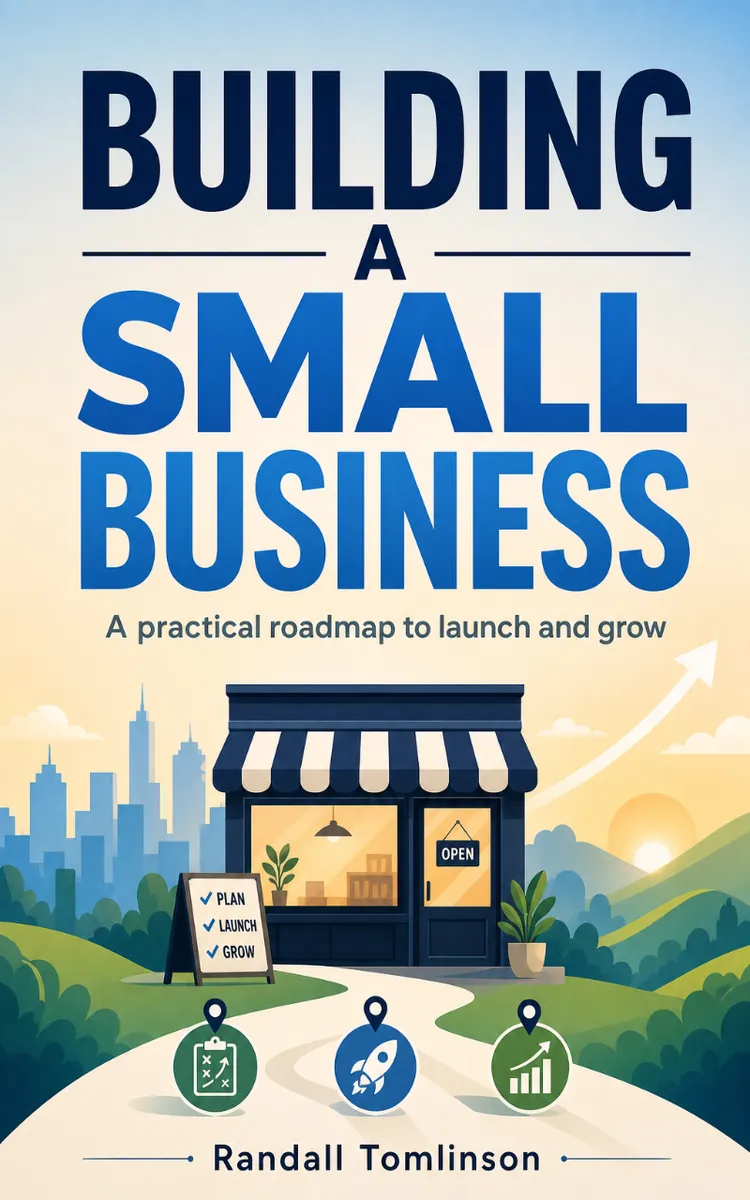
"Building A Small Business" is a business book by Randall Tomlinson with 5 chapters and approximately 9,859 words. Starting and growing a small business.
This book was created using Inkfluence AI, an AI-powered book generation platform that helps authors write, design, and publish complete books. It was made with the AI Business Book Writer.
Frequently Asked Questions
What is "Building A Small Business" about?
Starting and growing a small business
How many chapters are in "Building A Small Business"?
The book contains 5 chapters and approximately 9,859 words. Topics covered include Choosing a Profitable Niche, Defining Your Offer and Positioning, Pricing Products for Profit, Building a Customer Acquisition Engine, and more.
Who wrote "Building A Small Business"?
This book was written by Randall Tomlinson and created using Inkfluence AI, an AI book generation platform that helps authors write, design, and publish books.
How can I create a similar business book?
You can create your own business book using Inkfluence AI. Describe your idea, choose your style, and the AI writes the full book for you. It's free to start.
Write your own business book with AI
Describe your idea and Inkfluence writes the whole thing. Free to start.
Start writingCreated with Inkfluence AI


