
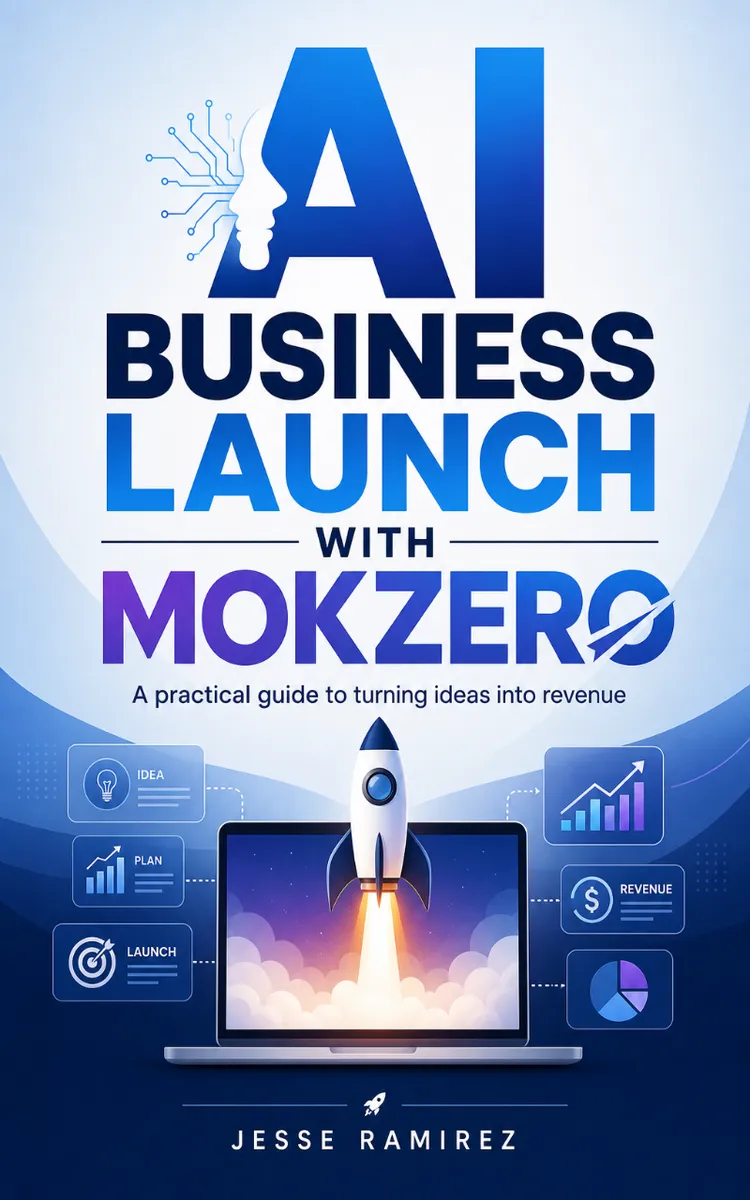
AI Business Launch With MOKZERO
Created with Inkfluence AI
Using AI tools via MOKZERO.app to launch a business
Table of Contents
- 1. Choosing a Profitable AI Problem
- 2. Defining Your Target Customer Persona
- 3. Writing a MOKZERO Offer Brief
- 4. Generating Your Landing Page Copy
- 5. Creating a Lead Magnet and CTA
- 6. Building Your Email Sequence in MOKZERO
- 7. Pricing and Packaging for Fast Launch
- 8. Launching, Measuring, and Iterating Weekly
Preview: Choosing a Profitable AI Problem
A short excerpt from “Choosing a Profitable AI Problem”. The full book contains 8 chapters and 15,911 words.
Picking an AI-Ready Business Problem You Can Actually SellWhat if your “great AI idea” never turns into money - not because your model fails, but because nobody feels the pain enough to pay? That’s the trap most first-time founders fall into: they build something cool, then they scramble to find a buyer. The fix starts before you touch AI output. You pick a problem that has clear demand, fast validation, and a path to monetization.
This chapter teaches you how to choose an AI-ready business problem using a simple tool called the Problem-Value Fit Scorecard. You’ll learn how to spot demand signals, run quick tests without wasting weeks, and shape the offer so people will pay you for the result - not for the tech.
By the end, you’ll be able to take 5-10 ideas, score them with the Scorecard, pick the best one, and outline a validation plan you can run in days using MOKZERO.app. You’ll also know what warning signs to watch for so you don’t end up with a “nice-to-have” product.
The Problem-Value Fit Scorecard (Demand × Speed × Monetization)An AI-ready business problem has three traits: people already spend money (or time) to solve it, you can test your solution quickly with real users, and you can charge for a clear outcome. The Problem-Value Fit Scorecard turns that gut feel into a practical check you can repeat.
Use this scorecard to compare ideas side-by-side. You’ll give each idea a score from 0 to 3 for each category, then add the totals. The highest score doesn’t guarantee success - but it tells you where to spend your time first.
Demand signal strength (0-3)
Score 0 if nobody is actively looking for solutions (no services, no communities, no paid tools, no active conversations). Score 1 if you see demand but it’s scattered and hard to reach. Score 2 if you see clear buyers and recurring needs (people pay for similar services/tools). Score 3 if you see buyers who already pay and you can reach them fast (for example, an industry with active job posts, agencies, or vendor directories).
User willingness to pay (0-3)
Score 0 if buyers rarely pay for this type of work. Score 1 if they pay occasionally or only when something goes wrong. Score 2 if they pay regularly for related services. Score 3 if they pay for speed, accuracy, or compliance - because those map well to AI outcomes.
Validation speed (0-3)
Score 0 if you need weeks of integration, data access, or custom systems to show value. Score 1 if you need some setup but you can still test within a couple of weeks. Score 2 if you can deliver a useful prototype using publicly available inputs or a small manual step. Score 3 if you can run a test in days with a simple output people can judge.
Monetization path clarity (0-3)
Score 0 if you can’t picture how you’d charge (no pricing logic, no clear buyer role). Score 1 if you can charge but it’s messy (too many custom hours). Score 2 if you can sell a fixed deliverable or subscription tied to a repeatable workflow. Score 3 if the buyer already pays for similar deliverables and you can replace part of that cost.
Now add your scores. The target isn’t a “perfect” number. It’s to pick ideas where the score is high in Demand signal strength and Validation speed at the same time. That combo prevents you from building in the dark.
Here’s a concrete example using Nadia (26), a part-time tutor. Nadia hears about AI and wants to build something for students. She writes down three ideas:
“Generate study notes from any topic.”
“Turn past exam questions into practice sets with answer explanations.”
“Write essays for students to submit.”
She scores them quickly:
Study notes: Demand signal maybe 1 (students use notes, but it’s broad); willingness to pay 1 (many free options); validation speed 3 (easy to test); monetization path 1 (hard to charge for generic notes).
Practice sets from past exams: Demand signal 2 (tutoring and exam prep services exist); willingness to pay 2 (parents pay for results); validation speed 2 (needs exam questions, but still testable); monetization path 2 (deliverable or package).
Writing essays: Demand signal 2, willingness 0-1 (many schools discourage it), validation speed 3, monetization path 1. Even if people click, you risk low trust and policy problems.
The second idea tends to score best because it connects to a specific buyer pain (exam prep), a fast test (turn a set of questions into practice), and a clear outcome (more practice with explanations).
Ask yourself one quick comprehension check: If I can’t reach buyers within a week, does my “demand” actually exist - or did I just like the topic? The Scorecard forces you to answer that.
Quick Validation Plan: Test the Outcome in Days, Not WeeksOnce you pick the top idea from the Scorecard, you need a validation plan that proves people want the outcome. Many founders waste time by building a “product” before they test the offer....
About this book
"AI Business Launch With MOKZERO" is a how-to guide book by Jesse Ramirez with 8 chapters and approximately 15,911 words. Using AI tools via MOKZERO.app to launch a business.
This book was created using Inkfluence AI, an AI-powered book generation platform that helps authors write, design, and publish complete books. It was made with the AI Ebook Generator.
Frequently Asked Questions
What is "AI Business Launch With MOKZERO" about?
Using AI tools via MOKZERO.app to launch a business
How many chapters are in "AI Business Launch With MOKZERO"?
The book contains 8 chapters and approximately 15,911 words. Topics covered include Choosing a Profitable AI Problem, Defining Your Target Customer Persona, Writing a MOKZERO Offer Brief, Generating Your Landing Page Copy, and more.
Who wrote "AI Business Launch With MOKZERO"?
This book was written by Jesse Ramirez and created using Inkfluence AI, an AI book generation platform that helps authors write, design, and publish books.
How can I create a similar how-to guide book?
You can create your own how-to guide book using Inkfluence AI. Describe your idea, choose your style, and the AI writes the full book for you. It's free to start.
Write your own how-to guide book with AI
Describe your idea and Inkfluence writes the whole thing. Free to start.
Start writingCreated with Inkfluence AI


