
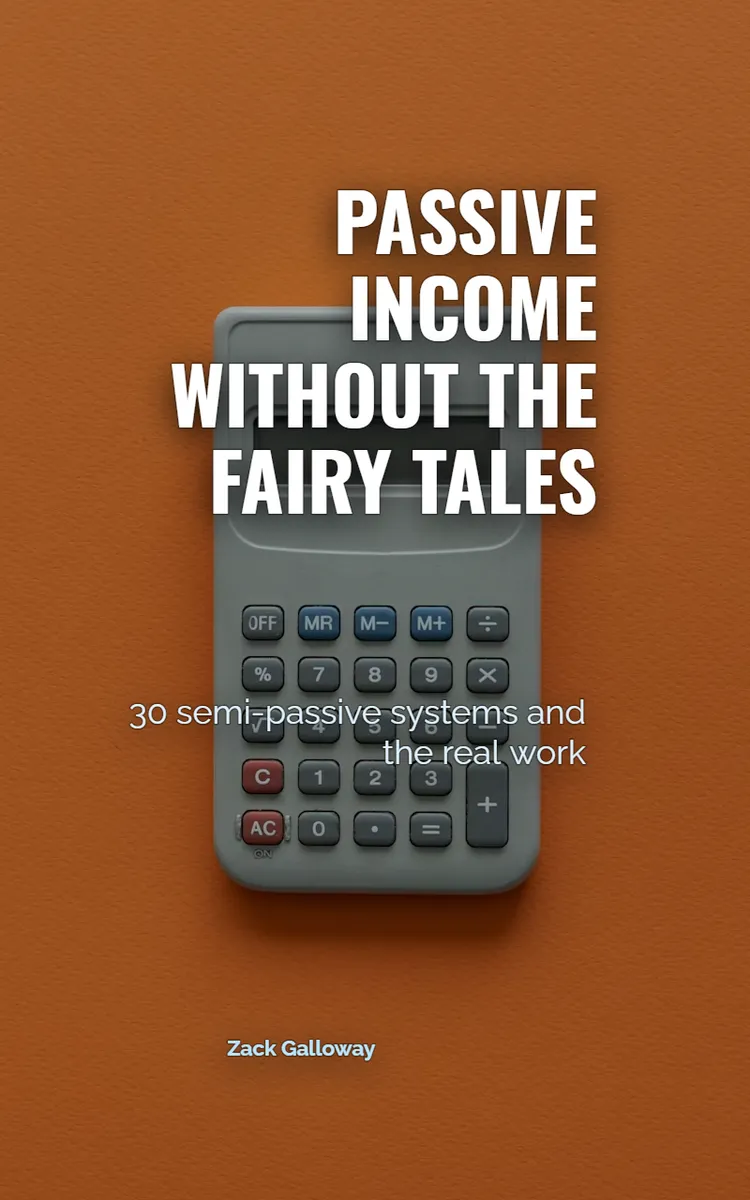

Semi-passive income systems, asset building, and ROI evaluation
Table of Contents
- 1. Income Types and Asset Resources
- 2. The Semi-Passive Reality Test
- 3. Your Build-First Cash Engine
- 4. Emergency Fund and Debt Kill Switch
- 5. Capital Saving and Reinvestment Rules
- 6. Opportunity Math: ROI, Payback, Break-Even
- 7. Maintenance Hours and Attention Risk
- 8. Platform Dependency and Tech Obsolescence
- 9. Legal, Tax, and Compliance Basics
- 10. SOPs: Build Once, Run Forever
- 11. Recurring Billing and Pricing Architecture
- 12. Scheduled Marketing and Funnel Timing
- 13. Email Automation That Actually Converts
- 14. Outsourcing to Freelancers Without Chaos
- 15. Virtual Assistants and Contractor Management
- 16. Inventory Monitoring and Reorder Logic
- 17. Customer Support Systems and Refund Control
- 18. Automated Reporting and Dashboards
- 19. Maintenance Schedules and Risk Controls
- 20. 30-Day Research Plan and Opportunity Shortlist
- 21. Build One System: MVP to Launch
- 22. Case Study: When “Passive” Collapses
- 23. Case Study: Boring Systems That Compound
- 24. 90-Day Asset-Building Plan and Reinvestment Loop
- 25. Five-Year Wealth-System Example Portfolios
Preview: Income Types and Asset Resources
A short excerpt from “Income Types and Asset Resources”. The full book contains 25 chapters and 72,854 words.
Income Types and Asset Resources
Distinguish Active, Recurring, Leveraged, Royalty, Rental, Portfolio, and Residual Income
What keeps paying when you stop working for an hour, a day, or a month - and what only looks independent because the work has moved out of sight?
That question matters because “passive income” covers several very different arrangements. A plumber who completes a repair earns active income. A gym owner who personally trains every client earns self-employment income, even if the business has a company name and a payment processor. A gym that charges members each month creates recurring revenue, but recurring revenue does not automatically mean passive income. The owner still may need to handle cancellations, equipment repairs, staff scheduling, complaints, and marketing.
The Income Taxonomy Map separates these categories by asking what creates the payment, who must keep working, and what happens when the owner steps away.
Active income pays for direct work. You exchange hours, labor, or personal attention for money. A contractor completes a job, a designer delivers a project, and a consultant attends a client meeting. Active income often offers the fastest route to cash because you can sell a skill before you own an asset. Its limitation is simple: your earning capacity usually follows your available time and energy.
Self-employment income describes active income earned through your own business rather than through an employer. A sole proprietor, independent tradesperson, or owner-operator may invoice customers directly and control pricing. Self-employment can produce better margins and more control than a job, but it can also create a demanding job with extra paperwork. Calling yourself a business owner does not change the labor requirement. If every customer needs you personally, the income remains closely tied to your presence.
Recurring revenue comes from repeat payments linked to an ongoing product, service, access right, or rental agreement. A monthly lawn-care plan, software subscription, paid newsletter, storage unit, or equipment lease can create recurring revenue. The payment repeats; the work may also repeat. A recurring customer who needs a fresh service visit every week creates a repeatable operating business, not necessarily passive income. Recurrence improves predictability, but it does not remove delivery costs.
Leveraged income uses an asset, system, team, audience, or technology to produce more output than your personal hours could produce alone. A recorded course can serve many buyers after you create it. A booking website can collect inquiries while you are away from your desk. A team can complete standardized cleaning jobs that you no longer perform personally. Leverage changes the relationship between your time and revenue, but it introduces new work: quality control, software costs, contractor management, refunds, and system updates.
Royalty income pays you when another party uses something you created or own. Examples include a book sold through a retailer, a photograph licensed for an advertisement, a design licensed for merchandise, or music used in a production. Royalty income can continue after the original creation, but sales and usage still depend on demand, distribution, contracts, and rights protection. One digital file does not guarantee a durable royalty stream. A product that solves a narrow, continuing need has a better chance than a product created only because it was easy to make.
Rental income pays for access to an asset for a defined period. The asset might be a property, parking space, trailer, pressure washer, camera, storage area, or specialized tool. Rental income looks attractive because the asset can serve multiple customers over time. Yet rentals create physical risks: damage, theft, downtime, maintenance, cleaning, scheduling, insurance, and late returns. A trailer that earns money for twenty days each month but requires frequent repairs may produce less useful income than a simpler asset with lower revenue and fewer problems.
Portfolio income comes from financial assets such as dividends, interest, and gains from investments. An investment portfolio can produce cash without customer service, inventory, or daily sales calls. However, portfolio income still carries market risk, interest-rate risk, business risk, and the possibility that income changes. Selling an asset for a gain differs from receiving a dividend or interest payment; both affect your finances, but they operate differently.
Residual income describes money that continues after the main work that created it, often through renewals, repeat purchases, commissions, or continuing rights. A salesperson may receive renewal commissions. A software creator may retain subscription revenue after the initial sale. An insurance agent may earn ongoing payments under a contract....
About this book
"Passive Income Without The Fairy Tales" is a finance book by Zack Galloway with 25 chapters and approximately 72,854 words. Semi-passive income systems, asset building, and ROI evaluation.
This book was created using Inkfluence AI, an AI-powered book generation platform that helps authors write, design, and publish complete books. It was made with the AI Ebook Generator.
Frequently Asked Questions
What is "Passive Income Without The Fairy Tales" about?
Semi-passive income systems, asset building, and ROI evaluation
How many chapters are in "Passive Income Without The Fairy Tales"?
The book contains 25 chapters and approximately 72,854 words. Topics covered include Income Types and Asset Resources, The Semi-Passive Reality Test, Your Build-First Cash Engine, Emergency Fund and Debt Kill Switch, and more.
Who wrote "Passive Income Without The Fairy Tales"?
This book was written by Zack Galloway and created using Inkfluence AI, an AI book generation platform that helps authors write, design, and publish books.
How can I create a similar finance book?
You can create your own finance book using Inkfluence AI. Describe your idea, choose your style, and the AI writes the full book for you. It's free to start.
Write your own finance book with AI
Describe your idea and Inkfluence writes the whole thing. Free to start.
Start writingCreated with Inkfluence AI


