
Read the first chapter
The whole of chapter one, free. About 8 min. Turn the pages with the arrows, your keyboard, or a swipe.
Chapter 1
The “I’ll Pay Later” Trap
That “I’ll pay later” message can feel polite, even hopeful, but it’s usually the start of a dead conversation. I’ve watched it happen: a customer asks for a price, agrees on the deal, says they’ll transfer later, and then the chat goes quiet for days-while your inbox keeps filling with new enquiries.
Tunde, 33, a WhatsApp reseller, told me this was his biggest problem. He wasn’t getting many “no’s.” He was getting delayed payments. He’d reply fast, send photos, confirm availability, then wait. By the time he followed up, the buyer was already gone-or worse, they were shopping in other chats at the same time. The issue wasn’t his product or his tone. It was that he treated the “later” as a timeline instead of a signal.
This chapter fixes that with a simple mindset and a repeatable check called The Later-Lag Audit. Your goal is to stop building trust on a promise that has no payment attached, and start qualifying buyers based on what they do after they say “later.” That’s how you turn DM conversations into daily money instead of “maybe someday.”
Key Stats - On WhatsApp and Instagram, most stalled deals are abandoned within 7-14 days after “later” (you’ll feel this immediately in your follow-up replies). - A typical active seller can spend 30-60 minutes per day replying to enquiries that never convert, mostly because they never get qualified properly. - The fastest-paying buyers usually show payment intent in the first few messages, not in the “later” part of the conversation. - More DMs does not equal more revenue: conversion depends on how quickly you separate “ready” from “not now.”
---
Tactics and Execution
The Later-Lag Audit is about one thing: identifying the real reason behind the delay, then changing your next message so the buyer either pays or stops taking up your time. The trap is thinking “later” means the same as “soon.” In practice, it usually means one of three things: they’re not ready, they’re not serious, or they’re buying from someone else and using you as a backup.
1) Spot the “later” pattern before you over-invest Your first job is to recognize the exact moment the buyer starts dodging payment. If the conversation goes like this: price → “I’ll pay later” → no transfer proof → no pickup/delivery plan, you’re already past the point where fast replying helps.
Use a simple trigger: when someone says “later,” you don’t rush to reassure them. You ask for the next concrete step. Not “okay sir,” not “no problem,” not “just let me know.” You make payment logistics the topic immediately.
Concrete reply formula (WhatsApp or Instagram DM): “Got it. To reserve it, when exactly will you send the transfer-today or tomorrow? Also, share your name and the amount you’ll pay.”
This works because it forces a choice (today vs tomorrow) and requests details that only serious buyers can provide without stalling.
2) Run The Later-Lag Audit in your replies (3 checkpoints) You don’t need a complicated system. You need a fast way to categorize the delay so you know how to respond.
Here are the three checkpoints you check every time “later” appears:
1. Payment intent: Did they ask for payment instructions, or are they just delaying after agreeing? - If they didn’t request payment details, they may not be ready to pay. 2. Timing specificity: Did they give a real timeframe (“today by 4pm”), or is it vague (“later”)? - Vague “later” is almost always a stall. 3. Action proof: Do they do anything measurable after saying “later”? - Proof can be screenshot of transfer, pickup confirmation, or a question that shows commitment (delivery address, bank name, amount).
Now your response changes based on what you see. This is where sellers usually fail: they respond the same way to every “later,” even though the buyer’s reason is different.
3) Convert “later” into a commitment, not a conversation Most sellers try to keep the buyer comfortable. That’s the trap. Comfort keeps the chat open. Commitment closes it.
Use a “reservation rule” that’s firm but fair. You’re not threatening. You’re setting a clear boundary tied to your stock or production time.
Example message (Tunde’s situation): “Okay. I can reserve it, but I only hold items for payment within the day. Please send the transfer today so I can pack and ship. If it’s tomorrow, I’ll need the exact time you’ll send.”
This does two things: - It stops you from waiting while they “think.” - It gives you an easy way to measure seriousness: they either name a time and act, or they don’t.
4) Use channel-specific follow-up that matches DM behavior WhatsApp and Instagram DMs behave differently, so your cadence should match how people actually check messages.
WhatsApp (usually higher reply speed, more “real-time” buying): Follow up sooner and ask for payment proof gently. People check WhatsApp frequently, so waiting 3-4 days often kills your conversion.
Instagram DMs (often more browsing, slower intent): Follow up with a short payment nudge plus a reason to act now (availability, slot, or delivery). Instagram buyers often compare options before paying, so you need to reduce “decision time” inside the chat.
Here’s a simple cadence you can actually run: - First “later” message: clarify timing + reservation rule. - If no payment proof within 24 hours (WhatsApp) or 48 hours (Instagram): send one payment reminder + ask for a yes/no next step. - If they still stall: offer a next available option (different quantity, next delivery window) instead of chasing the same item.
5) Build a content mini-campaign that reduces “later” messages You can’t only fix replies; you also need to prevent “later” from happening. When people don’t trust delivery timing, pricing clarity, or stock availability, they delay payment.
Create a short campaign that answers the questions buyers usually ask right before they say “later”: - “When will it arrive?” - “Is it still available?” - “What happens after I pay?” - “How do I pay?”
Caption formula (works for resellers and services): Hook about urgency + clear deliverables + payment path.
Example: “Available today. If you pay now, I’ll confirm and deliver/pickup by [time]. Price is [range]. Send ‘PAY’ in DM and I’ll send the exact total + bank details.”
Then pin a highlight or keep a saved reply flow so when they DM, you respond with the same clarity every time.
Content Calendar Sample
| Day | Content Type | Topic/Hook | Format | |---|---|---|---| | Mon | WhatsApp-ready post | “Available today. Pay now, confirm fast.” | Short text + image of product/service | | Tue | Instagram DM lead magnet | “Send ‘PAY’ to get total + bank details.” | Reel or carousel + DM prompt | | Wed | Proof post | “What happens after transfer (packing/shipping steps).” | Story + 3-step graphic | | Thu | Availability post | “Next slot/date for delivery/pickup.” | Static post + clear date | | Fri | Last-call soft close | “If you want it this weekend, pay by tonight.” | Caption with time + DM instruction |
Keep it simple: each piece should reduce confusion that causes “later.”
---
Metrics and Measurement
If you can’t measure the “later” problem, you’ll keep guessing and wasting time. The Later-Lag Audit gives you categories; your metrics prove whether the categories are improving.
| Metric | What It Measures | Target Benchmark | Tool to Track | |---|---|---|---| | Later-to-Payment Rate | % of buyers who say “I’ll pay later” and actually pay within your set window | ≥ 35% (WhatsApp), ≥ 25% (Instagram) in the first 2 weeks | WhatsApp/IG DM label + spreadsheet | | Time-to-First-Payment Proof | Hours from “later” message to transfer screenshot/confirmation | 24 hours (WhatsApp), 48 hours (Instagram) | Manual log in Google Sheets | | Stall Reply Rate | % of “later” buyers who go silent after your reservation rule | Keep it falling week to week | DM notes + weekly counts | | Qualified Deals Ratio | % of enquiries that reach a clear next step (payment instructions + timing) | 60%+ of active chats | Saved replies + checklist |
Here’s how to interpret it without fooling yourself: if your Later-to-Payment Rate stays low, your problem is not your product-it’s how you’re handling the delay. If Time-to-First-Payment Proof is getting worse, you’re likely softening your reservation rule or asking questions that don’t force action.
The single most important metric is the Later-to-Payment Rate. Everything else supports it. If you improve that number, you’ll feel it in your daily cash flow within days, not weeks.
Common measurement mistakes: tracking only “sales” (too late), counting everyone who paid as success without looking at who said “later,” and changing your follow-up wording every day so you can’t tell what actually worked.
---
Action Plan
You’re going to sequence this so you stop bleeding time first, then tighten your replies, then prevent “later” from entering the chat in the first place.
This Week: - [ ] Create a simple DM log in Google Sheets with columns: “Said later (Y/N), Platform, Timing (today/tomorrow/vague), Payment proof received (Y/N), Hours to proof.” - [ ] Update your “later” reply to include a reservation rule + a specific timing question (today vs tomorrow) and request payment details.
This Month: - [ ] Run one 5-day availability/delivery campaign (WhatsApp post + Instagram reel/carousel) with the “Send ‘PAY’ in DM” instruction. - [ ] Review your Later-to-Payment Rate weekly and adjust only one thing: either your reservation rule wording or your follow-up timing (not both).
Ongoing: - [ ] Tag every “later” message in your DM log and track Time-to-First-Payment Proof so you can spot slowdowns immediately. - [ ] Keep one saved reply for WhatsApp and one for Instagram that matches your reservation rule so you don’t improvise under pressure.
Quick Win: The next time someone says “I’ll pay later,” reply with a reservation rule and ask “today or tomorrow” plus the name/amount-no reassurance, no extra back-and-forth.
End of chapter one. 4 more chapters in the full book.
Swipe or use the arrows to turn the page
What's inside: 5 chapters
- 1. The “I’ll Pay Later” Trap
- 2. Buyer Psychology in DMs
- 3. Serious Buyer Fast-Check
- 4. Reply That Builds Trust
- 5. Close Naturally With the Next Step
About this book
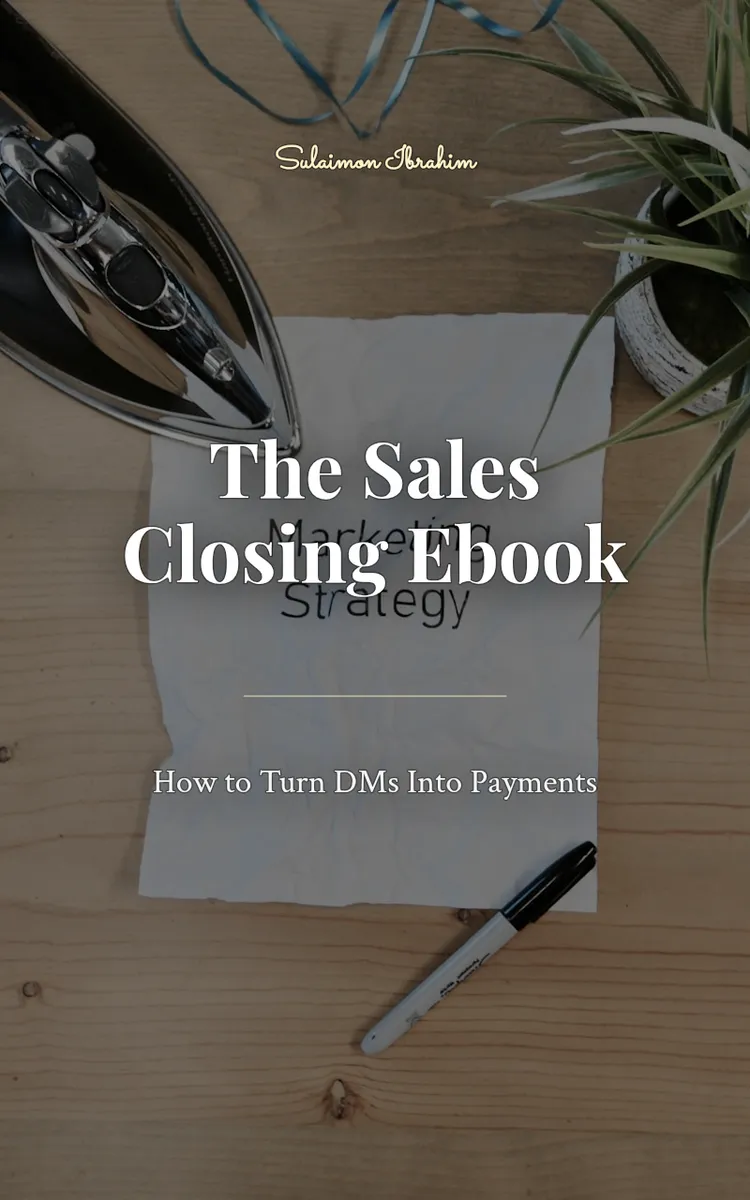
"The Sales Closing Ebook" is a social media book by Sulaimon Ibrahim with 5 chapters and approximately 8,589 words. Closing sales via WhatsApp and Instagram DM scripts.
This book was created using Inkfluence AI, an AI-powered book generation platform that helps authors write, design, and publish complete books. It was made with the AI Social Media Strategy Generator.
Frequently Asked Questions
What is "The Sales Closing Ebook" about?
Closing sales via WhatsApp and Instagram DM scripts
How many chapters are in "The Sales Closing Ebook"?
The book contains 5 chapters and approximately 8,589 words. Topics covered include The “I’ll Pay Later” Trap, Buyer Psychology in DMs, Serious Buyer Fast-Check, Reply That Builds Trust, and more.
Who wrote "The Sales Closing Ebook"?
This book was written by Sulaimon Ibrahim and created using Inkfluence AI, an AI book generation platform that helps authors write, design, and publish books.
How can I create a similar social media book?
You can create your own social media book using Inkfluence AI. Describe your idea, choose your style, and the AI writes the full book for you. It's free to start.
Write your own social media book with AI
Describe your idea and Inkfluence writes the whole thing. Free to start.
Start writingCreated with Inkfluence AI


