
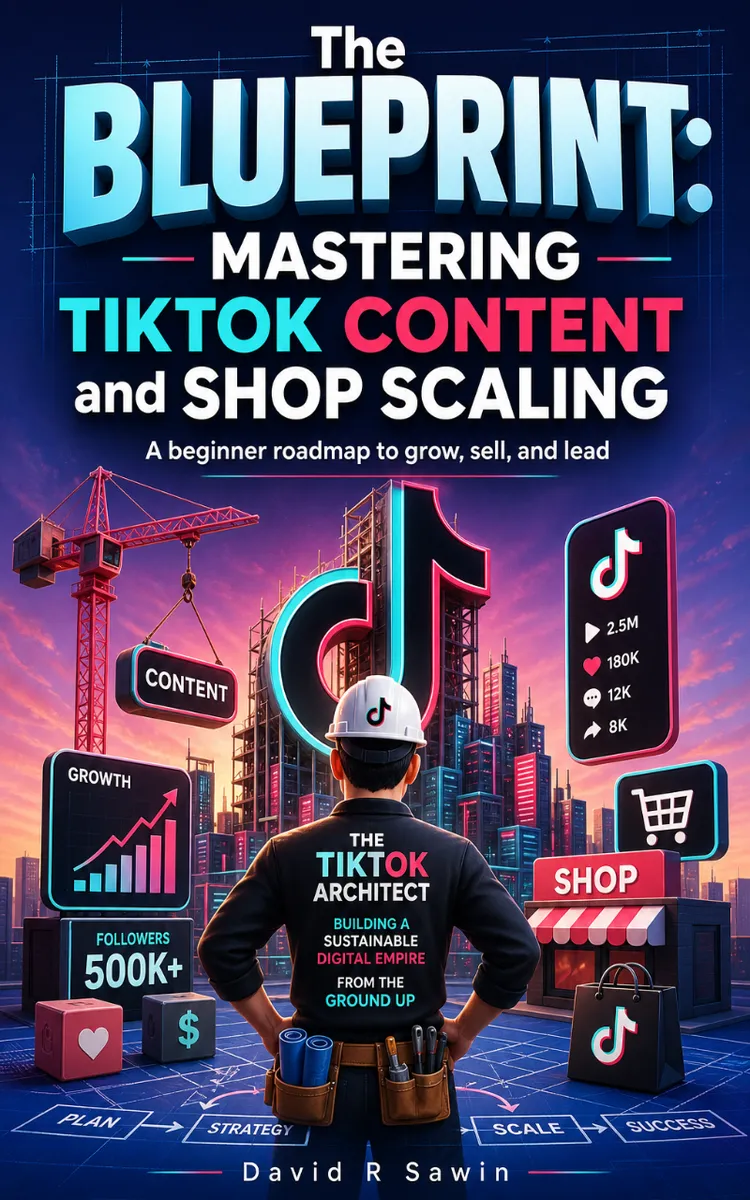

Read the first chapter
The whole of chapter one, free. About 8 min. Turn the pages with the arrows, your keyboard, or a swipe.
Chapter 1
TikTok Audience and Niche Match
Why This Matters (TikTok niche decides if people even stick around)
Have you ever posted something you thought was “good” and then watched your views flatline like your video got ghosted? On TikTok, that usually isn’t because you can’t make content. It’s because your audience match is off, and TikTok can’t figure out who should see you.
Your niche is the promise you make with every upload: what kind of value you deliver, for who, and in what style. When the promise is clear, viewers know what they’re getting before they even hit play, and they’re way more likely to watch to the end, follow, and come back. That matters because TikTok doesn’t just reward raw views; it rewards satisfaction signals like rewatching, shares, saves, and follows, which eventually feed your growth and monetization options (including Live, recorded content, and TikTok Shop).
The business goal is simple: pick a niche you can sustain, then build content angles that match TikTok culture so your content keeps getting served to the right people. If you don’t, you’ll bounce between topics, confuse viewers, and burn hours creating while your metrics politely tell you nobody cares.
Key Stats
• TikTok users spend a big chunk of their time on short-form video, which makes fast audience matching critical (the first seconds matter).
• A lot of TikTok growth comes from recommendation feeds, so your niche signals help TikTok place you in the right “viewer buckets.”
• Monetization ramps faster when you have consistent audience demand (people who already follow are more likely to buy via TikTok Shop and show up for Live).
• Creators with clear content themes typically get higher follow-through because viewers know what to expect next.
The Niche-to-For-You Compass: pick a niche that TikTok can actually sort
Nia, 22, works retail part-time and wants to turn her phone into a side hustle. Her first idea was to post “everything she likes”: outfit clips, random product hauls, gym days, and memes. Views were inconsistent, and some videos did okay while others barely moved. The problem wasn’t effort. It was that her audience didn’t have a single lane to remember her by.
Here’s how you stop that: use The Niche-to-For-You Compass. It’s not a fancy tool; it’s a way to connect three things so your content feels targeted even when you’re making it fast on your phone.
Step 1: Choose a niche you can repeat without losing your mind
A niche is not “beauty” or “fashion.” Those are categories. A niche is closer to a specific promise, like “easy outfits under $30 for work shifts” or “beginner-friendly skincare for oily skin in hot weather.” You don’t need to be the best at everything. You need to be the go-to person for one repeatable kind of result.
For Nia, the pivot was: instead of “outfits,” she narrowed to “budget outfit ideas for retail workers with limited time”. That’s specific enough to attract a consistent viewer, and it’s repeatable because her life produces content naturally.
Step 2: Define your target viewer like you’re describing a real person
Your target viewer is who your video is for when you’re not sure if it will work. Think in plain language: what do they want, what do they struggle with, and what do they recognize in your vibe?
Nia’s target viewer became: retail workers or shift workers who want to look put-together quickly but don’t want to spend hours shopping or planning outfits.
When you define it this way, you automatically start writing better captions and filming better hooks, because you’re aiming at a known person instead of “everyone.”
Step 3: Pick content angles that fit TikTok culture (not your mood)
A content angle is the “angle of attack” for one niche. It’s how you package the same topic repeatedly in ways TikTok users actually engage with.
On TikTok, angles that fit culture usually do one of these:
• They deliver a quick result (before/after, “do this, get that”)
• They teach something in a short, repeatable way (steps, formulas, checklists)
• They add social proof (real try-on, real time, real receipts)
• They create community through common experiences (shift-friendly, budget-friendly, beginner-friendly)
Nia didn’t change her niche every week. She changed her angles within that niche: quick outfit formulas, “what I’d wear to work” try-ons, and “how to look expensive on a budget” breakdowns.
Niche signals that become views: content angles + a realistic cadence
Once your niche and viewer are clear, you need angles and a cadence that don’t break your life. TikTok rewards consistency, but not boring repetition. You’ll get traction faster when you run multiple angles in rotation so different viewers find different reasons to stay.
Approach 1: The “Result First” angle (fast hook, fast payoff)
This is where you show the outcome immediately, then explain how you got there. It fits TikTok because people decide quickly if they’re staying.
Concrete template:
Caption formula: “I wore this to my shift and got asked where it’s from. Here’s the exact pieces + how to style it.”
Video structure: 0-2 seconds: full outfit reveal. 2-8 seconds: close-ups and prices/dupes. 8-20 seconds: 2 quick styling swaps.
Rationale: if your niche is “budget outfits for retail workers,” the viewer’s brain wants quick confirmation that you can deliver. The result-first angle answers that immediately.
Approach 2: The “Problem-Solution for your viewer” angle (relatable pain)
This angle starts with a problem your target viewer already complains about. Then you fix it in one short video.
Example problem prompts that work for Nia’s niche:
• “When you have 10 minutes before your shift but still want to look put together.”
• “What to wear when everything feels too tight or too boring.”
Rationale: TikTok loves content that makes viewers feel seen. When your viewer recognizes themselves in the first sentence, they stop scrolling to see if you have the answer.
Approach 3: The “Try-On + Receipts” angle (real evidence beats opinions)
Instead of talking about outfits, you show them working in real time: mirror try-on, bathroom lighting, walking around, even pointing out what’s comfortable for long shifts.
Campaign idea (3-video mini-run):
• Video 1: “Shift outfit under $40 that doesn’t feel cheap”
• Video 2: “Same vibe, different weather (layering in 20 seconds)”
• Video 3: “Would I wear this again? Yes/No and why”
Rationale: receipts create trust, and trust is what turns viewers into followers and followers into customers later (especially if you use TikTok Shop affiliate links).
Approach 4: The “Series” angle (repeatable format = easier growth)
A series is one content template you repeat weekly. Your viewers learn what to expect, and TikTok gets consistent signals about your niche.
For Nia:
Series name idea: “Shift in 30”
Every week: 3 outfits that take 30 minutes or less to put together.
Rationale: series reduce decision fatigue. You still make fresh content, but your brain already knows the structure.
Approach 5: The “Layered Education” angle (teach without sounding like school)
You keep it simple: one micro-lesson per video. For outfit niches, that could be “how to build a capsule,” “how to match shoes,” or “how to pick a flattering neckline.”
Rationale: TikTok education that’s short and practical earns saves and shares, which are strong follow-through signals.
Content Calendar Sample (to test niche + angles without guessing forever)
Day
Content Type
Topic/Hook
Format
Mon
Result First
“Outfit reveal for a 10-minute shift”
Try-on + quick styling swaps
Wed
Problem-Solution
“What to wear when you hate shopping”
Talking head + 3 outfit options
Fri
Try-On + Receipts
“Under $40 outfit that feels good all shift”
Mirror try-on + comfort notes
Sun
Series Episode
“Shift in 30: 3 looks from the same basics”
Split-screen or fast cuts
Run this kind of cadence for at least 2 weeks before you judge. You’re not just posting. You’re testing which angle gets the strongest satisfaction signals from your target viewer.
Metrics and Measurement that prove your niche match (so you’re not guessing)
Sequencing matters here: you measure early, adjust fast, then let the next batch run long enough to confirm. If you change everything after one video, you’ll never learn what actually works.
Use metrics that tell you whether the right people are seeing you and sticking. TikTok gives you lots of numbers, but only some of them tell you niche truth.
Metric
What It Measures
Target Benchmark
Tool to Track
Average Watch Time
How long people actually stay
Closer to your video length than your past posts
TikTok Analytics
Completion Rate (watch-to-end)
Whether viewers finish
Improving week over week; aim for meaningful end-watches
TikTok Analytics
Profile Visits per 1,000 views
If viewers want more of you
Consistent upward trend
TikTok Analytics
Follows per 1,000 views
If your content earns the next step
Higher on your strongest niche posts
TikTok Analytics
The single most important number is Average Watch Time (and the related completion rate). If your niche is wrong, people bounce fast, even if your topic sounds interesting to you. If your niche match is right, your watch time climbs because the right viewer is actually interested.
Common measurement mistakes are super easy to make: comparing a brand-new video to an old one with a different length, changing your niche weekly while still expecting the same metrics to “work,” and ignoring profile visits. A video can get views and still fail your niche match if it doesn’t convince people to follow or watch another video from you.
Your first test plan: niche match checklist you can run this week
You don’t need a perfect niche on day one. You need a fast test that tells you if TikTok is placing you in the right viewer bucket.
This Week:
• [ ] Pick 1 niche promise (one sentence) and film 4 videos using 2 different angles (Result First + Try-On + Receipts). Track watch time for each.
• [ ] Use TikTok Analytics to compare Average Watch Time and completion rate across the 4 posts; note which angle your target viewer stuck around for.
This Month:
• [ ] Turn the winning angle into a mini-series (3 episodes) and keep the niche promise the same. Track profile visits per 1,000 views.
• [ ] If you use TikTok Shop affiliate products later, keep them inside the content format that already wins watch time (do not “sprinkle” products into random topics).
Ongoing:
• [ ] Keep a simple rotation: one result video, one problem video, one receipts video, one series episode each week. Track whether follows per 1,000 views rise with the same angles.
• [ ] Save your top 10-performing hooks (first 2 seconds) and reuse the structure, not the exact words.
For immediate results, post 4 videos in a tight niche promise and let Average Watch Time tell you what to double down on next.
When your niche promise is clear and your angles fit TikTok culture, your content stops feeling like a lottery ticket and starts feeling like a system you can repeat. And that is how you build something monetizable, not just something that gets likes.
End of chapter one. 11 more chapters and about 16,181 words in the full book.
Swipe or use the arrows to turn the page


What's inside: 12 chapters
- 1. TikTok Audience and Niche Match
- 2. Content Calendar and Batch Creation
- 3. Recorded Posts: Hooks to Retention
- 4. TikTok Lives and Creator Trust
- 5. TikTok Shop Affiliates and Scaling
- 6. The #1 mistake creators make decoding the FYP — and what it costs you
- 7. The Sustainable Creator: Building Systems That Don’t Burn You Out
- 8. The Affiliate Engine: Crafting Scripts That Convert
- 9. The Sales Psychology of the Script: Influencing the Click
- 10. The Architect’s Aesthetic: Building a Brand Identity That Sticks
- 11. The Community Layer: Turning Viewers into Super-Fans
- 12. The Unlimited Creator: Scaling Beyond the Platform
About this book
"The Blueprint" is a social media book by David R Sawin with 12 chapters and approximately 16,181 words. Beginner guide to TikTok content, Live, Shop, and career growth.
This book was created using Inkfluence AI, an AI-powered book generation platform that helps authors write, design, and publish complete books. It was made with the AI Social Media Strategy Generator.
Frequently Asked Questions
What is "The Blueprint" about?
Beginner guide to TikTok content, Live, Shop, and career growth
How many chapters are in "The Blueprint"?
The book contains 12 chapters and approximately 16,181 words. Topics covered include TikTok Audience and Niche Match, Content Calendar and Batch Creation, Recorded Posts: Hooks to Retention, TikTok Lives and Creator Trust, and more.
Who wrote "The Blueprint"?
This book was written by David R Sawin and created using Inkfluence AI, an AI book generation platform that helps authors write, design, and publish books.
How can I create a similar social media book?
You can create your own social media book using Inkfluence AI. Describe your idea, choose your style, and the AI writes the full book for you. It's free to start.
Write your own social media book with AI
Describe your idea and Inkfluence writes the whole thing. Free to start.
Start writingCreated with Inkfluence AI


