
Read the first chapter
The whole of chapter one, free. About 8 min. Turn the pages with the arrows, your keyboard, or a swipe.
Chapter 1
The Slot Odds Nobody Sees
The Opening
A slot machine can be built to “feel” identical while quietly changing its payout odds by rewriting the rules under the glass. The paradox is that you’re watching the outcome, but the real action is happening earlier-inside the machine’s decision logic, where the game has already decided what kind of night it’s going to offer you. And because most players only see the spin, not the contract, the odds stay hidden in plain sight.
That’s what this chapter digs into: how payout odds are embedded in game rules-the parts you don’t read, because they’re scattered across configurations, pay tables, and regulatory wording that looks dull on purpose. We’ll treat the slot like a document: something you can learn to “read” even when it’s written to discourage you.
You’ll see why the machine’s math doesn’t live in the reels. It lives in how the game chooses results, how it pays you back, and what it’s allowed to do when your button gets pressed. If the outcome is decided before the reels “show” it, what, exactly, are you agreeing to every time you pull the lever?
The Deep Dive
The reels are the costume; the rules are the script
Look at a modern slot and you’ll notice how carefully the experience is staged. The reels spin with motion, symbols land with drama, and the payoff lands with a satisfying flash. But the symbols are presentation. The payoff odds are usually governed by the machine’s rule set: how it selects outcomes, how often it triggers special features, and what payout it assigns to a given spin.
That’s why two machines can share the same denomination, the same theme, even the same-looking bonus animation, yet behave differently in the long run. The audience sees the same performance. The machine runs a different script.
Historically, this divide got sharper as slots moved from mechanical to electromechanical and then to fully electronic systems. Early mechanical slots had fewer “knobs” to turn: the hardware could only do so much. As logic shifted into software-like control, designers gained the ability to shape outcomes with much finer detail-without changing how the machine looks while it’s doing it. The player’s eyes kept focusing on the reels, while the real designer work moved into internal decision rules.
Reading the pay table is only the first layer
The pay table looks like the obvious place to search for value: it shows which symbols pay, and it often spells out multipliers, wilds, scatters, and bonus triggers. But the pay table is only one page of the contract. It tells you what’s paid when a certain combination appears. It doesn’t always tell you how frequently that combination is selected under the hood.
In other words, the pay table can be like a menu that lists prices while hiding the cooking schedule. You can know how much a dish costs without knowing how often it will be available tonight. Casinos often rely on that gap-between what’s visible (what you receive) and what’s concealed (how likely you are to receive it in the first place).
Regulators require certain disclosures, but disclosures are not the same thing as transparency. A lot of the “hidden” odds live in areas that are permitted to be described indirectly: through the structure of the game, the configuration of features, and the way the machine’s internal logic maps button presses to outcomes. The result is that the odds are not missing; they’re just buried in the parts players don’t treat like a contract.
Why odds feel “random” even when the rules are doing the choosing
There’s a reason people say “it’s all random” and mean it. Most slot machines use random number generators (RNGs)-or, in older systems, mechanisms that approximate randomness through hardware behavior. With an RNG, the selection process is designed so that each spin is unpredictable to you. That’s different from saying it is unbiased in the long-term sense.
Unpredictable doesn’t mean fair. The machine can be engineered so that it returns a certain portion of wagers over time-often expressed as Return to Player (RTP). RTP is a long-run expectation, not a promise for your next 50 spins. And crucially, RTP is the product of the rule set: the frequency of triggers, the distribution of wins, the presence of caps, the weighting of certain outcomes, and the behavior of bonus rounds.
So when you see a “hot streak” or an “ice-cold run,” it’s not evidence that the machine is ignoring its rules. It’s evidence that the rules are working inside a system that’s actively designed to keep each moment from looking like the truth. The odds aren’t on the surface because the surface is built to keep your brain from spotting the contract.
The Hidden Odds Decoder: reading what the game is really promising
This is where the Hidden Odds Decoder framework comes in. The basic idea is simple: treat the machine’s visible elements as clues, then decode how those clues restrict the machine’s internal possibilities.
To do that, you look at three kinds of information that are usually scattered across what the machine shows and what it documents:
First, you use the pay table to learn what payouts exist and what triggers them. Second, you study the game structure-how bonus features start, what counts as a trigger, and how often the machine is allowed to “go there” based on its rules. Third, you focus on the constraints: things like maximum win behavior, symbol behavior (like whether wilds substitute only in certain contexts), and how the machine handles feature results.
Those constraints matter because they shape the distribution of outcomes. A distribution can be narrow or wide. It can be skewed toward many small wins or punctuated by rare larger ones. Either way, the payout odds are embedded in the rule mechanics that generate that distribution, not merely in the list of what’s possible.
And when you connect these clues, you start seeing something players miss: the machine doesn’t just pick a win. It picks a kind of win-often a category of outcome that’s designed to match a business goal like volatility and session length. The reels then display that choice in a way that feels alive.
A single example makes the point sharply. Suppose a slot has a bonus feature that pays dramatically more than the base game, but the trigger depends on a specific symbol appearing a certain way. Even without knowing the exact internal odds, you can infer that the frequency of that symbol’s qualifying pattern is a major driver of the machine’s long-run return. The “bonus trigger rule” is not a side detail; it’s one of the contract’s biggest clauses.
What You Did Not Expect
The surprising part is that the most important odds aren’t always the ones tied to the biggest payouts. They’re often tied to the small rules-the exact definition of what counts as a trigger, how wilds substitute, whether scatters pay only if they form a specific pattern, and whether a bonus can retrigger inside another feature.
This matters because players naturally chase the loud numbers: the maximum win, the advertised jackpot-style language, the impressive bonus animation. But those are often consequences of deeper mechanics. If the trigger rule is designed to be rarer than your instincts expect-or designed to be “available” in a way that favors certain session dynamics-then the machine’s odds are effectively being set in that quiet corner.
What changes is your mental map. Instead of treating a slot as “a stream of outcomes,” you start treating it as “a system of gates.” Each gate-trigger conditions, feature access, symbol behavior-controls what the machine is allowed to do next. The payout odds are hidden behind those gates, not behind the win amounts alone.
The Human Story
Rosa, 34, is a rideshare driver, which means she lives in short, repeating windows of downtime. Her evenings are stitched together from brief breaks: a quick stop for gas, a thirty-minute meal, a couple of spins at a nearby bar because the lights are bright and time feels thinner when there’s motion on the screen. She doesn’t come in hunting theory. She comes in hunting relief from the long day.
What she noticed wasn’t “bad luck.” It was rhythm. Some machines seemed to eat her money in a steady way that felt almost predictable-like the machine always found a reason not to pay during her limited session length. Other machines would take more up front and then suddenly offer something that looked like a gift. Rosa didn’t know what RTP was, and she didn’t need to. She knew what her wallet felt like after leaving.
When she finally compared notes, she stopped looking only at the biggest win and started looking at the fine print around the bonus. On one machine, the bonus triggered only if a certain pattern appeared in a specific position pattern, while on another, the trigger was looser and the feature could start from symbols that looked “almost the same” during play. The difference wasn’t in how exciting the bonus looked on the screen. It was in how the game decided whether the bonus was even allowed to begin.
That’s the human connection to the Hidden Odds Decoder. Rosa wasn’t decoding math from a spreadsheet. She was recognizing that the machine’s behavior comes from rule gates, and those gates show up in the way the bonus starts-not just in what the bonus pays. Once she saw that, the slot stopped feeling like a mystery ball and started feeling like a contract written to be read sideways.
What This Tells Us
Slot machines are built to be unpredictable to you in the moment, but predictable to the designer over time. That split-random-looking performance paired with rule-based constraints-isn’t a bug. It’s the whole point.
Human beings are drawn to the visible drama and forget the buried clauses. We watch the reels and ignore the contract language that governs them, then act surprised when the outcome matches the structure we never bothered to interpret. The deeper lesson isn’t just about slots-it’s about how often we mistake what we can see for what we’re actually agreeing to.
If payout odds can be hidden inside game rules, then what else in daily life is quietly controlled by gates we don’t know we’re passing through-until the bill arrives?
End of chapter one. 25 more chapters in the full book.
Swipe or use the arrows to turn the page
What's inside: 26 chapters
- 1. The Slot Odds Nobody Sees
- 2. Why “Advantage” Feels Like a Secret
- 3. The Reel Math Behind Big Wins
- 4. Session Engineering: Bankroll, Not Hope
- 5. Casinos Fear the Player Who Tracks
- 6. Two Floors, One Question: A Las Vegas Strip Bank and a Midwest Casino at Noon
- 7. What Most Players See: A Glance at "Left Value" and Move On
- 8. The deeper question hiding behind “Expand this section with more detail”
- 9. The Slot State That Pays: Naming Chapter 9
- 10. A purple diamond stuck at 71 with a must-hit-by of 75 catches more often than people realize.
- 11. The Moment the Ocean Paused: Two Ocean Magic Scenes Worth Noticing
- 12. What Everyone Believes About "Expand this section with more detail"
- 13. A counterintuitive payoff: why “left states” become +EV
- 14. Two Floors, One Question: A Las Vegas Strip Bank and a Midwest Casino at Noon
- 15. What Most Players See: A Flashy Meter and a Chance to Keep Walking
- 16. The real question these machines are circling: What counts as visible value?
- 17. The Multiplier Ledger: What Those Numbers Actually Mean
- 18. The Reset at Seven: what it is and where you see it
- 19. The Moment a Machine Whispers “Paid Forward”
- 20. The Slot State That Draws Advantage Players Like Bees to Honey
- 21. The Unexpected Pattern: A Machine That Almost Always Pays Before 1888
- 22. Two Floors, One Blue Diamond: A Strip Bank at Midnight and a Local at Noon
- 23. What Most Players Think About “Left Work” on a Slot
- 24. The deeper ledger hiding behind a buffalo stampede
- 25. The Visible Ledger That Pays
- 26. The Slot Odds Nobody Sees
About this book
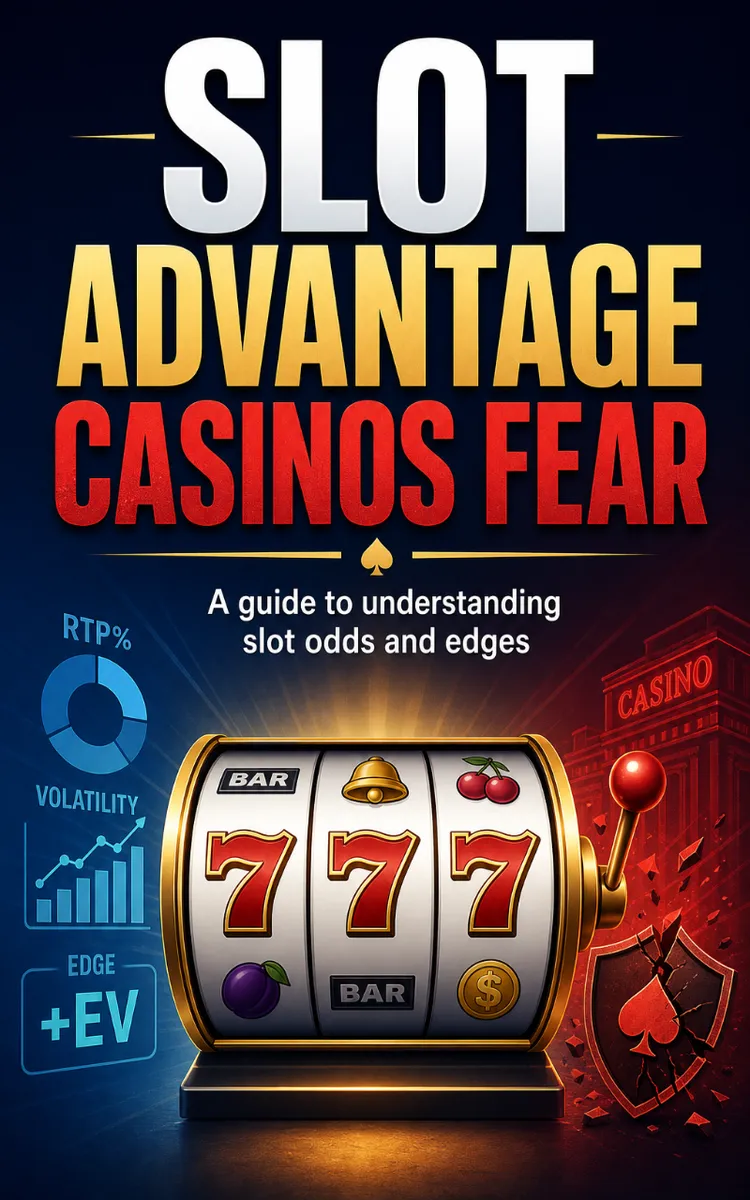
"Slot Advantage Casinos Fear" is a study guide book by Steven Meade with 26 chapters and approximately 28,657 words. Slot machine strategy and understanding odds.
This book was created using Inkfluence AI, an AI-powered book generation platform that helps authors write, design, and publish complete books. It was made with the Study Guide Generator.
Frequently Asked Questions
What is "Slot Advantage Casinos Fear" about?
Slot machine strategy and understanding odds
How many chapters are in "Slot Advantage Casinos Fear"?
The book contains 26 chapters and approximately 28,657 words. Topics covered include The Slot Odds Nobody Sees, Why “Advantage” Feels Like a Secret, The Reel Math Behind Big Wins, Session Engineering: Bankroll, Not Hope, and more.
Who wrote "Slot Advantage Casinos Fear"?
This book was written by Steven Meade and created using Inkfluence AI, an AI book generation platform that helps authors write, design, and publish books.
How can I create a similar study guide book?
You can create your own study guide book using Inkfluence AI. Describe your idea, choose your style, and the AI writes the full book for you. It's free to start.
Write your own study guide book with AI
Describe your idea and Inkfluence writes the whole thing. Free to start.
Start writingCreated with Inkfluence AI


