
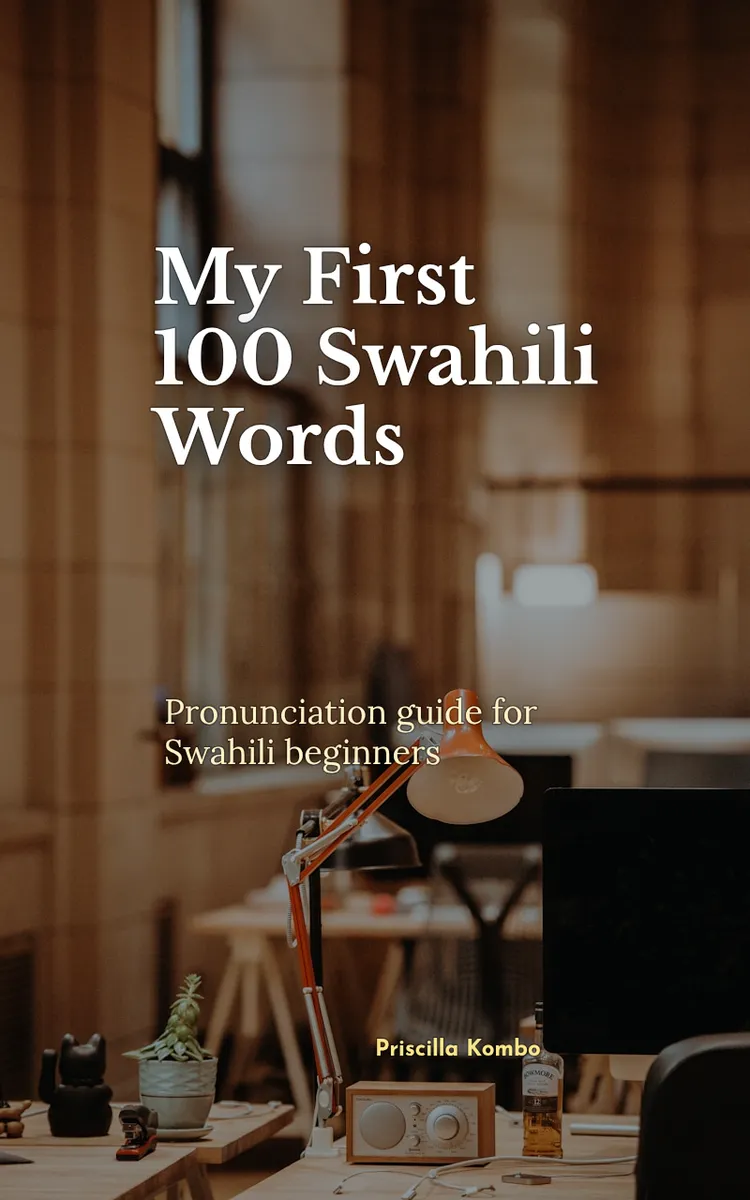
My First 100 Swahili Words
Created with Inkfluence AI
First 100 Swahili vocabulary words with pronunciation
Table of Contents
- 1. Swahili Words #1-20: Understanding the Fundamentals of My First 100 Swahili Words
- 2. Swahili Words #21-40: Getting Started with My First 100 Swahili Words
- 3. Swahili Words #41-60: Essential Skills for My First 100 Swahili Words
- 4. Swahili Words #61-80: Building Your My First 100 Swahili Words Practice
- 5. Swahili Words #81-100: Overcoming Common My First 100 Swahili Words Challenges
Preview: Swahili Words #1-20: Understanding the Fundamentals of My First 100 Swahili Words
A short excerpt from “Swahili Words #1-20: Understanding the Fundamentals of My First 100 Swahili Words”. The full book contains 5 chapters and 7,565 words.
Overview
If you can say “Hello” and “Thank you” clearly, doors open fast - on the street, at a shop, or when someone asks you a simple question. Chapter 1 gives you Swahili words #1-20 for greetings and everyday courtesy, with spelling and a simple phonetic guide so you can speak from day one.
You’ll learn the most useful forms for first conversations (like morning/afternoon greetings, polite words, and quick responses) and the small pronunciation details that usually cause beginner mistakes. At the end of this chapter, you’ll know exactly which words to practice first for your next real interaction.
The Breakdown
> Quick pronunciation check before you start: Swahili letters are usually pronounced like they look. Focus on clean syllables and short, clear vowel sounds.
| Letter/Pattern | Simple Tip | Example |
|---|---|---|
| a | “a” like father | asante (a-SAN-te) |
| e | “e” like bed | habari (ha-BAR-ee) |
| i | “i” like sit | nzuri (n-Zoo-ree) |
| o | “o” like more | pole (POH-leh) |
| u | “oo” like food | sawa (SAH-wah) |
#1: Jambo
Problem: Many beginners say “jambo” like English “jam-bo,” and it sounds unclear. If your greeting sounds confusing, people may pause for a second and then switch to slower speech. You lose that first, confident moment.
Solution: Say ja (like “ya” but with less “y”) + mbo (like “m-boh”). Practice it 5 times: ja-MBO. Use it as a simple greeting when you meet someone casually.
Result: You’ll sound natural and friendly right away.
#2: Habari
Problem: “Habari” is common, but beginners forget it’s often part of a question. If you say it alone, people might wait for the full phrase. You may also stress the wrong syllable and make it hard to understand.
Solution: Learn the full question: Habari? (ha-BAH-ree). Then use the common reply pattern: Nzuri (n-Zoo-ree) or Sijambo (see-jaM-boh). Try: ask Habari?, then pause and let the other person answer.
Result: You can start a real conversation with one short question.
#3: Nzuri
Problem: Beginners sometimes pronounce it like “n-zoo-ree” but with a long “oo,” which can feel too stretched. Also, they use it when they should answer “good” to a greeting. That mix-up can confuse the flow of the conversation.
Solution: Say n-Zoo-ree (short, clear). Use it as an answer to Habari:
- Habari? → Nzuri.
If you want to be more complete, add asante (#11) after.
Result: People will understand you mean “I’m good.”
#4: Sijambo
Problem: Some learners use Jambo instead of Sijambo and accidentally say the wrong meaning. Sijambo is often used when you want to say “I’m not okay / not well,” so mixing it up can cause awkwardness.
Solution: Say si-jaM-boh (see-jaM-boh). Use it carefully as a response when you truly want to say you’re not well. If someone asks Habari?, you can answer: Sijambo.
Result: You communicate clearly when you need to say you’re not doing well.
#5: Asubuhi njema
Problem: Beginners try to shorten it too much and end up with unclear words. Saying only “asubuhi” can sound incomplete in greetings. In morning situations, people expect a full polite phrase.
Solution: Say: a-su-Boo-hee (asubuhi) + n-jeh-mah (njema). Practice slowly: a-su-Boo-hee n-jeh-mah. Use it in the morning when you see someone.
Result: You sound respectful and natural in morning greetings.
#6: Mchana mwema
Problem: Learners often confuse mchana (afternoon) with asubuhi (morning). If you greet with the wrong time word, it can feel off even if the person understands you.
Solution: Pronounce m-cha-na (m-CHAH-na) + m-weh-mah (mwema). Use it around midday and early afternoon: Mchana mwema!
Result: Your greeting matches the time of day correctly.
#7: Jioni njema
Problem: “Jioni” (evening) is often mispronounced as “jo-nee” with extra English stress. Also, beginners may use evening greetings too early in the day. That timing mismatch can make your words feel wrong.
Solution: Say ji-o-nee (jee-o-nee) + n-jeh-mah. Use it in the evening: Jioni njema!
Result: You’ll greet people at the right time with correct Swahili.
#8: Habari za leo
Problem: Beginners ask Habari but forget the “today” part. Without leo, your question can feel too general. People may answer broadly instead of focusing on the day.
Solution: Say ha-BAH-ree za LEH-oh. Use it like: Habari za leo? (How are things today?) Then listen and respond with Nzuri (#3) or Sijambo (#4).
Result: You guide the conversation toward “today.”
#9: Tafadhali
Problem: If you skip politeness, requests can sound harsh - especially to people you meet the first time. Beginners also confuse it with “thanks,” and then their request becomes the wrong tone....
About this book
"My First 100 Swahili Words" is a list book book by Priscilla Kombo with 5 chapters and approximately 7,565 words. First 100 Swahili vocabulary words with pronunciation.
This book was created using Inkfluence AI, an AI-powered book generation platform that helps authors write, design, and publish complete books.
Frequently Asked Questions
What is "My First 100 Swahili Words" about?
First 100 Swahili vocabulary words with pronunciation
How many chapters are in "My First 100 Swahili Words"?
The book contains 5 chapters and approximately 7,565 words. Topics covered include Swahili Words #1-20: Understanding the Fundamentals of My First 100 Swahili Words, Swahili Words #21-40: Getting Started with My First 100 Swahili Words, Swahili Words #41-60: Essential Skills for My First 100 Swahili Words, Swahili Words #61-80: Building Your My First 100 Swahili Words Practice, and more.
Who wrote "My First 100 Swahili Words"?
This book was written by Priscilla Kombo and created using Inkfluence AI, an AI book generation platform that helps authors write, design, and publish books.
Write your own list book book with AI
Describe your idea and Inkfluence writes the whole thing. Free to start.
Start writingCreated with Inkfluence AI


