
Read the first chapter
The whole of chapter one, free. About 8 min. Turn the pages with the arrows, your keyboard, or a swipe.
Chapter 1
Reclaiming Control Through Identity
When Your Day Starts in React Mode, Not Choice Mode
Tanya, 34, customer success manager, didn’t even notice the moment her day got hijacked. It was small at first: the first angry email hit her inbox, she felt her chest tighten, and before she’d finished reading it she’d already drafted a reply. Not because she was sure - because she wanted the discomfort to stop.
By lunch, she’d spent hours “handling” instead of leading. She was chasing the loudest messages, answering before she understood, and promising fixes she couldn’t actually deliver on time. When her manager asked for an update on a key account, Tanya had one ready - because she’d been busy. Busy isn’t the same as in control, though. And the worst part? She could feel herself getting pulled into the same pattern again tomorrow.
If you keep reacting like that, how do you ever become the person who chooses?
Rebuilding Agency: Shifting “I React” Into “I Choose” Through Identity
That’s the tension this chapter is about: you don’t regain control by trying harder. You regain control by becoming the kind of person who chooses - especially when you want to react.
Tanya didn’t need more willpower. She needed a different identity in the moment. Not “I’m a customer success manager who handles things.” More like: “I’m the kind of person who chooses my response, even when I feel pressure.” That shift changed how she moved through her day. When she started responding from identity instead of emotion, she stopped letting other people’s urgency write her script.
Here’s the core contrast.
Old Belief: “My feelings and other people’s pressure decide what I do. I just react.” New Reality: “My identity decides what I choose. My feelings can show up, and I still choose.”
Why does this matter so much? Because reaction isn’t just a behavior - it’s a belief about who’s in charge. When you believe you “can’t help it,” you hand over the steering wheel to whatever emotion is loudest. You end up feeling busy, exhausted, and weirdly powerless, even when you’re doing everything “right.”
When Tanya started treating choice as part of who she was, her day changed in practical ways. The next time a customer fired off a frustrated message, she didn’t immediately draft a reply. She paused long enough to name what was happening internally: This is anger trying to protect me. Then she chose a response structure: acknowledge, clarify, and propose a next step. Same customer. Same job. Different identity. Her replies got calmer, more accurate, and - this is the part that surprised her - more effective. People don’t just want quick answers; they want to feel seen and understood. When you choose instead of react, you actually deliver that.
And there’s another layer: identity is sticky. If you tell yourself “I’m the type of person who reacts,” you’ll keep finding evidence to prove it. Tanya noticed that her “react” identity wasn’t only about anger. It was also about fear - fear of being blamed, fear of falling behind, fear of not being enough. The moment she reframed her identity around agency, she didn’t have to pretend she wasn’t afraid. She just stopped letting fear run the show.
The Identity-to-Action Loop: Why “I Choose” Feels Different
Most people think the problem is their actions. If only they could stop snapping, stop procrastinating, stop overexplaining, stop saying yes when they mean no… then they’d feel in control.
But control doesn’t start in your calendar. It starts in your identity - the quiet sentence your brain uses to explain what’s happening.
Here’s the Identity-to-Action Loop in plain language:
When a situation hits, your brain asks, “Who am I in this moment?” If your identity is “I react,” your body moves first and your choices come later (if they come at all). If your identity is “I choose,” you still feel the pull - but you create a small gap before action. That gap is where control lives.
That gap might be tiny. Tanya’s “pause” was often 20-40 seconds. Not a meditation retreat. Just enough time to stop her fingers from racing ahead of her understanding. That’s the point: you don’t need a dramatic transformation. You need a repeatable moment of choice.
Signs this “react” identity is running your life
1. You feel surprised by your own behavior. After you respond, you think, “Why did I say it like that?” 2. You treat discomfort as an emergency. The moment you feel stress, you rush to fix it instead of figuring out what it’s pointing to. 3. You default to speed over accuracy. You’d rather be first than be right - especially when you’re worried you’ll be judged. 4. You keep repeating the same conflict pattern. Different people, same outcome: tension escalates, and you end up spending energy putting out fires.
The moment you name “I choose,” you stop letting the loudest emotion author your next move.
Where Your Choice Actually Lives (and How to Notice It)
Let’s get practical about what “choice” really means, because it can sound fluffy if you don’t anchor it.
Choice isn’t always “do the perfect thing.” Sometimes it’s simply choosing the next right move. Like Tanya choosing not to hit send on an angry draft. Or choosing to ask one clarifying question before promising anything. Those are choices. They’re identity showing up as behavior.
In real life, the “I react” identity often shows up as automatic language: - “I have to respond right now.” - “They’re upset, so I’m responsible.” - “If I don’t fix it, I’ll look bad.” - “I can’t afford to slow down.”
When those sentences run your day, your identity is basically telling you, You’re here to manage other people’s emotions. That’s not control - that’s service without boundaries.
“I choose” flips the script. It doesn’t deny responsibility. It redirects it. You’re responsible for what you do next, not for controlling the other person’s feelings.
Here’s a concrete example from Tanya’s week. A customer complained that a feature wasn’t working. Her first urge was to defend the product and over-explain. Her choice-identity said, I choose what I do with this moment. So she replied with: - one sentence acknowledging the frustration, - one question to pinpoint what “not working” meant, - and a clear plan for the next step.
She still cared. She just stopped trying to win the emotional battle. That’s agency: you’re not stuck in the role your stress hands you.
Reflection Questions That Expose Your “React” Script
Answer these honestly - no judging, no rewriting history. The goal is to notice the pattern so you can interrupt it.
1. When do you react the fastest - email, meetings, in-person conversations, or when you feel criticized? Your answer probably points to a specific trigger. Once you know the trigger, you can build a choice habit right there.
2. What story does your brain tell right before you act? (Examples: “I’ll get blamed,” “I have to fix this,” “I’m not safe,” “I’ll fall behind.”) Try to capture the exact wording you’d use if you were talking to a friend. That sentence is the identity in disguise.
3. What do you fear would happen if you paused for 30 seconds before responding? Often the fear is irrational but understandable. Naming it reduces its grip. Tanya realized her fear wasn’t “the customer will be mad” - it was “I’ll be seen as incompetent.”
4. Where do you confuse “being responsible” with “being in control”? If you’re trying to control outcomes you can’t control (someone else’s mood, someone else’s timeline), you’ll feel powerless. Identify one place you’re carrying too much.
5. If your identity was “I choose,” what would you do differently in your very next uncomfortable moment? Don’t make it poetic. Make it specific: one sentence you’d say, one action you’d delay, one boundary you’d hold.
The Identity-to-Action Loop Challenge (Start Today)
You’re going to train the “gap” - the space between pressure and action - so choice becomes familiar, not forced.
Challenge Title: The 30-Second Choice Gap (7 Days)
• For the next 7 days, pick one moment per day where you usually react (a message, a meeting comment, a stressful phone call, a sudden request). - Before you respond or act, do this exact sequence: - Breathe once (just one slow inhale and exhale). - Name the identity in your head: “I choose.” - Complete one clarifying step before you commit. Examples: - ask one question, - delay sending for 10 minutes, - write the reply but don’t send yet, - outline the next step before you promise anything. - Keep it small. The win is the interruption, not the perfect outcome.
Expected difficulty rating: Medium (because you’ll feel the urge to skip the pause)
You’ll know it’s working when… - You feel the reaction wave start, and you catch it earlier than before. - You make fewer “oops” responses - especially ones you regret. - Even when the outcome isn’t ideal, you feel steadier because you controlled your next move. - You stop describing yourself as “the kind of person who reacts” and start noticing yourself as “the kind of person who chooses.”
Your Next Level of Control Is an Identity You Can Use
Here’s what Tanya learned after a few cycles of the Choice Gap: control didn’t arrive as confidence first. It arrived as evidence. Each time she chose instead of reacted, her brain got new proof that she wasn’t helpless. That proof turned into identity, and identity turned into behavior.
If you want real control, don’t wait to feel ready. Build the person you want to be by practicing the moment you usually lose.
The fastest way to regain control is to stop outsourcing your next action to your emotions.
• You don’t just change behaviors - you rebuild the identity behind them. - “I choose” creates a gap where agency can show up, even when you feel pressure. - Reaction usually comes from a hidden story about blame, safety, or responsibility. - A small, repeatable pause beats big promises every time.
And next, we’ll take that identity shift and give it structure - so “I choose” doesn’t vanish the moment life gets loud.
End of chapter one. 7 more chapters in the full book.
Swipe or use the arrows to turn the page


What's inside: 8 chapters
- 1. Reclaiming Control Through Identity
- 2. Breaking the Belief Chain of Fear
- 3. Designing Boundaries Without Losing Love
- 4. Choosing Habits That Match Your Values
- 5. Stopping Procrastination With the 10-Minute Override
- 6. Communicating Needs With the Direct-Soft Method
- 7. Building Resilience After Setbacks
- 8. Living With Purpose Using the North Star Plan
About this book
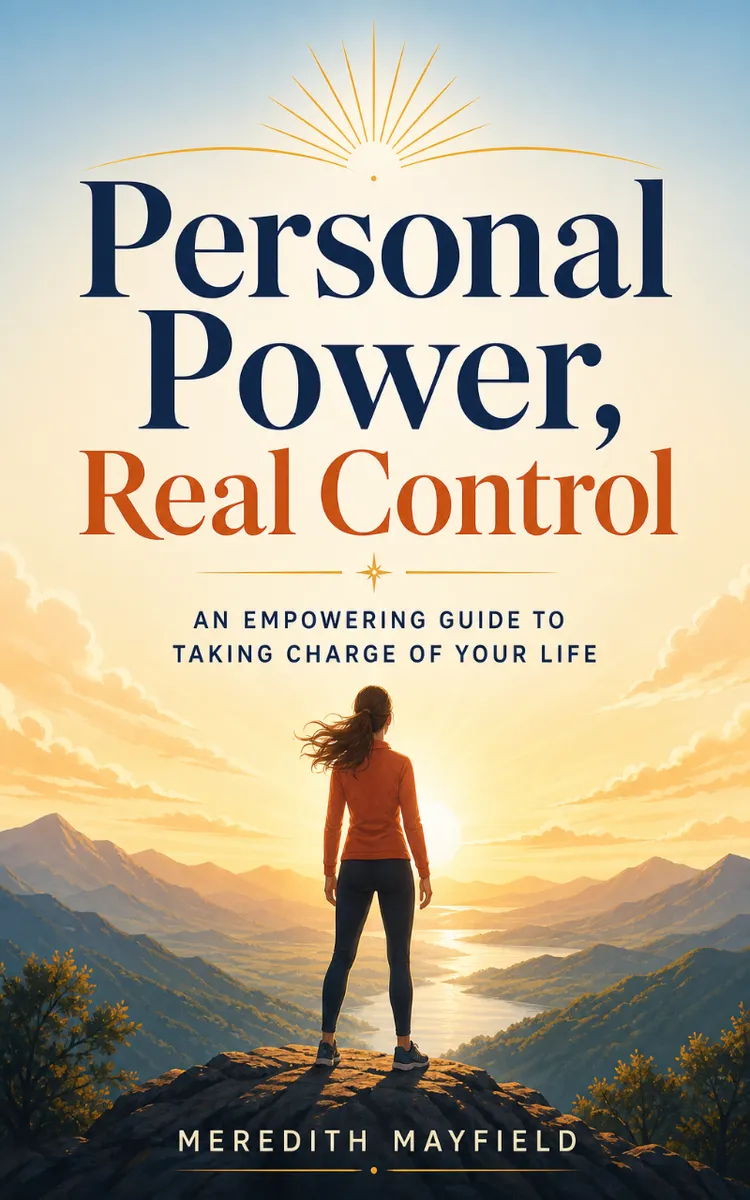
"Personal Power, Real Control" is a self-help book by Meredith Mayfield with 8 chapters and approximately 12,956 words. Self-empowerment strategies for gaining control and personal agency.
This book was created using Inkfluence AI, an AI-powered book generation platform that helps authors write, design, and publish complete books. It was made with the AI Self-Help Book Writer.
Frequently Asked Questions
What is "Personal Power, Real Control" about?
Self-empowerment strategies for gaining control and personal agency
How many chapters are in "Personal Power, Real Control"?
The book contains 8 chapters and approximately 12,956 words. Topics covered include Reclaiming Control Through Identity, Breaking the Belief Chain of Fear, Designing Boundaries Without Losing Love, Choosing Habits That Match Your Values, and more.
Who wrote "Personal Power, Real Control"?
This book was written by Meredith Mayfield and created using Inkfluence AI, an AI book generation platform that helps authors write, design, and publish books.
How can I create a similar self-help book?
You can create your own self-help book using Inkfluence AI. Describe your idea, choose your style, and the AI writes the full book for you. It's free to start.
Write your own self-help book with AI
Describe your idea and Inkfluence writes the whole thing. Free to start.
Start writingCreated with Inkfluence AI


