
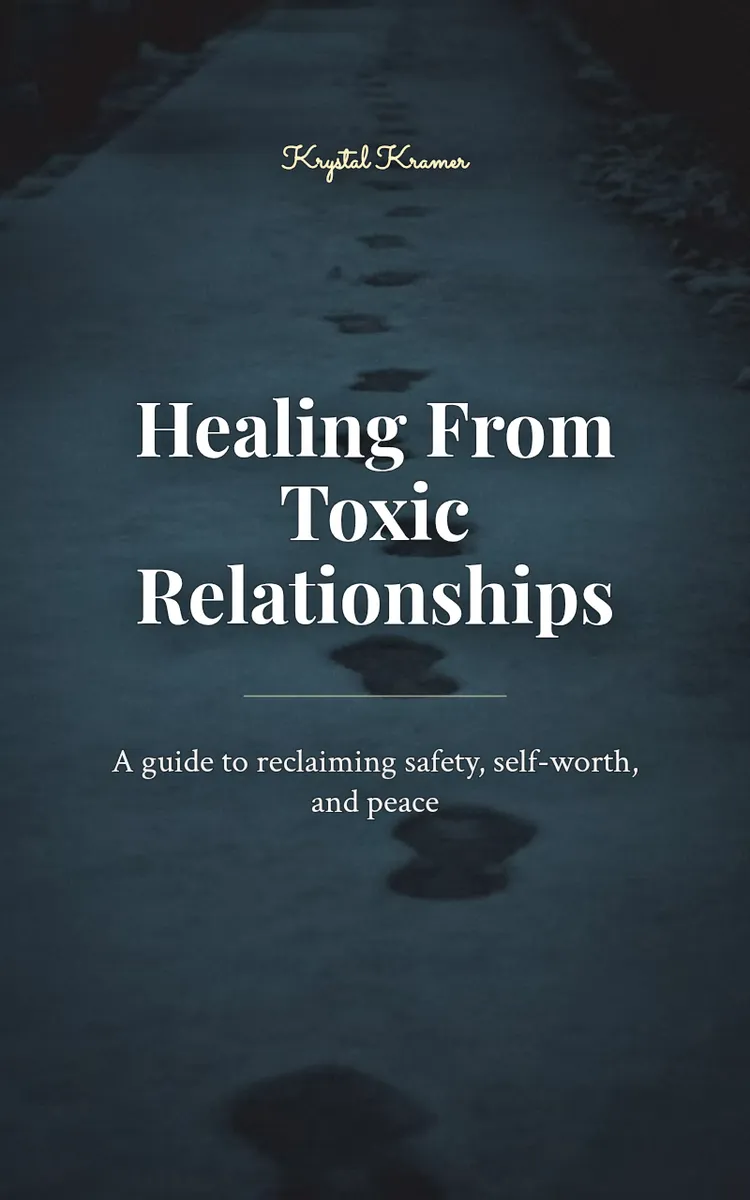
Healing From Toxic Relationships
Created with Inkfluence AI
Self-help guidance for people in toxic relationships
Table of Contents
- 1. Rewriting the Love-Lock Beliefs
- 2. Building Boundaries Without Guilt
- 3. Detaching From Intermittent Reinforcement
- 4. Repairing Your Self-Worth After Gaslighting
- 5. Creating a Purpose-Driven Healing Plan
Preview: Rewriting the Love-Lock Beliefs
A short excerpt from “Rewriting the Love-Lock Beliefs”. The full book contains 5 chapters and 8,374 words.
Replaying the Love-Lock: When Your Brain Still Thinks You Deserve the Lock
You know the moment. It’s not when things are at their worst - it’s after. After the apology that sounds sincere for ten minutes. After the “I didn’t mean it like that.” After you’ve wiped the tears, fixed your face, and told yourself, Maybe I’m overreacting.
Then your chest does that familiar drop when your partner gets quiet again. Not because you’re “dramatic.” Because some part of you is still waiting for the other shoe to fall… and also still believing that if you just love harder, you can keep the relationship from slipping away.
Talia, 32, a nurse manager, told me she could write down exactly what was happening in her head - yet she still stayed. “I know he’s not good to me,” she said, “but my brain keeps trying to earn love like it’s a shift I can pick up.” She’d look at her life and think she was choosing it. But when she slowed down, she realized she was obeying something older than the current fight. Something like a trained belief - what this book calls a Love-Lock Belief - that keeps you stuck in the same cycle even when you want out.
What if the hardest part of leaving isn’t the leaving - it’s the beliefs that keep you “staying right on time”?
---
The Love-Lock Beliefs That Keep You Staying (Even When You Want to Go)
Here’s the contrast that matters most: not your feelings, not your hope, not even your attachment - your beliefs. Those are the rules your brain uses to decide what love is “supposed” to look like.
Old Belief: If someone loves me, I can work hard enough to make them consistent.
New Reality: Love doesn’t require earning; it requires safety, respect, and follow-through.
With toxic love, you get trained to confuse effort with devotion and confusion with “maybe they’ll change.” You start measuring love by how much you can endure, how quickly you can repair, and how well you can read between the lines. So even when your body is begging you to stop, your mind scrambles for the “right” explanation that keeps the hope alive. Hope feels like relief. Leaving feels like betrayal of the version of them you keep trying to resurrect.
Talia described it in a way that hit hard: she’d go from work - where people actually had standards - to home, where she was expected to lower hers. When he’d say, “You’re so sensitive,” she would immediately try to become less sensitive, as if her nervous system was the problem. She’d think: If I just stay calm, be grateful, don’t bring it up… maybe he’ll finally treat me right.
But the reality wasn’t that she needed to be calmer. It was that she was being trained to accept inconsistency as normal. The “earning” belief made her feel responsible for his behavior. The “safety and respect” truth made her realize responsibility is not the same as control - and control isn’t love.
When you swap the belief, your decisions start feeling different. Not dramatic. Not impulsive. Just… clearer. Like your brain stops arguing with your body and starts listening to what’s actually happening.
---
The Love-Lock Rewrite: How Toxic Love Trains Your Mind (and How to Spot It)
The Love-Lock Belief Rewrite works because it targets the rule underneath the pattern. Toxic relationships don’t only hurt you in the moment. They teach your mind what to expect, what to tolerate, and what to call “normal.” That’s why you can be smart, self-aware, and exhausted - and still find yourself negotiating away your own needs.
A Love-Lock Belief usually forms from repetition: the same apology, the same cycle, the same “I didn’t mean it,” the same sudden sweetness after you’ve swallowed your anger. Over time, your brain learns a shortcut: If I do this, I can prevent the worst outcome. That shortcut feels protective. It also keeps you trapped.
Here’s what that looks like in real life. If you believe love is something you earn, you’ll interpret boundaries as insults. If you believe inconsistency is temporary, you’ll call your discomfort “overthinking.” If you believe you’re responsible for their mood, you’ll feel guilty for every time you ask for basic respect.
Signs this pattern is running your life
1. You keep trying to “solve” their behavior instead of naming it. You’ll analyze, adjust, smooth things over - anything to avoid the confrontation that might make them fully show you who they are.
2. You feel responsible for their emotions more than your own. You don’t just notice their anger; you feel like it’s your job to manage it.
3. You treat apologies like proof instead of behavior like proof. One good day convinces you the whole problem was a misunderstanding.
4. Your standards shrink quietly. You used to want consistency, kindness, and clarity. Now you’re okay with confusion - as long as you get occasional warmth.
...
About this book
"Healing From Toxic Relationships" is a self-help book by Krystal Kramer with 5 chapters and approximately 8,374 words. Self-help guidance for people in toxic relationships.
This book was created using Inkfluence AI, an AI-powered book generation platform that helps authors write, design, and publish complete books. It was made with the AI Self-Help Book Writer.
Frequently Asked Questions
What is "Healing From Toxic Relationships" about?
Self-help guidance for people in toxic relationships
How many chapters are in "Healing From Toxic Relationships"?
The book contains 5 chapters and approximately 8,374 words. Topics covered include Rewriting the Love-Lock Beliefs, Building Boundaries Without Guilt, Detaching From Intermittent Reinforcement, Repairing Your Self-Worth After Gaslighting, and more.
Who wrote "Healing From Toxic Relationships"?
This book was written by Krystal Kramer and created using Inkfluence AI, an AI book generation platform that helps authors write, design, and publish books.
How can I create a similar self-help book?
You can create your own self-help book using Inkfluence AI. Describe your idea, choose your style, and the AI writes the full book for you. It's free to start.
Write your own self-help book with AI
Describe your idea and Inkfluence writes the whole thing. Free to start.
Start writingCreated with Inkfluence AI


