
Read the first chapter
The whole of chapter one, free. About 6 min. Turn the pages with the arrows, your keyboard, or a swipe.
Chapter 1
Naming Hate Without Feeding It
The first time Darius noticed hate waking up in him, it didn’t show up as a cartoon villain. It showed up as something sharper and quieter - his jaw tightening in the warehouse, his hands moving faster than they needed to, his mind hunting for a reason to blame. One comment from a coworker about “how he does things” turned into a whole story in his head. He could feel the heat rise, like a motor revving in the wrong gear.
And then he did something that surprised him. Right in the middle of the moment, he named what was happening inside him: “This is hate.” Not “I’m right,” not “They’re disrespecting me,” not even “I’m being treated unfairly.” Just that simple label. The hate didn’t vanish. It got smaller. Like it had fewer corners to hide in.
That’s what this chapter is about: learning to label hateful feelings early - so they lose their power over your choices, and you can keep your attention where it actually belongs.
This Chapter Is For You If You’re Ready to Stop Letting Hate Drive - You’ve felt that quick surge - anger, disgust, resentment - that makes you want to strike back, withdraw, or prove a point. - You notice hateful thoughts turning into plans, speeches, or “justifications” before you even realize you’ve been pulled along. - You want a practical way to interrupt the moment without pretending you don’t have hard feelings. - You’re willing to try a small habit you can do in seconds, not a life overhaul you have to wait for.
Naming Hate Without Feeding It (The Core Truth) When you name hateful feelings early, you weaken their grip and protect what you truly need.
Here’s the core truth that matters: hateful feelings don’t get stronger because you “think about them.” They get stronger because they start running the show - writing narratives, picking targets, and pushing your body to act. Naming them early is like putting a hand on the steering wheel before you crash.
Darius didn’t label “the other person” first. He labeled himself and his inner state. He used one phrase - “This is hate” - and then he asked a second question: “What do I actually need right now?” That question didn’t erase the problem at work. It kept the moment from becoming a full-blown identity war.
For example, that coworker comment could have turned into hate-fueled revenge - snapping, sabotaging, or carrying a grudge that would show up in his next shift. Instead, Darius noticed what the hate was trying to do: defend his pride, regain control, and stop feeling small. Once he saw that, he could choose a need that didn’t require harm. He needed respect. He needed clarity. He needed to move through the shift without carrying a poison backpack.
In Practice, This Means… - You pause sooner - before hate turns into a story you can’t stop repeating. - You stop treating hate like proof that the other person is “bad” or “dangerous.” - You shift your focus from “Who caused this?” to “What do I need to handle this?” - You choose a response that keeps your values intact, even if your feelings are loud.
The Name-It, Claim-It Pause (Daily Actions That Actually Work) The habit you’re building is simple enough to do on a busy day, even if you’re tired and the day’s already annoying. It’s called The Name-It, Claim-It Pause.
1. Morning (30 seconds): pick your “need question.” Before your day gets messy, decide what you’ll ask when hate shows up. Use one line, like: “What do I need right now - respect, safety, clarity, rest, or control of my next step?” Write it on your phone notes. Keep it short.
2. Midday (when the heat starts): Name it immediately. The moment you catch the hateful feeling - resentment that feels personal, contempt, disgust, that “I can’t stand you” energy - say it to yourself: “This is hate.” Do not add a speech. No extra diagnosis. Just the label.
3. Midday (right after naming): Claim it as a feeling, not a command. Then add: “I’m having hate, not I must act from hate.” You’re claiming the moment as yours. You’re not handing your choices to your emotions.
4. Evening (2 minutes): check what you chose. Ask: “When hate showed up, did I respond from hate or did I respond from need?” If you slipped, that’s data, not failure. You’re training your timing, not proving you’re perfect.
This is where the practical part lives. Naming isn’t denial. Claiming isn’t self-righteousness. It’s a tiny interruption that keeps your attention from getting hijacked.
Darius at Work: Before / Action / Result Before: Darius heard a coworker make a cutting comment about his process. The heat hit fast. His mind started building a case: They’re disrespecting me. They’re trying to embarrass me. I shouldn’t have to take this. His body responded with that tight, ready-to-fight energy - like the next word had to be a weapon.
Action: During the next breath, he used The Name-It, Claim-It Pause. He named it: “This is hate.” Then he claimed it: “I’m having hate, not I must act from hate.” Finally, he asked his need question: “What do I need right now?” The answer came quickly: respect and clarity - so he could keep doing his job without chaos.
Result: Instead of snapping or retaliating, he took one clean step. He asked a neutral question about the comment’s point and set a boundary without attacking: “Can you show me what you mean? I want to make sure we’re aligned, but I’m not okay with the jab.” The coworker backed off. Darius finished his shift steady. And the bigger win? He didn’t carry the hate home with him.
That’s the difference. The hate didn’t become “gone.” It became “contained.”
Time to Reflect on What Hate Is Trying to Do Naming and pausing is a skill, but reflection makes it stick. Use these prompts like a flashlight, not like a courtroom.
1. Where exactly do you feel hate in your body? Notice the pattern - jaw, stomach, chest, heat in your face. When you know the location, you’ll catch it faster.
2. What story does hate try to write about “them”? Honest example: hate might label them as careless, disrespectful, stupid, or out to get you. Write the story in one sentence. That’s enough.
3. What need is underneath the hate? Hate often disguises a real need - dignity, fairness, safety, rest, competence, belonging. If you can name the need, you can meet it without harming anyone.
4. What action does hate push you toward in the next 10 minutes? Hate loves shortcuts: snapping, ignoring, plotting, gossiping, escalating. Just identify the pull. Awareness is power here.
5. What would “claiming it” look like for you next time? Decide your exact line. Maybe it’s, “This is hate,” followed by, “I choose my next step.” Keep it consistent so you don’t have to think in the moment.
The goal isn’t to judge yourself for having the feeling. The goal is to stop letting the feeling pick your behavior.
Your Turn: Complete This Today (Decisive Action) Pick one moment you’ve already had recently - something where hate showed up and you didn’t like how you handled it. Then do this in one focused run:
• Write two lines: 1) “This is hate because…” (describe what happened without blaming) 2) “What I actually needed was…” (respect, clarity, safety, rest, competence - whatever fits)
• Now write your next-step response for a similar situation: one sentence you could say, or one action you could take that serves your need.
Time needed: about 10-15 minutes.
You will know it worked when… you can clearly name the hateful feeling and clearly name the need underneath it - without turning the whole situation into a permanent verdict about who “they” are.
Do this once, and you’ll feel it: hate loses some of its charm when it has a name. And it loses even more power when you claim your attention for what you truly need. That’s how change starts - small, honest, and steady.
End of chapter one. 7 more chapters in the full book.
Swipe or use the arrows to turn the page


What's inside: 8 chapters
- 1. Naming Hate Without Feeding It
- 2. Choosing Purpose Over Payback
- 3. Understanding Hate’s Hidden Need
- 4. Practicing Boundary Strength Without Bitterness
- 5. Rewriting the Story You Keep Replaying
- 6. Building Daily Gratitude Habits
- 7. Practicing Empathy Without Losing Yourself
- 8. Choosing Healthier Motivation for the Future
About this book
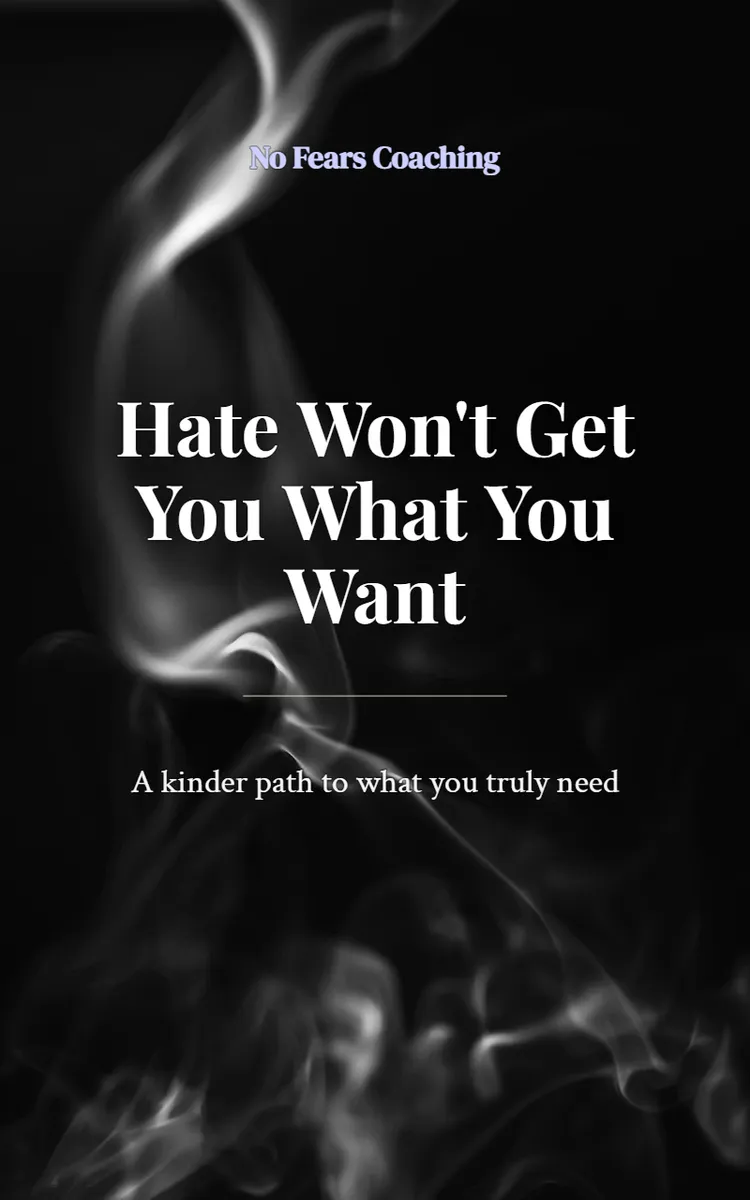
"Hate Won't Get You What You Want" is a inspirational book by No Fears Coaching with 8 chapters and approximately 12,632 words. Overcoming hate and choosing healthier motivation.
This book was created using Inkfluence AI, an AI-powered book generation platform that helps authors write, design, and publish complete books. It was made with the AI Inspirational Book Writer.
Frequently Asked Questions
What is "Hate Won't Get You What You Want" about?
Overcoming hate and choosing healthier motivation
How many chapters are in "Hate Won't Get You What You Want"?
The book contains 8 chapters and approximately 12,632 words. Topics covered include Naming Hate Without Feeding It, Choosing Purpose Over Payback, Understanding Hate’s Hidden Need, Practicing Boundary Strength Without Bitterness, and more.
Who wrote "Hate Won't Get You What You Want"?
This book was written by No Fears Coaching and created using Inkfluence AI, an AI book generation platform that helps authors write, design, and publish books.
How can I create a similar inspirational book?
You can create your own inspirational book using Inkfluence AI. Describe your idea, choose your style, and the AI writes the full book for you. It's free to start.
Write your own inspirational book with AI
Describe your idea and Inkfluence writes the whole thing. Free to start.
Start writingCreated with Inkfluence AI


