
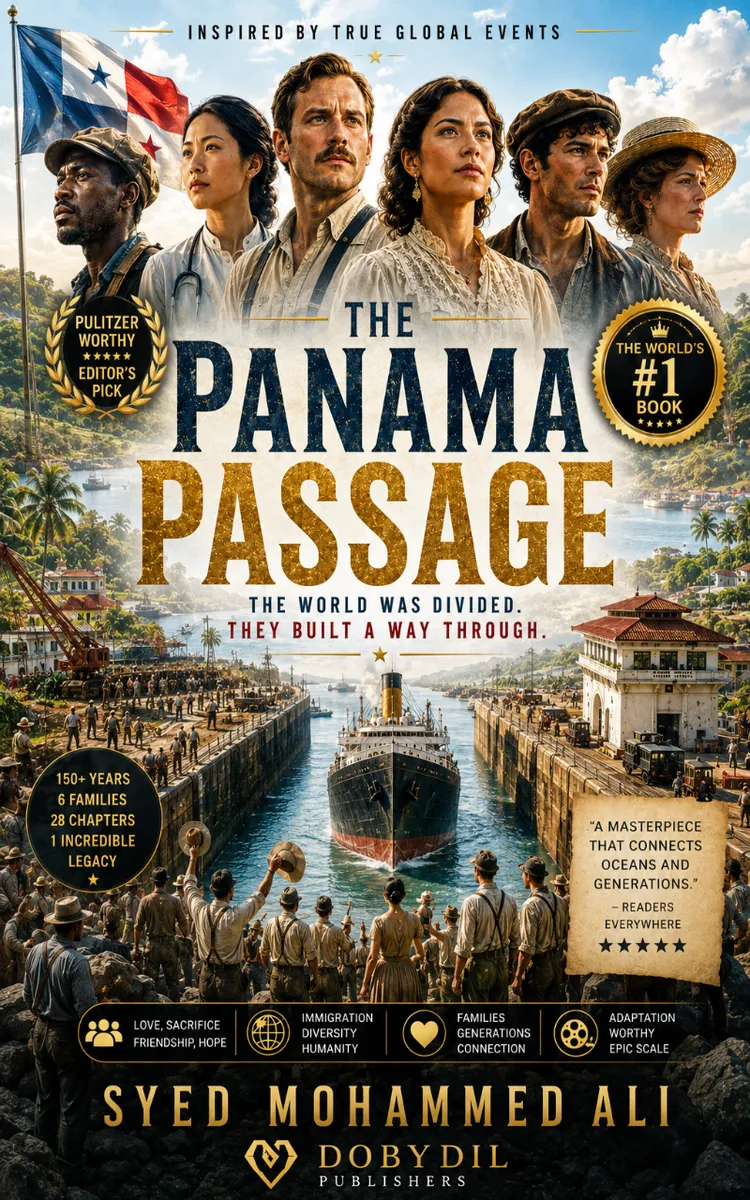
The Panama Passage
Created with Inkfluence AI
Multi-generational novel about building the Panama Canal
Table of Contents
- 1. The Isthmus Between Two Oceans
- 2. A Map That Refuses to Stay
- 3. Mosquitoes and the First Ledger
- 4. The Jungle Swallows the Survey
- 5. Benjamin’s Promise to Sofia
- 6. The First Failure Leaves Scars
- 7. A Doctor’s Question No One Answers
- 8. Dynamite That Misfires in the Rain
- 9. Samuel Finds a Way Through
- 10. The Lock-Gate Dream on Paper
- 11. Elena’s Interview That Turns Dangerous
- 12. The Quinine Run That Fails
- 13. Sofia’s School Becomes a Refuge
- 14. Gabriel’s Letter From the Quarry
- 15. The Americans Arrive, Too Late
- 16. The Fever Map Goes Viral
- 17. Dynamite Lessons From a Broken Hand
- 18. The Workers Refuse the Empty Promises
- 19. The Lock Gates Hold-Then Crack
- 20. A Mother Counts the Cost of Progress
- 21. Opening Day’s Quiet Prayer
- 22. The Captain’s First Voyage
- 23. War Turns the Canal Into Lifeline
- 24. New Families, Same Promises
- 25. Traders Bring Jokes and Cargo
- 26. The Canal Zone Tests Identity
- 27. Independence Sings Through Streets
- 28. Noah Finds the Hidden Family Thread
- 29. The Panama Passage Opens Between People
Preview: The Isthmus Between Two Oceans
A short excerpt from “The Isthmus Between Two Oceans”. The full book contains 29 chapters and 84,121 words.
A helicopter of gulls and angry insects rose from the tree line as Benjamin Carter stepped onto the mud at the edge of the Darién jungle, boots sinking as if the earth had decided to hold him. His field notebook was tucked under his shirt, already damp at the corners. Behind him, men laughed too loudly - Americans trying to sound like they belonged in heat that could melt tin - and a mule snorted, shaking its head as if it knew better than to trust the ground.
The air pressed down in layers. It was thick with wet leaves and diesel from the skiff that had hauled them in, and the sound of the river - somewhere unseen, always there - came through the canopy like a drumbeat. Benjamin wiped his forehead with the back of his wrist and tasted sweat and river silt. He had imagined the Isthmus as a problem that could be measured, reduced to lines on paper. Instead, it greeted them like a living thing: green walls, slick roots, and water that kept moving even when the men tried to stand still.
“Captain says we’ve got a day before the weather turns,” Samuel Okoro called from beside a canvas bundle, one hand on the strap of a battered case. Samuel’s voice carried that stubborn steadiness Benjamin had come to rely on. “If we can mark the ridge, we can get the survey moving.”
Mei Tanaka had already knelt at the damp edge where the ground dipped toward the river. Her hair was tied back tight, and she pressed two fingers to the soil as if she could read it the way some people read a page. “The river rises faster than you think,” she said, not looking up. “Heat makes it swell overnight.”
Gabriel Rossi hovered near a pile of stakes and signal flags, his Italian accent turning practical words into something almost musical. “We came for the passage,” he said, half joking. “Now the passage comes for us.”
Benjamin forced his eyes to the task in front of him. His team had landed optimistic but underprepared, and he could feel it in the way everyone kept glancing at the sky as if waiting for permission. The instruments were the heart of the survey - compass, level, measuring chains, theodolite - metal and glass wrapped in oilcloth that should have kept them safe. But the jungle edge was not a neat office floor. It was water and rot and shade, and it offered no guarantees.
“We’re not here to admire it,” Benjamin said, and surprised himself with how sharp the words sounded. He lowered his voice. “We’re here to find a viable route for this survey team. A line we can follow.”
Elena Brooks - hair pinned back, eyes bright with the kind of hunger that made her dangerous - stood a few paces off with her notebook already open. She had insisted on coming, and Benjamin had let her, because her questions made men stand straighter. “Viable,” she repeated, tasting the word like it might crack. “Is that the word you’re writing in your report? Or are you going to call it what it feels like?”
Benjamin didn’t answer. The truth was too close to fear. He moved toward the gear laid out on a strip of slightly higher ground, where the mud had a firmer crust. The oilcloth on the instrument case sagged with damp. When he lifted it, a slow, sour smell rose - metal sweating under wet fabric.
“Careful,” Mei murmured. “If it’s wet now, it will be worse at night.”
Benjamin opened the case anyway. The glass on the level looked cloudy, not broken but misted as if the jungle had already started to claim it. The compass needle trembled when he held it up, then steadied. That steadiness felt like a promise, small but real.
He turned to the others, pushing the doubt down like a nail. “We’ll work from here,” he said. “We mark a temporary line across the ridge, take bearings, and return tonight before the rivers decide to move.”
Samuel gave a short laugh. “The rivers decide everything,” he said. “But we’ll decide too.”
They started forward in a line that tried to look orderly. Sticks scraped against bark. Fabric snagged on vines. Benjamin kept his gaze low, scanning for something solid enough to place a stake. The jungle didn’t give him paths; it offered obstacles disguised as greenery. When the ground dipped, water seeped up through the roots, and Benjamin had to step over a slick patch that looked harmless until his boot slid half an inch and his shin went numb from cold that didn’t match the heat.
From somewhere deeper, a drum of thunder rolled, slow and distant, like the jungle clearing its throat. The sky stayed bright, though. It was that kind of brightness that made Benjamin uneasy - sunlight filtered through leaves, turning everything green and gold, as if the world was pretending to be gentle.
Elena walked beside him, her skirt hem already darkening with damp. “You’re not writing this part,” she said.
Benjamin glanced at her. “What part?”
“The part where you can’t tell if you’re walking on earth or on something that’s waiting to swallow you,” she said. She didn’t sound accusatory. She sounded awed. “Men in America think maps are proof....
About this book
"The Panama Passage" is a fiction book by Syed Mohammed Ali with 29 chapters and approximately 84,121 words. Multi-generational novel about building the Panama Canal.
This book was created using Inkfluence AI, an AI-powered book generation platform that helps authors write, design, and publish complete books. It was made with the AI Novel Writer.
Frequently Asked Questions
What is "The Panama Passage" about?
Multi-generational novel about building the Panama Canal
How many chapters are in "The Panama Passage"?
The book contains 29 chapters and approximately 84,121 words. Topics covered include The Isthmus Between Two Oceans, A Map That Refuses to Stay, Mosquitoes and the First Ledger, The Jungle Swallows the Survey, and more.
Who wrote "The Panama Passage"?
This book was written by Syed Mohammed Ali and created using Inkfluence AI, an AI book generation platform that helps authors write, design, and publish books.
How can I create a similar fiction book?
You can create your own fiction book using Inkfluence AI. Describe your idea, choose your style, and the AI writes the full book for you. It's free to start.
Write your own fiction book with AI
Describe your idea and Inkfluence writes the whole thing. Free to start.
Start writingCreated with Inkfluence AI


