
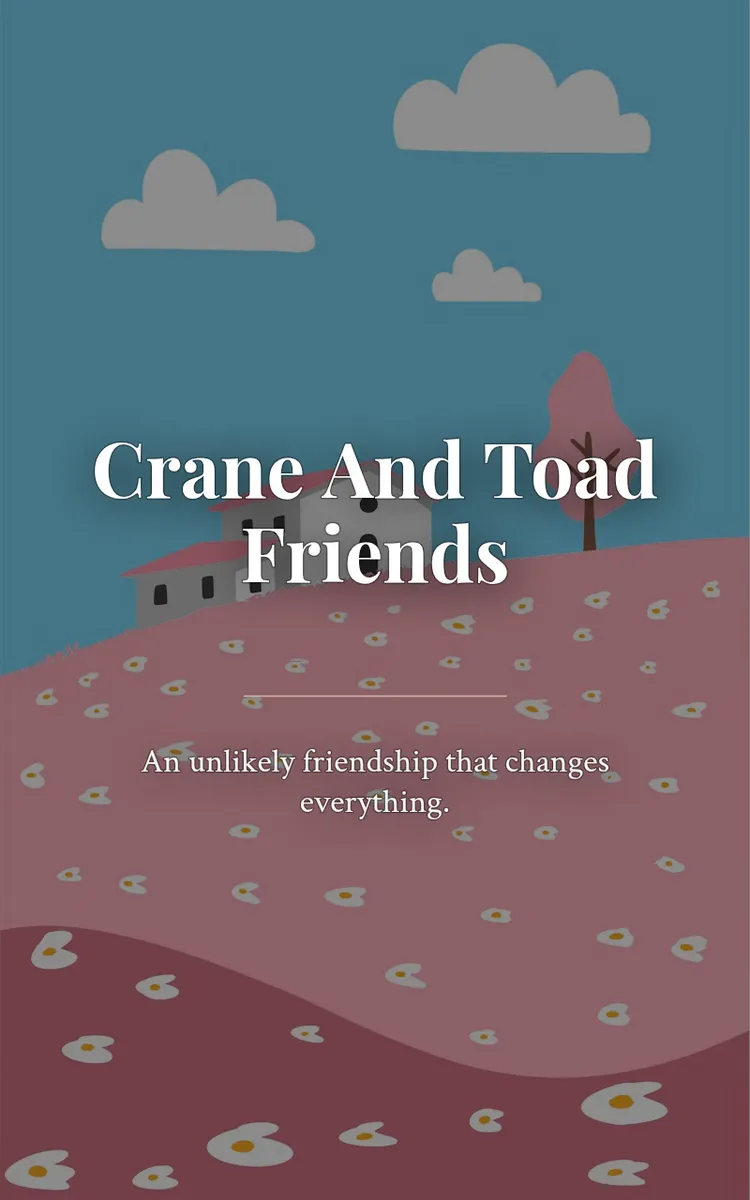
Read the first chapter
The whole of chapter one, free. About 7 min. Turn the pages with the arrows, your keyboard, or a swipe.
Chapter 1
Spotting Each Other at the Pond
A cool mist hung over the pond as a crane stood very still at the muddy edge. Its long legs made soft, careful sounds in the wet ground, like taps from a quiet drum. The water smelled like green plants and clean rain. Tiny ripples bumped the reeds, and a dragonfly buzzed past with a quick, bright flick.
Farther in, a toad rested on a flat stone. Its skin felt bumpy and warm in the sun, even though the pond air was chilly. The toad’s eyes blinked slowly as a leaf floated by, turning and turning like it was dancing. Then the toad noticed a new shadow in the water-tall, narrow, and graceful.
The crane’s head dipped toward the pond. Its beak clicked once, tasting the air. “Hello,” the crane said in a gentle voice, as if it didn’t want to scare the fish. The words came out clear, and the pond seemed to listen.
The toad’s back legs tucked in. “Hello,” the toad answered, a little smaller than it meant to be. It tried to look brave, but the crane was taller than the reeds and wider than the wind. “Are you… new?”
The crane tilted its head. “I’ve been here a little while,” it said. “I like the way the water shines. And I like the quiet.”
The toad gave a slow blink. “I like it too,” it said. “But I haven’t seen you before.”
They both watched the pond for a moment, just to make sure nothing changed too fast. Then the toad’s tummy made a soft sound, like a tiny drum. It wasn’t hungry in a loud way, but it was hungry in a “something is missing” way. The toad hopped closer to the water’s edge and looked around.
A small pile of tasty pond treats lay on a little patch of sand near the far side of the reeds-close enough to smell, too far to reach in one hop. The toad tried anyway. Its back legs pushed, its body stretched, and then-plop-it landed in the shallow mud with a wet gulp of disappointment. The sand patch was still there, but the toad couldn’t get to it without slipping.
“Oh!” the toad said, and the sound came out like a sigh.
The crane watched the toad’s hop, head swaying slightly. “You want that?” it asked, nodding toward the sand.
The toad puffed out its cheeks. “I can smell it,” it said. “It smells like good bugs. But the mud makes my feet slide. I don’t want to fall in deeper.”
The crane stepped back and then forward again, testing the ground with one careful leg. The water lapped at the shore, cool and steady. “Maybe you don’t have to hop all the way,” the crane said. “Maybe we can find another path.”
The toad looked at the reeds, then at the sandy patch, then at the crane’s long legs. “You could reach it,” it said quickly. “But you don’t eat the same things I do.”
The crane smiled in the way cranes do, with their eyes and their calm. “I can reach,” it agreed. “But I don’t want to take your food. I want to help you get it.”
The toad’s shoulders relaxed a bit. “Help?” it repeated, like the word was new.
“First,” the crane said, “let’s try what we can do alone.” It lowered its beak toward the water. The crane’s long neck made a smooth line through the mist. With one gentle dip, it stirred the pond’s surface near the mud, making small ripples that pushed floating bits toward the shore.
The toad leaned forward, hoping. It felt the air move as the crane’s neck swung. It heard the water tap-tap against the stone. It watched tiny specks drift closer-almost close enough to grab.
“See?” the crane said. “A little bit can come nearer.”
The toad reached out with its sticky tongue, but the floating bits slipped past, drifting away with the current. The toad’s tongue curled back, and it blinked hard, embarrassed. “It’s close,” it said, “but it won’t stay.”
The crane lifted its head. The crane’s eyes looked thoughtful, not worried. “Then the pond needs a different kind of help,” it said.
The toad hopped sideways, testing the mud again. Its feet slid a little, and it steadied itself on a root. The toad stared at the far side of the reeds where the sand patch sat. “I keep almost getting there,” it said. “But the mud is slippery where the water touches.”
The crane took one slow step toward the reeds. Its toes pressed into the wet soil, and the mud held it better than it held the toad. The crane looked at a log that lay half in the water, half on the shore. One end of the log was shiny and slick from pond water. The other end was rougher, with bits of bark and small roots clinging to it.
“A log,” the toad said, watching. “But it’s wet.”
“Yes,” the crane said. “Wet can be slippery. But not every part is the same.”
The toad stared at the log like it was a puzzle. “How do we know?” it asked.
The crane didn’t rush. It walked to the log and touched it lightly with its beak. The log gave a soft creak, like it was tired but not broken. The crane peered down, then moved its leg to the rougher end. It shifted its weight carefully, testing.
The log didn’t slide far. It wobbled a little, then settled. The crane looked back over its shoulder. “This end feels steadier,” it said. “If you go on the rough part, you might not slip.”
The toad’s mouth opened and closed once, as if it was choosing courage. “You’ll be here?” it asked.
“I’ll be here,” the crane promised. “You can go slowly. And I won’t touch you. You’re the one who knows how your body feels.”
The toad nodded, even though its skin still felt a little prickly with worry. It took a careful breath, smelling pond plants and damp wood. Then it hopped onto the log’s rough end.
Its feet met the bumpy surface. It wiggled once, then steadied. The log didn’t pull it like the mud did. The toad’s eyes widened with surprise. “It’s… not sliding,” it said.
“Good,” the crane said softly. Its voice sounded like a calm wind. The crane kept one leg planted and watched the toad’s path.
The toad moved inch by inch, using tiny pushes. It could feel the log’s texture through its toes-rough, then smoother, then rough again as it reached a patch where the bark clung tight. The water below made gentle shushing sounds, but the toad stayed above it.
When the toad reached the log’s end near the sand patch, it hopped off and landed with a soft thump. The sand felt warm and dry compared to the mud. The toad turned in a circle, eyes bright.
“I can reach it now!” it said.
The crane stepped forward carefully, lowering its head so it could see the sand patch too. “Do you want to eat?” it asked.
The toad hesitated. “Yes,” it said honestly. “But you might want something too.”
The crane looked at the pond, then at the reeds, then back at the toad. “I do,” it admitted. “But I can wait. First, let your food be yours.”
The toad started to nibble at the small pond treats near the sand. It didn’t rush. It listened to the water, felt the warmth of the sun on its back, and enjoyed the quiet. After a few bites, it glanced toward the crane. “What do you eat?” it asked, curious again.
The crane lowered its beak to the pond and found a small water creature near the reeds. It didn’t snatch too fast. It simply tasted and swallowed carefully, like a crane choosing its meals on purpose.
The toad watched, then gave a thoughtful little ribbit. “That looks different from mine.”
“It is different,” the crane said. “But this is still the same pond. We both belong here.”
The toad’s eyes blinked slowly. “I thought maybe you were from somewhere else,” it said. “You look like you belong in the sky.”
The crane’s neck rose just a little, proud but gentle. “I belong in the pond too,” it said. “I stand here when I’m resting. I watch the water. I listen for movement.”
The toad swallowed and then turned its head toward the crane. “I’ve never noticed you,” it said. “I guess I was busy thinking only about my own food.”
The crane nodded. “Sometimes I think the same,” it said. “I was busy looking for what I need.”
The toad finished its nibbling and sat back on the sand patch, feeling satisfied. The mud behind it looked less scary now, because the log made a bridge. It hopped once, testing its balance, and the toad felt steady.
“Thank you,” the toad said, and this time the words sounded bigger.
The crane dipped its head. “You’re welcome,” it replied. “And you helped too. You went first. You trusted the rough part.”
The toad smiled in a toad way-quiet and round. “We both tried,” it said.
They sat together near the edge where the sand met the reeds. The pond kept making its soft sounds: water tapping stones, leaves brushing each other, a bird calling far away. The mist thinned, and warm light touched the log and the toad’s bumpy skin.
As the crane watched the water and the toad watched the crane, they both felt something new settle in their hearts-something safe and friendly. They had noticed each other, and they had found their shared home. A warm lesson stayed in the pond air: When you notice someone in your home and share what you can, kindness turns into friendship.
End of chapter one. 4 more chapters in the full book.
Swipe or use the arrows to turn the page
What's inside: 5 chapters
- 1. Spotting Each Other at the Pond
- 2. The Muddy Log Gets Stuck
- 3. Sharing Snacks Without Worrying
- 4. A Rainy Day Hiding Plan
- 5. A Kind Promise for Tomorrow
About this book
"Crane And Toad Friends" is a children's book by Anonymous with 5 chapters and approximately 7,805 words. A crane and a toad form an unlikely friendship.
This book was created using Inkfluence AI, an AI-powered book generation platform that helps authors write, design, and publish complete books. It was made with the AI Children's Book Creator.
Frequently Asked Questions
What is "Crane And Toad Friends" about?
A crane and a toad form an unlikely friendship
How many chapters are in "Crane And Toad Friends"?
The book contains 5 chapters and approximately 7,805 words. Topics covered include Spotting Each Other at the Pond, The Muddy Log Gets Stuck, Sharing Snacks Without Worrying, A Rainy Day Hiding Plan, and more.
Who wrote "Crane And Toad Friends"?
This book was written by Anonymous and created using Inkfluence AI, an AI book generation platform that helps authors write, design, and publish books.
How can I create a similar children's book?
You can create your own children's book using Inkfluence AI. Describe your idea, choose your style, and the AI writes the full book for you. It's free to start.
Write your own children's book with AI
Describe your idea and Inkfluence writes the whole thing. Free to start.
Start writingCreated with Inkfluence AI


