
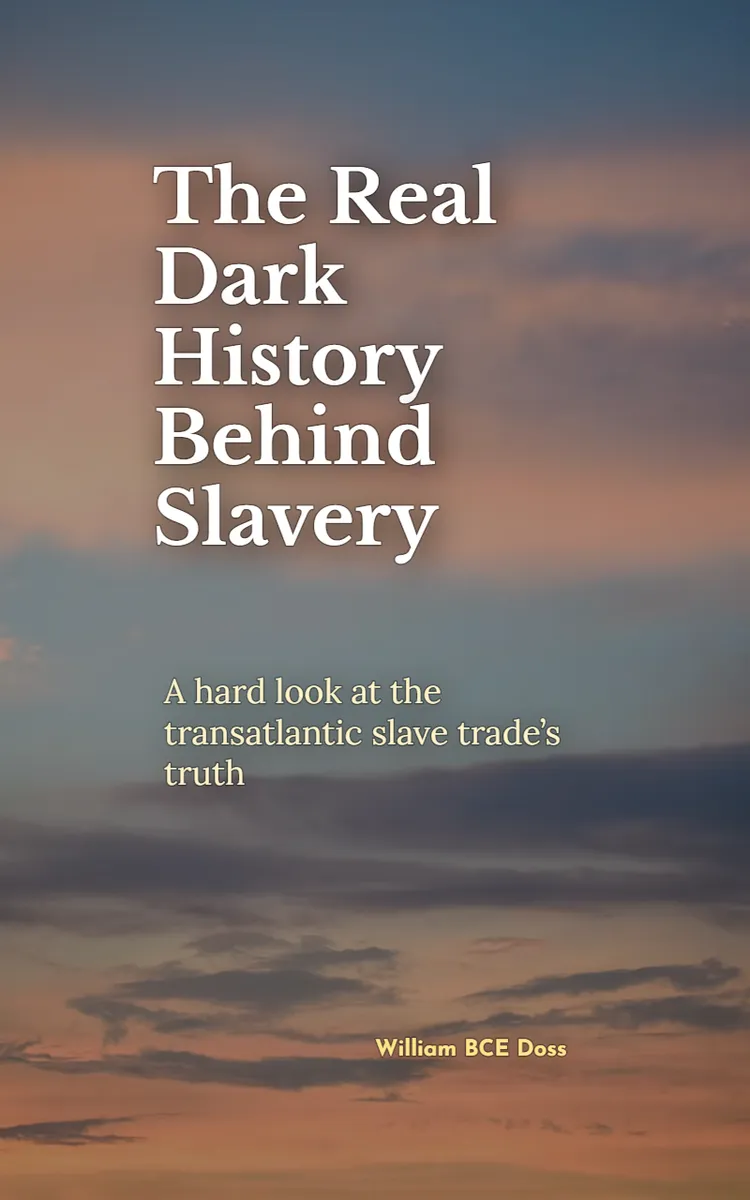
Read the first chapter
The whole of chapter one, free. About 10 min. Turn the pages with the arrows, your keyboard, or a swipe.
Chapter 1
The First Lie That Sold People
The First Lie That Sold People: How “Consent” Was Manufactured
In a port city, a person can be dressed, measured, priced, and shipped - and still be described on paper as if they agreed. That is the paradox at the heart of how the transatlantic slave trade survived as a business: the system needed human beings to look like customers, not victims, and it worked by rewriting what “consent” meant.
Elena, 34, works as a museum educator, and she has learned that visitors react differently when a story arrives dressed as paperwork. A contract looks clean. A signature looks like a choice. Even a dry inventory list can feel harmless, until you notice what it quietly erases: the person who couldn’t realistically refuse. Her job is to turn that moment of discomfort into understanding, and this chapter follows the same thread - how propaganda tactics turned enslavement into something ordinary buyers could tolerate, even expect, like a service that ran on rules.
We are not chasing myths or conspiracy theories. We’re tracing the tactics - how writers, traders, and governments made enslavement sound legal, normal, and profitable, using the language of consent, trade, and order. The central mystery is simple and chilling: what kind of “agreement” can be forced without ever being called coercion?
The Consent-By-Story Ladder: Turning Abduction Into “Choice” on Paper
The first lie wasn’t just “people are property.” That idea had to be made usable, and the real work was closer to marketing than ideology. Traders and their supporters used a Consent-By-Story Ladder, a set of rhetorical steps that pushed responsibility away from the slave system and toward the people being taken.
The ladder starts with a familiar move: presenting capture as something else - purchase, indenture, exchange, recruitment, even voluntary migration. Once the label changes, the moral weight shifts. A reader might still recoil at “slavery,” but “contract labor” sounds like something you could opt into. The next step is to wrap that new label in documents. Bills of sale, shipping records, and colonial paperwork did more than record events; they turned a violent process into a paper trail that looked predictable and lawful.
Here’s the counterintuitive part: propaganda didn’t have to convince everyone at once. It only had to convince enough people that they could sleep at night while buying a human life. In practice, that meant feeding ordinary buyers a chain of stories that made the trade feel like commerce rather than conquest.
Elena tells her visitors that language can be a tool, not just a description. When she shows a facsimile of a bill of sale or a ship’s entry, she points to the way the paperwork behaves like a magician’s misdirection. It names a commodity, assigns value, and flows forward as if the past were settled. What’s missing is the person’s voice - not because it never existed, but because the system made it dangerous or impossible to be heard in the places where decisions were recorded.
And this is where the “ladder” becomes more than a metaphor. The stories weren’t random; they were designed to land at predictable stops:
First, the system offered a justification: people were taken in “war,” “raids,” or “conflict,” so enslavement could be treated as a byproduct of violence that someone else started. Second, it offered a procedural comfort: since there was paperwork, there must have been rules. Third, it offered a market logic: if ships sailed, if goods were insured, if merchants carried the risk, then the trade must be legitimate enough to operate.
That last rung is crucial. Propaganda made enslavement feel like it belonged to the same moral world as trade in cloth, sugar, or timber. It didn’t ask buyers to become monsters; it invited them to become customers.
The Deep Dive: Legal Language, Normal Trade, and the Machinery of Plausibility
To understand how “consent” was manufactured, you have to look at how early modern societies handled law, property, and commerce. By the time the transatlantic trade was at full volume, European colonial systems had developed ways to categorize people and things. Once a person could be treated as property in a legal sense, the next step was to build a narrative that made the transition from person to property feel routine.
One tool was the language of ownership and transfer - the idea that a human being could be “transferred” like cargo. Another was the language of transaction. If an item changes hands in a market, it doesn’t feel like theft; it feels like buying. Propaganda leaned hard on that emotional shortcut.
A second tactic was selective storytelling about the supply side. Much of the trade depended on networks in Africa and within the Americas - local politics, warfare, and coercion were part of the broader landscape. But the propaganda frame narrowed the story so that it looked like a simple supply chain. Instead of emphasizing how people were captured and compelled, supporters emphasized how goods were collected and shipped. The violence became background noise, and the buyer saw only the familiar shape of trade.
Then came a third tactic: legitimizing through institutions. Insurance, contracts, courts, and colonial offices all gave the trade a kind of administrative glow. Even when the violence was undeniable, the existence of bureaucratic processes could be used to imply moral order. If a court recorded a claim, if an official stamp appeared on a document, the system could present itself as part of the orderly world.
Elena often compares this to what happens when a familiar format hides something ugly. A restaurant menu is normally about food; if you suddenly see language that makes a person sound like a product, your mind has to adjust. The format is the trick. The same idea drove pro-slavery writers: they didn’t only argue; they restructured the way the trade looked on the page.
There is also a blunt historical reality that makes the propaganda tactics easier to see: the system relied on distance. Once ships crossed the Atlantic, buyers didn’t have to watch the capture, the chaining, the transport, or the sale up close. They could meet the story at a cleaned-up endpoint - an auction, a ledger, a shipment - where the messy middle had already been buried under paperwork.
That’s why the “Consent-By-Story Ladder” mattered. It turned distance into moral insulation.
And it worked best when it aligned with what ordinary people already understood about commerce. In many ports, markets were the daily rhythm of life. Merchants dealt in risk, quality, and price. That mindset could be redirected: if a transaction could be priced, it could be justified. If it could be justified, it could be repeated.
What You Did Not Expect: How “Voluntary” Became a Selling Point
The surprise is that propaganda sometimes treated enslavement as if it were a kind of choice - not always by claiming everyone was happy, but by suggesting that outcomes could be framed as acceptable because some people had been involved in the process. That framing could sound like nuance, but it functioned like a cover.
Why does this matter? Because it changes what we think propaganda was doing. It wasn’t only brute-force denial. It was story engineering - taking situations where coercion existed and translating them into language that made coercion harder to see. If a system can call compulsion “agreement,” then the moral responsibility migrates away from the buyer and toward a narrative of trade.
In practice, “voluntary” framing often showed up through the way authorities described movement and labor. People might be described as transferred, engaged, or placed into service, with the implication that the process had a choice-like structure. The wording did not have to be identical every time to do its job. It only had to create the same effect: the buyer could imagine a contract-like relationship rather than a kidnapping.
Elena’s museum work highlights how easily that imagination spreads. Visitors, even careful ones, often assume that if something is recorded as a transaction, then the transaction must have been fair. She has seen how quickly a mind reaches for “maybe it was complicated” when confronted with cold paperwork. That impulse - understand the world by fitting it into familiar categories - is exactly what the slave trade’s defenders exploited.
There’s a scientific angle here that isn’t about lab experiments so much as about how humans process information. When people encounter a familiar pattern - “buyer,” “seller,” “price,” “delivery” - they tend to treat the pattern as evidence of legitimacy. The content of the pattern can override the content of the reality beneath it. In other words, our brains are tuned to accept the structure of a transaction as a sign of normality, even when the underlying human cost is catastrophic.
That makes propaganda tactics unusually effective. They didn’t only sell slavery; they sold the idea that slavery could be understood like any other business relationship. The lie was not merely false information. It was a shift in how you were supposed to look at the evidence.
Once you see that, you start noticing the seams: the way documents emphasize value and transfer, while the human context - the ability to refuse, the presence of violence, the threat behind the signature - fades into silence.
The Human Story: Elena’s Museum, the Paper Trail, and the Question of “Signature”
Elena’s exhibit centers on the gap between what paperwork says and what human life demands. She chose a small set of documents because she learned that visitors can’t hold a whole history in their heads, but they can hold a single object. One piece of paper - typed, stamped, filed - can become a doorway.
On a table behind glass, she places a reproduction of a transaction record connected to the broader trade. The handwriting and language look formal. The structure feels like the kind of record a shopkeeper might keep. There is a rhythm to it: names, quantities, terms, value. Nothing in the format screams “violence.” Nothing in the tone invites the reader to picture a person being forced onto a ship.
Elena doesn’t dramatize. She treats the document like evidence. She asks visitors to notice what the document does, not what it claims to mean. It lists. It transfers. It establishes a framework where the buyer can feel secure. The missing part - the possibility of refusal, the experience of terror, the absence of real negotiation - sits outside the paper’s boundaries. The system built those boundaries on purpose.
She also brings in a second kind of material: shipping and port context, where the trade’s scale becomes visible not as a statistic but as a pattern. Ships repeat routes. Records repeat terms. The trade looks like a system that expected routine. That routine is one of the propaganda tactics in disguise. When a practice repeats across years and across documents, it can start to look like tradition, and tradition can start to feel neutral.
For Elena, the turning point is always the same. Visitors arrive thinking about slavery as an obvious moral wrong. Then they confront the machinery of legality - how the trade dressed itself in familiar clothes - and the story becomes harder to dismiss. It isn’t that the documents make the trade less real. It’s that they make the trade’s social acceptance easier to understand.
Elena watches that understanding land. People often shift from “how could they do that?” to “how did the system make it seem do-able?” That question is the heart of this chapter’s mystery. The first lie wasn’t only about what happened. It was about what could be believed afterward.
What This Tells Us: The Comfort of Paper and the Human Need for Coherence
The deeper lesson is not that people were ignorant. Many were informed. The deeper lesson is that humans crave coherence - especially when the alternative is to admit complicity. Propaganda tactics worked by aligning the trade with the forms of everyday life: contracts, prices, institutions, procedures. When the story fits the familiar shape of commerce, the mind can refuse to look closer.
That doesn’t mean every buyer believed every lie in the same way. It means the system only needed enough belief to keep the gears turning. The paper trail didn’t just record slavery; it trained people to interpret evidence in a way that protected their comfort.
And once you see how “consent” can be manufactured through story and paperwork, you start wondering where else societies have done something similar - where the language of legality and normal trade hides coercion in plain sight, and where the signatures look clean because the people behind them were never allowed to refuse. What other horrors have survived by learning how to sound like business?
End of chapter one. 7 more chapters in the full book.
Swipe or use the arrows to turn the page


What's inside: 8 chapters
- 1. The First Lie That Sold People
- 2. Counting Bodies: The Math of Profit
- 3. The Ships’ Hidden Rules of Survival
- 4. The Middle Passage’s Silent Technologies
- 5. Who Profited at Home, Not Abroad
- 6. Resistance That Rewrote the Route
- 7. Abolition’s Convenient Amnesia Engine
- 8. Why the Dark History Still Echoes
About this book
"The Real Dark History Behind Slavery" is a curiosity book by William BCE Doss with 8 chapters and approximately 15,194 words. History of the transatlantic slave trade and its hidden realities.
This book was created using Inkfluence AI, an AI-powered book generation platform that helps authors write, design, and publish complete books.
Frequently Asked Questions
What is "The Real Dark History Behind Slavery" about?
History of the transatlantic slave trade and its hidden realities
How many chapters are in "The Real Dark History Behind Slavery"?
The book contains 8 chapters and approximately 15,194 words. Topics covered include The First Lie That Sold People, Counting Bodies: The Math of Profit, The Ships’ Hidden Rules of Survival, The Middle Passage’s Silent Technologies, and more.
Who wrote "The Real Dark History Behind Slavery"?
This book was written by William BCE Doss and created using Inkfluence AI, an AI book generation platform that helps authors write, design, and publish books.
Write your own curiosity book with AI
Describe your idea and Inkfluence writes the whole thing. Free to start.
Start writingCreated with Inkfluence AI


