
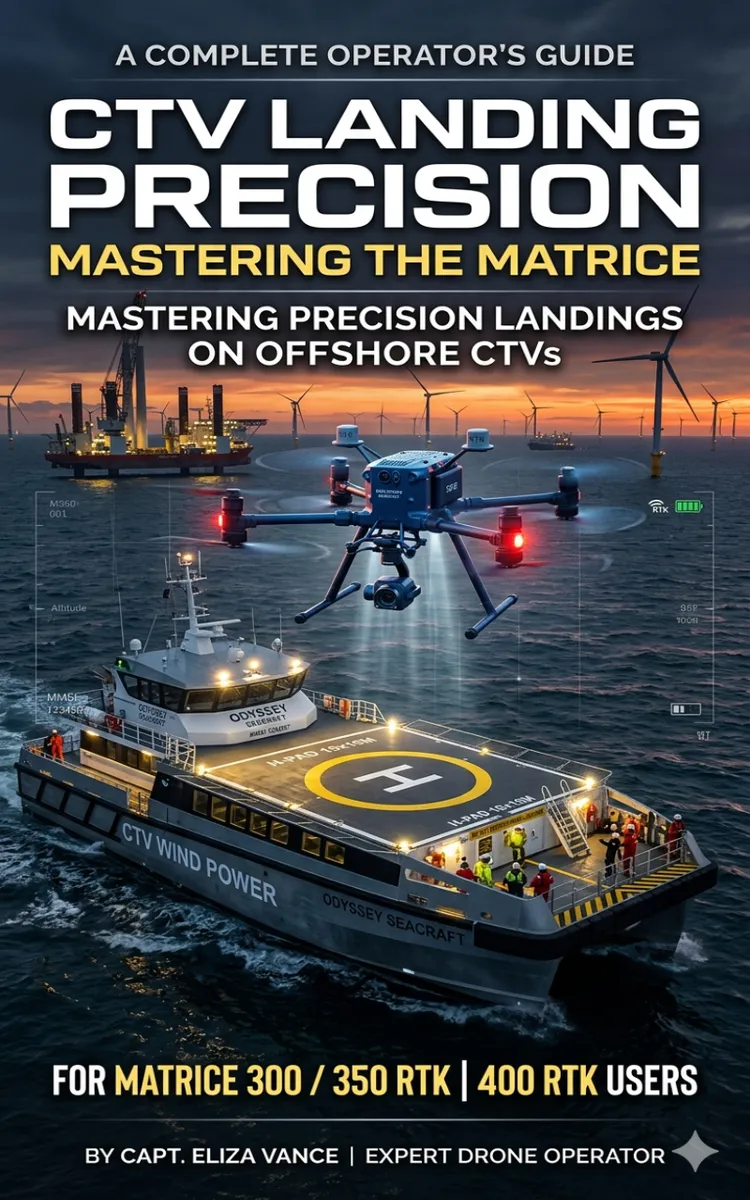
Read the first chapter
The whole of chapter one, free. About 10 min. Turn the pages with the arrows, your keyboard, or a swipe.
Chapter 1
Pre-Flight Landing Risk Checklist
What do you do when the deck moves under your feet and your GPS spot-lock starts to drift-yet you still need a clean, controlled landing? On a CTV boat, your landing risk doesn’t come from the drone alone. It comes from wind changes over the water, deck motion, the way GPS/RTK behaves when you’re near steel and masts, and the obstacles that sneak into your approach path. If you treat landing like a “press down and hope” task, you’ll eventually meet a situation you can’t recover from.
This chapter gives you the Deck-Ready Risk Ladder: a quick, hands-on way to assess landing hazards before you take off, so you only attempt landings you can actually control. You’ll learn how to check wind, deck motion, GPS/RTK expectations, approach obstacles, and battery margins, then decide what to do when something doesn’t look right. By the end, you’ll be able to walk onto the boat, run the checks in order, and set a clear go/no-go call for the landing plan-plus you’ll know which emergency options you can deploy without scrambling.
Why This Matters
A CTV boat landing looks simple from a distance: you set the drone down on the deck and move on. Up close, you’re managing multiple “moving targets” at once. The deck pitches and rolls. Wind shifts as the boat turns. GPS quality can change as you reposition around railings, antennas, and carbon or metal structures. Even if your Matrice (or similar Matrice series drone) flies perfectly in open air, the last few seconds on deck are where small errors turn into tip-overs, prop strikes, or a drone that won’t hold position.
This chapter solves one specific problem: it prevents you from starting a landing when the environment and your setup don’t match what your drone needs to land safely. You’ll build a landing plan around reality-what the boat is doing right now, what the wind is doing right now, and what your positioning system can deliver right now. After these checks, you’ll be able to answer “Can I land here, right now?” with a practical decision, not a guess.
Practical takeaway / reflection prompt: After you finish your checks, ask yourself one question: “If the deck moves and the wind swings for 10-20 seconds, do I still know what I’ll do?” If you can’t answer that, your landing plan isn’t ready yet.
How It Works
The Deck-Ready Risk Ladder ranks landing hazards from “controlled and expected” to “too risky to attempt.” You don’t need fancy math. You need a repeatable order of checks so you catch the big problems early-before you burn battery, position the drone into a tight approach, or commit to a landing mode that won’t behave well in your conditions.
Use the ladder like this: check the environment first, then check your positioning expectations, then check your approach path, then check battery margins, then check emergency options. Each rung matters because it affects what the drone will do during the final approach and touch-down.
1. Wind + gust direction check (set your landing tolerance) - Look at both speed and direction relative to the deck landing point. On boats, wind direction changes as the hull yaws. Your goal isn’t a perfect calm-it’s a stable approach where the drone doesn’t fight you at the last meter. - If you see obvious gusting (wind socks or surface ripples changing fast), treat that as higher risk because it directly impacts your ability to hold position during descent.
2. Deck motion check (match approach speed to boat behavior) - Watch the deck for pitch and roll cycles while the boat holds course. If you feel yourself bracing with your feet, the drone will feel it too. - The key is timing: you want your descent to land during a more level moment, not at the peak of a roll.
3. GPS/RTK expectations check (know what “hold position” will do) - GPS (Global Positioning System) gives position using satellites. - RTK (Real-Time Kinematic) improves GPS accuracy using a correction signal from a base or network. - Near steel rails, masts, and antennas, GPS can degrade. RTK can also become unreliable if the correction link drops or satellites used for the solution change. - Your goal: confirm your positioning mode and expect whether the drone can hold its spot tightly during descent.
4. Approach path obstacle check (clear the “final lane”) - Walk your approach like a pilot: from your typical takeoff heading, map the last approach line to the landing pad. - Watch for things that don’t matter at 10 meters but matter at 2 meters-antenna whips, stanchions, cable runs, crane arms, rigging, and even spray patterns that can obscure visual cues.
5. Battery margin check (reserve enough for a stable abort) - Battery margin means you keep extra charge for an abort, not just for landing. - If you plan a tight circuit because you “think” you’ll land quickly, you remove your ability to climb, reposition, and try again. - Your goal: confirm you can hold safe altitude long enough to reset approach if the deck suddenly worsens or the wind spikes.
6. Emergency option check (decide your “out” before you descend) - Pick what you’ll do if the drone can’t hold position, drifts toward an obstacle, or positioning quality drops during descent. - Decide your abort altitude and your relocation heading before you start the final approach so you don’t make those choices while you’re already task-loaded.
Concrete example (from a real CTV workflow): Talia Nguyen runs coastal survey flights where the deck often sits under a metal radar mast. She doesn’t treat that mast as “just hardware.” She plans the approach so the drone crosses the landing pad line only when it’s clear of mast-induced GPS shadowing, and she times descent to deck leveling. When the wind swings while she’s in the last 3-5 meters, she aborts early instead of trying to “ride it down.”
Ask yourself: On your last landing, where did you first feel uncertainty-wind, deck motion, positioning, or obstacles? The ladder forces you to check those in a predictable order so you catch problems before they become decisions under pressure.
Practical takeaway / reflection prompt: Use the ladder every time. If you skip one rung, you’re not saving time-you’re borrowing risk from the final seconds.
Putting It Into Practice
Let’s run a realistic pre-flight landing assessment for a Matrice-series drone on a CTV boat. Talia’s boat typically launches with a deck pad near the centerline, but the mast and railings sit close enough that positioning quality can change as the drone lines up.
Step-by-step: Deck-Ready Risk Ladder on the deck
1. Pick the landing pad reference and confirm it stays put - Mark the landing pad with a visible reference on the deck (tape line or a painted marker). - Confirm the pad doesn’t move relative to deck hardware during normal operation (no loose brackets, no shifting mounts). - Expected outcome: you remove “landing point drift” from the problem so you can focus on wind, motion, and positioning.
2. Check wind at the deck level, not just from the wheelhouse - Watch wind indicators (windsock, flag, or consistent water surface direction) near the landing pad area. - If you see rapid changes in surface chop direction, treat gusting as active risk. - Expected outcome: you decide whether you need a calmer approach window (boat holds course) before you even start the approach.
3. Watch deck motion for 30-60 seconds - Look for the deck’s roll and pitch cycle. If the deck swings strongly, plan to time descent to the “flatter” part of the cycle. - Expected outcome: you avoid dropping into a roll that tilts the drone on touch-down.
4. Verify GPS/RTK readiness and what mode you will land with - Confirm your positioning system status on the controller/app: - You need the positioning mode you plan to use for landing (GPS-only vs RTK-enhanced). - Check for correction link status if you use RTK (the system should show whether corrections look valid). - If you see warnings or unstable status, mark that as higher risk. - Expected outcome: you decide whether you proceed or switch to a landing plan that doesn’t rely on “tight hold” during descent.
5. Inspect the final approach lane for obstacles within the last few meters - From your typical approach heading, look at what sits above and around the pad: mast elements, railings, hanging cables, and any hard-to-see features near the pad edge. - Move your body to get a low-angle view from deck height. Obstacles that look harmless from standing height can intrude on the drone’s final path. - Expected outcome: you know whether your approach line needs to stay offset, or whether you need a different landing approach direction.
6. Confirm battery margin for an abort + retry - Start with the battery level you plan to launch with, then estimate how long you’ll need for: - a stable hover/hold near altitude, - a climb/abort maneuver, - a reposition to a safer approach line, - and a second landing attempt. - Expected outcome: you don’t land with “just enough.” You keep enough reserve to recover from a late-stage problem.
7. Decide your emergency option before takeoff - Pre-brief your actions: - What altitude you will climb to if you detect drift, - whether you will hold position to re-stabilize or immediately change heading, - and what obstacle-free direction you’ll use to clear the mast/rail zone. - Expected outcome: you remove the biggest cause of accidents-late, improvised decisions.
Quick checklist
• Wind: stable direction at deck level? Gusting? - Deck motion: watch roll/pitch for 30-60 seconds, plan descent timing. - Positioning: GPS/RTK status looks solid for landing mode? - Approach lane: clear obstacles within the last few meters? - Battery margin: enough for abort + retry, not just landing? - Emergency out: know your abort altitude and relocation heading?
Expected outcome: a clear go/no-go call If wind looks stable, deck motion stays within your normal operating feel, positioning status holds steady, and the final approach lane stays clear, you mark the landing as Deck-Ready and commit to the approach plan.
If any rung fails-especially positioning instability or a blocked final lane-you don’t “try anyway.” You adjust the plan (different approach heading, delay landing until the boat attitude improves, or choose a different landing pad). If battery margin is low, you abort the landing attempt decision early and run the mission logic to keep the drone safe.
Practical takeaway / reflection prompt: When you finish the checklist, state your go/no-go in one sentence out loud. It forces clarity: wind + deck motion + positioning + obstacles + battery + emergency out.
What to Watch For
Here are the mistakes that show up most often during CTV-borne landings, and how you fix them before they bite you.
Wind you checked “earlier” but not “now” Wind on a boat changes as the hull turns. Pilots often check wind from a single moment-then the boat yaws, and the drone descends into a different wind angle.
Do this: Re-check wind right before you start the final approach. Use deck-level cues (surface chop direction or a visible indicator near the pad). If you see quick direction shifts, slow down your approach and be ready to abort before the last few meters. Not this: Trust the first wind reading from takeoff time and commit to descent even after the chop direction changes.
Fix you’ll notice: Your drone stops drifting sideways during descent and you stop “correcting late.”
Deck motion you ignored because the boat “looks steady” A boat can feel steady in your body but still roll enough to tilt the landing point. If you land at the wrong moment, the drone touches down while the deck is actively moving.
Do this: Watch the deck roll/pitch for a full minute and time your descent to the flattest part of the cycle. Keep your descent smooth-don’t rush the last meter. Not this: Start descending as soon as the drone reaches approach altitude, even when the deck is in the middle of a visible roll.
Fix you’ll notice: You reduce touch-down surprises-less rocking and fewer “why is it sliding?” moments.
Positioning status you assumed would stay good GPS/RTK quality can shift near masts, railings, and antennas. If you treat positioning warnings as “minor,” you can end up with a drone that won’t hold position tightly when you need it most.
Do this: Verify GPS/RTK status right before landing and again during the final approach. If the system reports unstable positioning or correction problems, abort early and reposition to a cleaner area before you descend again. Not this: Continue the final descent because “it worked last run” while the positioning indicators change or degrade.
Fix you’ll notice: Your aborts happen sooner, and your landings become repeatable instead of luck-based.
Practical takeaway / reflection prompt: After your next attempt, write one line: “Which ladder rung failed or got close to failing?” That single note trains you faster than any debrief.
With the Deck-Ready Risk Ladder in your workflow, you’ll start treating landing as a planned maneuver-not a gamble. Next, you’ll apply the same thinking to the landing sequence itself: how to set your approach line, manage descent timing, and keep control when the drone is closest to the deck.
End of chapter one. 4 more chapters in the full book.
Swipe or use the arrows to turn the page

What's inside: 5 chapters
- 1. Pre-Flight Landing Risk Checklist
- 2. Approach Path Setup Over the Deck
- 3. Precision Landing Using Visual Cues
- 4. Failsafe Triggers and Safe Abort Calls
- 5. Post-Landing Deck Safety and Debrief
About this book
"Safe Drone Landing Techniques" is a how-to guide book by f b with 5 chapters and approximately 9,344 words. Safe landing procedures for DJI Matrice drones on CTV boats.
This book was created using Inkfluence AI, an AI-powered book generation platform that helps authors write, design, and publish complete books. It was made with the AI Ebook Generator.
Frequently Asked Questions
What is "Safe Drone Landing Techniques" about?
Safe landing procedures for DJI Matrice drones on CTV boats
How many chapters are in "Safe Drone Landing Techniques"?
The book contains 5 chapters and approximately 9,344 words. Topics covered include Pre-Flight Landing Risk Checklist, Approach Path Setup Over the Deck, Precision Landing Using Visual Cues, Failsafe Triggers and Safe Abort Calls, and more.
Who wrote "Safe Drone Landing Techniques"?
This book was written by f b and created using Inkfluence AI, an AI book generation platform that helps authors write, design, and publish books.
How can I create a similar how-to guide book?
You can create your own how-to guide book using Inkfluence AI. Describe your idea, choose your style, and the AI writes the full book for you. It's free to start.
Write your own how-to guide book with AI
Describe your idea and Inkfluence writes the whole thing. Free to start.
Start writingCreated with Inkfluence AI


