
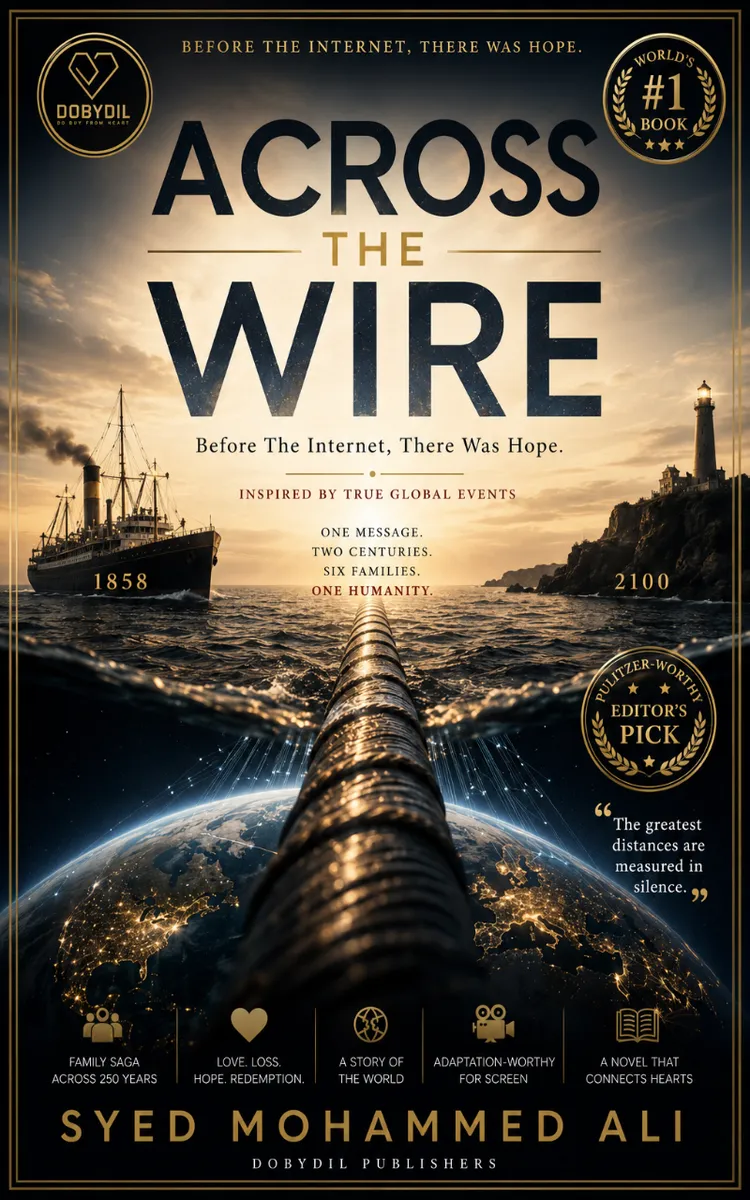
Across The Wire
Created with Inkfluence AI
A 2100 archivist uncovers linked families via telegrams.
Table of Contents
- 1. The Box That Shouldn’t Exist
- 2. The 1866 Name That Doesn’t Match
- 3. Ethan Walker Hears the Ocean
- 4. The Cable’s First Tear
- 5. Sofia Rossi’s Wedding Telegram
- 6. Daniel Brooks and the Deep Splice
- 7. Marcus Reed Follows a Ghost Address
- 8. The Soldier Who Never Received
- 9. The Missing Letter in the Drawer
- 10. Elena Petrov Learns the Wrong Tongue
- 11. The Voice on the Wire
- 12. The Call That Breaks a Promise
- 13. Telegraph to Television’s Long Wait
- 14. Moonlight Signals and Private Grief
- 15. The Internet That Erases Receipts
- 16. Email Replies That Never Arrive
- 17. The Silence After the Server Crash
- 18. Emma’s Box Opens Like a Door
- 19. The Telegrams That Refuse to Stay Dead
- 20. The Recording Under the Floorboards
- 21. The Reunion Nobody Planned
- 22. The Truth in One Misdelivered Telegram
- 23. The Last Message Crosses Again
- 24. One Humanity, Six Families
- 25. Across The Wire, Across The Heart
- 26. Connected at the Restored Cable
Preview: The Box That Shouldn’t Exist
A short excerpt from “The Box That Shouldn’t Exist”. The full book contains 26 chapters and 70,433 words.
The subterranean archive vault beneath the museum was never truly dark, not with the fiber-lamps embedded in the stone like pale veins. Still, after hours, the light seemed to thin out around the edges, leaving the center of the aisles to hold their breath. Emma Brooks stood alone at the end of Row 7, fingertips hovering over an accession cradle that had no label in the system - an unlogged box sitting there as if the catalog had simply blinked and missed it.
It wasn’t the box itself that made her uneasy. It was the way it had been placed. Whoever had set it down had aligned it with the markings on the concrete, square and careful, like it belonged. The lid was sealed with a strip of pale polymer that caught the lamp glow and threw it back in sharp, clean lines. But the museum’s inventory records - her records - showed nothing for that cradle. No request. No transfer. No audit trail. Just a gap in the chain of custody that had no business existing in 2100.
Emma leaned in, listening. The vault had its own quiet soundtrack: distant ventilation fans, the occasional soft tick of temperature regulation, the faint hum from the wall relays. Under it all, her own breathing sounded too loud. She pressed her palm against the polymer seal. It was cool, not brittle, and when she lifted the edge, it resisted like something meant to be permanent.
Before she broke it, she checked the accession tag.
The tag was there, tucked into a slot on the side of the box, printed in crisp ink that looked almost new. A sealed inventory tag, stamped with a date that should have matched the archive’s latest migration. But the tag’s code - along with a handwritten note that had survived the centuries in stubborn, dark strokes - contradicted the vault’s own indexing. The system said the cradle should have been empty since the last reconciliation. The tag insisted the box had been verified, logged, and sealed.
Emma swallowed, tasting metal that wasn’t in the air so much as in her mouth from all the nerves. “Okay,” she murmured, and the word sounded like a confession in the empty vault. She pulled up the archive interface on her wrist slate, letting the light from the screen wash her knuckles blue. A blank query returned a familiar message: no matching accession. No record. No permissions granted.
“No permissions,” she whispered again, and the vault felt colder for it. That was the first obstacle, not the seal. The system had decided this box wasn’t hers to open.
She looked around the aisle as if the answer might be leaning against a shelf. The vault camera coverage was nominal - most of it. There were always blind corners in subterranean spaces, little architectural compromises from a century of renovations. She had memorized them when she was younger, when rules were still something you could map.
Tonight, she didn’t want to map. She wanted to understand.
Emma broke the polymer seal.
The lid came up with a dry, reluctant sound, like paper separating from paper. Inside, the contents were wrapped in layers of cloth that had been treated against rot, their weave tight and slightly rough under her fingertips. The first envelope was heavy in a way modern paper never was, the fibers denser, the edges irregular as if cut by hand rather than machine. She lifted it carefully. The paper smelled faintly of coal dust and old varnish - an anachronistic ghost, but a believable one, the kind that clung to telegraph-era materials.
She turned the envelope over. No stamp. No museum mark. No sender line.
Her throat tightened. In the archive, sender information was the spine. Without it, you could still catalog the object, sure, but you couldn’t verify origin, and without origin you couldn’t authenticate context. The system could be wrong; the archive could be wrong. But the materials rarely lied to her. Ink sometimes faded. Handwriting sometimes slanted. Paper sometimes tore. Yet the absence of a sender line - so deliberate it felt like a decision - made her stomach sink.
“Come on,” she said, voice low. “Don’t be a trick.”
She set the first envelope back and pulled the sealed inventory tag free from the box’s side. The tag’s code wasn’t random. It had the structure her department used for cross-referenced collections. The contradiction wasn’t just a mismatch in data. It was the kind of mismatch that only happened when someone copied from a source that wasn’t what it claimed to be.
Emma took out her portable scanner and ran it over the tag. It returned a warning she’d never seen in that format: TRANSLATION CONFLICT. The vault’s indexing engine, built on a century of metadata and migrations, was trying to reconcile the tag with a record that didn’t exist. The system wasn’t merely uncertain. It was arguing with itself.
Behind the glass of her slate, the archive interface flickered once, like a blink. Somewhere in the vault, a relay clicked - an administrative tone too precise to be accidental.
Emma froze.
...
About this book
"Across The Wire" is a fiction book by Syed Mohammed Ali with 26 chapters and approximately 70,433 words. A 2100 archivist uncovers linked families via telegrams..
This book was created using Inkfluence AI, an AI-powered book generation platform that helps authors write, design, and publish complete books. It was made with the AI Novel Writer.
Frequently Asked Questions
What is "Across The Wire" about?
A 2100 archivist uncovers linked families via telegrams.
How many chapters are in "Across The Wire"?
The book contains 26 chapters and approximately 70,433 words. Topics covered include The Box That Shouldn’t Exist, The 1866 Name That Doesn’t Match, Ethan Walker Hears the Ocean, The Cable’s First Tear, and more.
Who wrote "Across The Wire"?
This book was written by Syed Mohammed Ali and created using Inkfluence AI, an AI book generation platform that helps authors write, design, and publish books.
How can I create a similar fiction book?
You can create your own fiction book using Inkfluence AI. Describe your idea, choose your style, and the AI writes the full book for you. It's free to start.
Write your own fiction book with AI
Describe your idea and Inkfluence writes the whole thing. Free to start.
Start writingCreated with Inkfluence AI


