
Read the first chapter
The whole of chapter one, free. About 10 min. Turn the pages with the arrows, your keyboard, or a swipe.
Chapter 1
The 10-Minute Panic Reset
The Opening
The most dangerous part of getting lost isn’t the forest-it’s the moment your brain starts treating time like it’s breaking. One wrong turn can be survivable; a panicked loop that makes minutes feel like hours can turn survivable into desperate fast.
Talia, 34, park ranger-in-training, described it in plain words after a training hike: the instant she realized she couldn’t match the trail to the map, her thoughts began racing ahead of her senses. She didn’t just feel fear. She felt *urgency*-a pressure that seemed to demand movement immediately, as if standing still would cost her something she couldn’t name. In that state, the mind can start “solving” the problem by doing what it always does under threat: grabbing the nearest explanation and committing to it.
This chapter explores the quickest way people regain control when they realize they’re lost and the clock inside their head begins to warp. It’s not about becoming fearless or turning panic into courage; it’s about understanding how panic hijacks perception, and how a tiny slice of time-measured in minutes, not moods-can restore a steadier grip on reality.
The central mystery is this: why does the moment you need careful thinking feel like the moment you can’t afford it?
The Deep Dive
The 10-Minute Panic Reset Protocol
The phrase “10-Minute Panic Reset Protocol” isn’t a medical treatment or a magic spell. It’s a name for a simple idea that shows up again and again in survival guidance and training: when panic takes over, *your first job is not to navigate*-your first job is to get your nervous system back into a band where navigation is possible.
The reason this matters is that “lost” isn’t only a location problem. It’s also a body problem. When you’re startled, your heart rate climbs, breathing changes, and your attention narrows. Psychologists often describe this as a shift from flexible thinking to threat-focused attention. In plain terms, your brain starts scanning for danger and stops scanning for options. The world gets louder, but your thinking gets worse.
Under stress, the brain also tends to overestimate how fast events are happening. People don’t just feel afraid; they feel behind. That feeling can be more misleading than the missing trail itself. A person may interpret every uncertainty as proof that time is running out, even when the environment is stable and the sun hasn’t moved much. It’s counterintuitive, but it’s common: panic turns “I don’t know where I am” into “I’m about to fail,” and it does that without waiting for evidence.
Talia’s training hike had a map in her hand and a compass in her pack. What she didn’t have was a buffer between “I’m lost” and “I must act right now.” After the fact, she could see the chain clearly: she looked for a sign, didn’t recognize it, then started moving faster, then started second-guessing every turn, then got more exhausted, which made everything feel harder to interpret. The protocol’s purpose is to interrupt that chain when it’s still short.
The “ten minutes” part matters because panic isn’t static; it rises, peaks, and then-if you stop feeding the loop-often settles. The nervous system has rhythms. Training instructors and wilderness leaders talk about the idea that there’s a window where your body can come down enough that your mind can work again. Ten minutes is a practical length: long enough for breathing and heart rate to shift, short enough that it doesn’t become another reason to delay decisions.
How Panic Changes What You Notice
To understand the protocol, it helps to look at how humans process information when we’re stressed. A key player here is the amygdala, a structure in the brain involved in detecting threat. When it’s activated, it can push attention toward “danger signals” and away from broader context. At the same time, stress hormones like adrenaline and cortisol change how your body runs-making your muscles tense and your breathing shallow. That combination can create a strange experience: you’re hyper-alert, yet you miss details.
In wilderness settings, details are everything. A small variation in slope can mean you’re on the wrong drainage. The angle of sunlight can help-or mislead-depending on how you interpret it. Under panic, your mind tends to grab a single interpretation and stick to it. That’s why lost people often report repeating the same kind of mistake: they keep checking the same wrong assumption instead of widening the search.
Talia noticed this during her training. She kept trying to “force” the scene to match the map she had been studying before she got turned around. When it didn’t match, she responded by pushing harder-moving more, checking more frequently, scanning for confirmation. But stress doesn’t make confirmation easier; it makes it feel necessary. The result is a narrowing of attention that can turn uncertainty into stubbornness.
There’s also a timing distortion. When we’re stressed, our sense of duration can stretch or shrink. A few minutes of panic can feel like a long march. That distortion matters because it changes how you evaluate options. If you feel like you’re already losing daylight, you may choose actions that reduce safety-like rushing through terrain, skipping careful checks, or abandoning a slower plan. The protocol is essentially a way to say: before you treat time as an emergency, make sure your perception of time is still trustworthy.
One surprising piece of evidence from studies of stress and cognition is that “working memory”-the mental space where you hold and compare information-gets less reliable when anxiety is high. If you’re trying to read a map, use a compass, and remember bearings at the same time, anxiety can make that multitasking fragile. People don’t usually fail because they don’t know how; they fail because stress makes the mental juggling act collapse.
The Old Problem, New Naming
The 10-minute idea sounds modern, but panic management in wilderness contexts has older roots. Long before smartphones and GPS, survival texts and training emphasized calming the body before doing complex tasks. In maritime history, for example, navigators learned that “crisis thinking” was not the same as good navigation. During storms or low-visibility events, crews who panicked tended to make coordinated movements harder, not easier. Even in everyday life, you can see the pattern: when people get spooked in a busy space, they collide with each other before they collide with the environment.
What’s new is that we now have a better language for what’s happening inside the body. In modern practice, wilderness instructors borrow from sports science and first-aid principles that focus on controlling breathing and reducing agitation. The protocol doesn’t require exotic techniques; it relies on a basic truth: slowing down the body creates a better platform for the mind.
Talia’s training instructor used a phrase that stuck with her: treat panic as an input, not a command. That’s the heart of the protocol. Panic is information-your system is warning you that something feels unsafe. But it doesn’t mean your next thought is automatically correct. Under stress, the mind can create urgency without accuracy.
There’s another historical thread here: the way people interpret lostness has changed with technology. In the pre-GPS era, you could still be lost while moving slowly and carefully, because navigation tools were limited and the terrain was the map. Today, some people expect instant certainty from electronics. When they don’t get it-when a signal drops or a screen shows a confusing position-panic can kick in more abruptly because the mind was primed to believe help was already present. That’s not a moral failing. It’s how expectations shape stress.
The protocol’s role, then, is to restore a baseline: you’re still lost, but you’re not trapped inside a mental alarm system. That matters because navigation is a skill that depends on calm enough attention to compare cues over time-something panic actively undermines.
A Simple Reality Check in the Field
There’s a practical way to see why the protocol works: in wilderness situations, your environment doesn’t usually change instantly. A ridge doesn’t rearrange itself in a minute. The slope you’re standing on still has the same shape. The sun still moves slowly. Even when time matters, the world is mostly consistent.
Panic makes the world feel like it’s accelerating. It makes every choice feel irreversible. That’s why a short “reset” can be more than psychological-it can prevent a chain of bad decisions that happen because you rushed while your perception was unreliable.
Talia described it as the difference between trying to “solve” the situation with frantic motion and trying to “understand” it with a body that’s not screaming. Once the initial peak passed, she could look at the same landmarks and see relationships she’d missed earlier. She could hold multiple possibilities in mind without immediately dismissing one. The map became readable again-not because the paper changed, but because her brain stopped treating uncertainty like a threat that needed immediate elimination.
The protocol also has a social angle. In training communities-ranger programs, search-and-rescue groups, long-distance hiking circles-people talk about panic not as a personal weakness but as a predictable phase. When someone recognizes it early, they can prevent the group from spiraling together. Panic can spread through conversation: one person says “we’re doomed,” and suddenly everyone is acting like they’re doomed. A reset creates a quieter tone that lets others think again too.
This is why the 10-minute framing is useful. It gives panic a boundary. It says: there’s a short window where fear is allowed to run its course, and then there’s a return to thinking. The wilderness doesn’t care about your feelings, but your feelings control how you interact with it.
What You Did Not Expect
The counterintuitive finding is that the quickest way to regain control is often not to “do the next correct thing,” but to stop the nervous system from demanding speed. People assume that if they’re lost, the solution must be immediate action-move, search harder, decide faster. But high urgency is a tax on perception, and perception is the raw material navigation runs on.
This changes how we understand survival. It’s not just about knowledge of trails, bearings, or weather. It’s about the timing of when your mind can use that knowledge. The 10-minute panic reset matters because it treats panic like a variable that can be managed, not a verdict that must be obeyed.
In other words, the “right” decisions made at the wrong emotional temperature can be worse than slower, calmer errors. Panic doesn’t only make you feel bad-it changes what you can reliably notice, remember, and compare.
The Human Story
Talia’s training hike took place in a mixed landscape where paths were intermittent and the woods opened onto rocky ground. She carried the basics: a map, a compass, and the kind of attention instructors expect from new rangers. The turning point came when she encountered a trail junction that looked close to what she had studied, but not close enough to trust. She didn’t panic instantly. It grew.
At first, she kept her pace and checked for confirmation. Then the confirmation didn’t arrive. The longer she stayed in that mismatch-trail not matching expectation-the more her breathing tightened and her focus narrowed. She began scanning for “the answer” rather than for “the relationship between features.” That distinction sounds academic, but in the field it’s visceral: you either compare cues, or you hunt for proof.
Her instructor noticed the shift and later described it as the classic “time collapse” feeling-when lostness turns into urgency, and urgency turns into overreaction. After they paused and she came down from the peak, she could talk through what she was seeing in a way she couldn’t earlier. She stopped treating every uncertainty as a crisis and started treating it as information that needed a slower pace of interpretation.
What’s striking is how ordinary the environment was. There wasn’t a dramatic storm, no sudden injury, no sudden danger beyond the basic fact of being turned around. The crisis was internal: the gap between what she wanted to know and what she could actually process at that moment. The 10-minute panic reset protocol gave her a way to bridge that gap-enough calm to let the tools she already knew how to use become useful again.
That’s the link back to the central mystery. Lostness is often framed as a problem of direction, but the fastest route back to control runs through the nervous system. The wilderness doesn’t change your location first; it changes your perception of time and possibility.
What This Tells Us
Humans are built to react to threat quickly, and that speed is useful-until it’s applied to uncertainty where careful thinking matters. The “10-minute panic reset” idea reminds us that intelligence isn’t just what you know; it’s what your body allows your mind to do at the moment you need it most. When time feels like it’s collapsing, the mind may be reacting to fear rather than reality.
There’s something quietly unsettling about that: the most urgent moments in the wilderness-and in life-can be the moments when our perception is least reliable. And once you see that, you start wondering how many other “emergencies” are partly made by the brain’s alarm system rather than by the world itself.
End of chapter one. 7 more chapters in the full book.
Swipe or use the arrows to turn the page


What's inside: 8 chapters
- 1. The 10-Minute Panic Reset
- 2. Find Water Without Guessing
- 3. Fire That Survives Wind
- 4. Shelter: The Heat-Anchor Build
- 5. Navigation by Sun and Shadows
- 6. Foot Care Before Blisters Win
- 7. The Signal Triangle for Rescue
- 8. How Lost Days Change You
About this book
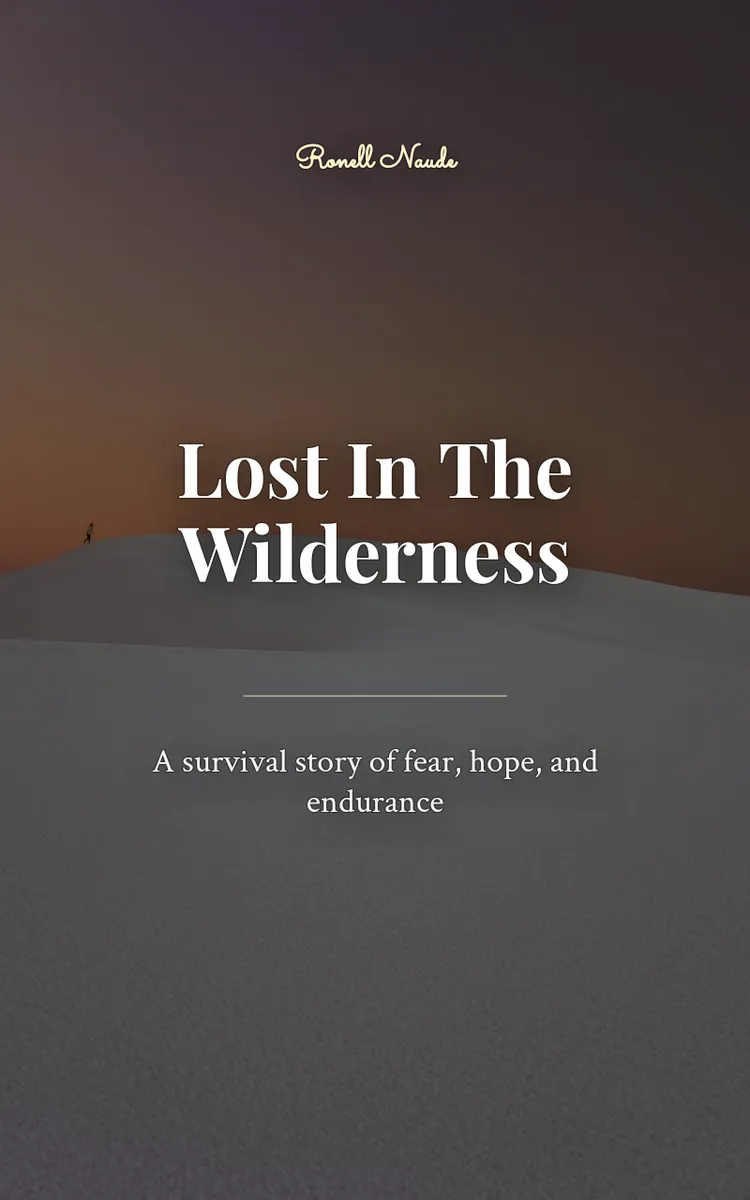
"Lost In The Wilderness" is a curiosity book by Ronell Naude with 8 chapters and approximately 13,800 words. Survival experience in the wilderness over several days.
This book was created using Inkfluence AI, an AI-powered book generation platform that helps authors write, design, and publish complete books.
Frequently Asked Questions
What is "Lost In The Wilderness" about?
Survival experience in the wilderness over several days
How many chapters are in "Lost In The Wilderness"?
The book contains 8 chapters and approximately 13,800 words. Topics covered include The 10-Minute Panic Reset, Find Water Without Guessing, Fire That Survives Wind, Shelter: The Heat-Anchor Build, and more.
Who wrote "Lost In The Wilderness"?
This book was written by Ronell Naude and created using Inkfluence AI, an AI book generation platform that helps authors write, design, and publish books.
Write your own curiosity book with AI
Describe your idea and Inkfluence writes the whole thing. Free to start.
Start writingCreated with Inkfluence AI


