
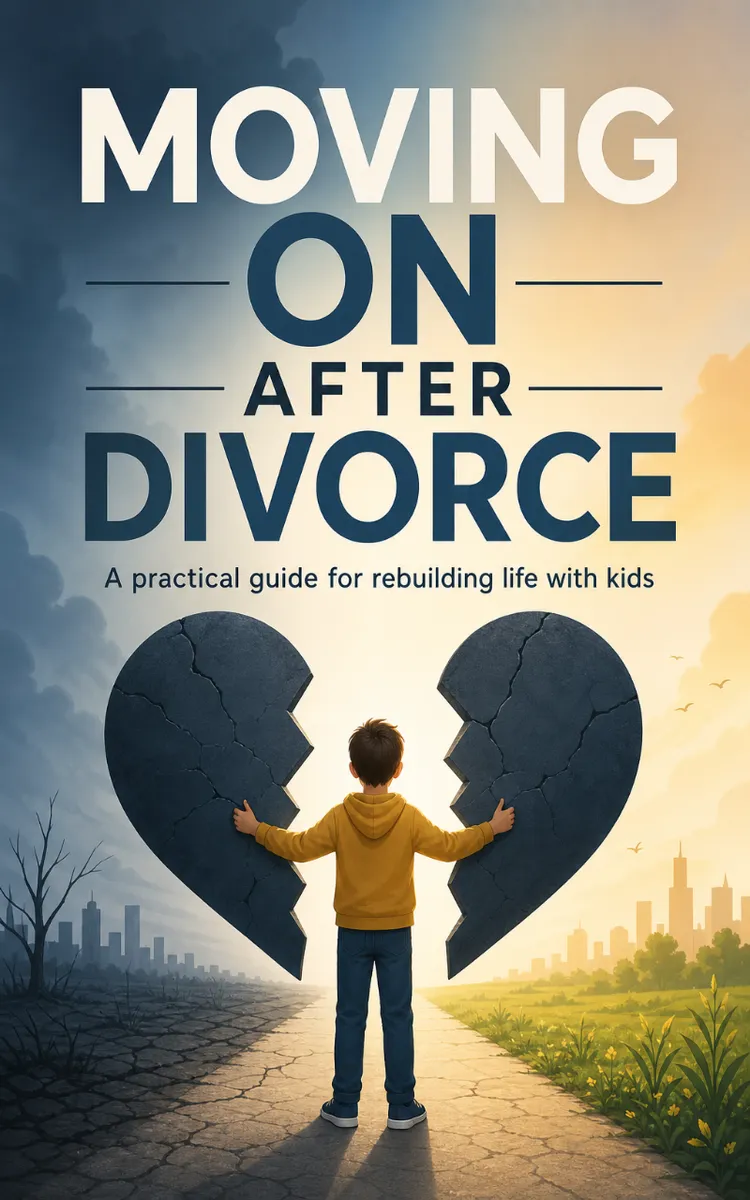
Moving On After Divorce
Created with Inkfluence AI
Coping with divorce and rebuilding life while parenting children
Table of Contents
- 1. Rebuilding Your Post-Divorce Identity
- 2. Letting Go of Divorce Story Beliefs
- 3. Co-Parenting Boundaries Without Guilt
- 4. Communicating With the 3-Message Rule
- 5. Creating a Weekly Stability Routine
- 6. Managing Triggers With the Pause Plan
- 7. Healing Your Attachment Through Repair
- 8. Designing a Purpose-Forward New Chapter
Preview: Rebuilding Your Post-Divorce Identity
A short excerpt from “Rebuilding Your Post-Divorce Identity”. The full book contains 8 chapters and 14,491 words.
When Your Name Feels Like a Costume
Nina, 34, stood in the kitchen with her coffee cooling in the exact mug her ex used to reach for every morning. For a few seconds, she didn’t feel sad or angry - she just felt… blank. Like she was waiting for someone to walk in and tell her what the day was supposed to be.
Later that week, she caught herself introducing herself at school like she was still half-attached to the marriage. Same tone. Same smile. Same “I’m fine.” But inside, the truth was louder: she couldn’t tell where “Nina” ended and “the version of Nina we built together” began. And when the kids asked questions about the changes - new routines, new rules, the missing presence at dinner - she felt the tug to answer as if she had it all figured out. She didn’t. She just needed to feel solid again.
How do you rebuild who you are when the marriage is gone but the old identity still keeps showing up?
The Identity Rebuild Map: Finding “You” After the Marriage
A lot of people think rebuilding your identity means finding a new hobby, buying a fresh outfit, or turning divorce into a “new chapter” with a shiny beginning. Those things can help, sure. But if you don’t build a stable sense of self underneath, you end up with a pretty cover and shaky pages.
That’s where the Identity Rebuild Map comes in. It’s not complicated, and you don’t need a journal the size of a textbook. It’s a simple way to name the parts of you that still exist, even when the marriage ended - and to reconnect them so your day-to-day life feels like yours again (especially when you’re parenting).
Old Belief: “Once the marriage ended, I lost myself, so I have to reinvent from scratch.”
New Reality: “I didn’t lose myself - I’m just untangling myself. My identity is still here; I’m relearning how to live from it.”
When Nina started using the Identity Rebuild Map, she didn’t suddenly become a different person. She became more accurate. She realized she’d been using the marriage like a frame - something that made decisions feel easier because “we” decided. Now she was learning to decide as “me,” even if her first choices felt awkward.
Here’s why that shift matters: when your identity is fuzzy, parenting decisions get harder. You second-guess your tone. You over-explain. You try to be everything for everyone because you’re afraid there won’t be a “you” left if you stop performing. But when you can clearly name your values and your boundaries, your kids feel it. Not as a speech, not as a lecture - just as calm, consistency, and the sense that you’re steady even when life is messy.
Why the “Untangling” Reframe Actually Works
Before the divorce, your identity likely got braided with your partner’s - your routines, your priorities, your future plans, your way of handling conflict. Even if the marriage wasn’t healthy, it still shaped you. So when it ends, it can feel like you’re mourning your old life and trying to figure out who you are without the scaffolding.
The “untangling” approach helps because it doesn’t demand a dramatic personality makeover. It invites you to look at what’s still true. Nina realized she still loved teaching, still cared deeply about fairness, still had a strong “protect the kids” instinct. Those weren’t erased. They were just buried under “how we did things.” Once she started honoring those parts, her confidence didn’t come from pretending she was fine. It came from recognizing she was already a person with a center.
A concrete example: one night, Nina had to set a new bedtime rule during her parenting time. In the past, she might’ve wavered - maybe softened it, maybe negotiated too much - because she was used to “we’ll figure it out together.” After untangling, she approached it like this: This is my boundary, and it’s about helping the kids feel safe and rested. She still said it kindly. But she didn’t bend until she felt guilty. The kids adjusted faster than she expected, and Nina felt more like herself afterward.
Signs You’re Still Living in a “Marriage-Edition” Self
Sometimes the old identity keeps running your life even when you’re trying to move forward. It’s not that you’re stuck - it’s that your brain is using familiar patterns to protect you. Here are a few signs that the marriage-edition self is still driving:
1. You feel “behind” in your own life. Like everyone else is living normally and you’re just trying to catch up - especially when you’re making decisions that used to be shared.
2. Your mood depends on whether the relationship is calm. If things are tense between you and your ex, you feel like your whole personality disappears.
3. You default to people-pleasing when you’re triggered. You say yes when you want to say no, then resent it later (or you over-explain because you fear conflict).
4....
About this book
"Moving On After Divorce" is a self-help book by Francois Mutombo with 8 chapters and approximately 14,491 words. Coping with divorce and rebuilding life while parenting children.
This book was created using Inkfluence AI, an AI-powered book generation platform that helps authors write, design, and publish complete books. It was made with the AI Self-Help Book Writer.
Frequently Asked Questions
What is "Moving On After Divorce" about?
Coping with divorce and rebuilding life while parenting children
How many chapters are in "Moving On After Divorce"?
The book contains 8 chapters and approximately 14,491 words. Topics covered include Rebuilding Your Post-Divorce Identity, Letting Go of Divorce Story Beliefs, Co-Parenting Boundaries Without Guilt, Communicating With the 3-Message Rule, and more.
Who wrote "Moving On After Divorce"?
This book was written by Francois Mutombo and created using Inkfluence AI, an AI book generation platform that helps authors write, design, and publish books.
How can I create a similar self-help book?
You can create your own self-help book using Inkfluence AI. Describe your idea, choose your style, and the AI writes the full book for you. It's free to start.
Write your own self-help book with AI
Describe your idea and Inkfluence writes the whole thing. Free to start.
Start writingCreated with Inkfluence AI


