
Read the first chapter
The whole of chapter one, free. About 11 min. Turn the pages with the arrows, your keyboard, or a swipe.
Chapter 1
The Room That Kept You Waiting
The key clicked twice in the lock, a sound too crisp for the thick carpet under my feet. Someone—boots fading in the hallway, a coat brushing fabric—had just told me to wait, and then the door sealed me into a room that felt built to hold silence. The air was stale with old varnish and something metallic that didn’t belong to paint or brass. A single table stood in the center, its legs sunk into the floor as if the room had pressed it there and decided it would never move again.
I kept my hands visible anyway. I didn’t know why. The rules had been spoken like they were simple—wait alone, don’t touch anything, and don’t open the door—but the way the voice had said it made “simple” feel like a lie people told before they pushed. I stood with my back to the wall, listening to the distant shuffle of footsteps that never quite came back and the faint hum that lived behind the plaster. It wasn’t electrical. It was deeper than that, a pressure in my teeth, as if the room itself were holding a note and waiting for me to sing along.
The want in me was immediate and ugly: I wanted the door to open again. I wanted whoever had sent me in—whoever had decided I was expendable—to return and explain what the waiting was for. I wanted time to undo itself. If the room was meant to keep me still, then I was going to be still only long enough to survive it.
The first obstacle came dressed as patience. Minutes slid by without footsteps, without voices, without any sound from the hall. My watch face glowed faintly, then dulled, as if the light had decided it wasn’t sure it was allowed. I walked toward the table, not because I wanted to touch it, but because the room’s center felt like the only place the darkness didn’t reach as far into the corners.
When I drew close, the table’s surface looked too clean for a room that smelled of age. No dust clung to the edge. No scratches marred the wood. In the middle sat a sword.
I didn’t see it at first. My eyes kept finding the space around it, the way darkness refuses to admit it has shape. Then the sword’s presence resolved into something physical: a crossguard like a bar of iron dragged from a furnace, a blade that drank the dim light and held it. Around it, darkness pooled—not creeping from the edges, but gathered as if it had been poured into a shallow circle. Within that pool, the sword emitted brilliant light, bright enough to make the carpet’s fibers throw back tiny sparks, bright enough to make my skin prickle.
I took a step back so fast my heel snagged on the carpet seam. “Hey,” I called, voice cracking against the room’s hush. “Who put that here?”
No answer came. The hum behind the plaster deepened, and the air cooled in a single breath, like a draft exhaled from somewhere too far down in the building to be a vent. I tried the door again. The handle turned under my palm, but it turned without giving. The latch clicked back into place as if it had never been touched.
“Okay,” I said, and my own words sounded wrong, too loud, too human. “Okay. I’m not touching anything. I’m just— ”
The table’s light flared. Not brighter, exactly. Sharper. Like the room adjusted its focus to see me more clearly. The darkness around the sword thickened, then rippled, and for a heartbeat I swore I heard a sound like wet fabric being torn—distant and impossible, the kind of noise you only hear when you’re dreaming something you can’t afford to wake from.
My throat tightened. “That wasn’t in here a second ago,” I muttered, though I couldn’t have said what “a second ago” meant inside a locked room.
I backed away again, keeping my gaze locked on the sword. I didn’t want to look at the corners, but the corners seemed to look back. The hum sharpened into a rhythm that matched my pulse and then slipped out of sync, turning my body into a metronome for something else.
A scrape sounded behind me.
I spun. The door stood exactly where it had stood, sealed and indifferent. No movement in the hallway. Yet the scrape came again, closer this time, like nails worrying wood.
The carpet near the table shifted.
Not the way fabric wrinkles. It moved like something heavy settling under it, the fibers lifting and dropping in a slow pattern. My stomach turned hard. I forced myself not to run—running had been the mistake in stories, and stories were built from warnings—but my legs wanted to flee the room’s center, as if the table were a magnet and I were metal.
“Stop,” I said, though I didn’t know who I was ordering. “Stop it.”
The hum swelled until it vibrated in my jaw. The light from the sword held steady while the darkness around it churned, and in that churn I caught glimpses of shapes that didn’t belong to any geometry I understood. Then the carpet split with a soft, obscene sound—like cloth tearing in a tailor’s shop—and something rose from beneath the table’s shadow.
Bodies.
Ten of them.
They emerged in a half-circle around the table, not neatly arranged, not placed. They were laid out like the room had decided “found” was the same as “finished,” as if the moment of opening hadn’t required careful hands. Limbs sprawled at angles that made my mind recoil. Blood darkened the carpet in thick patches, soaking into fibers and spreading in slow, patient blooms. The smell hit a moment later—iron and something sour that made my eyes water. Most of the faces were visible, but not whole. The torn-apart injuries weren’t just wounds; they were rearrangements, as if something had taken them apart for parts and then lost interest in putting them back.
My knees threatened to fold. I grabbed the wall to keep upright, fingers clutching at paint that felt wrong under my skin—too cool, too damp. One body’s chest didn’t rise. Another’s eyes stared upward with glazed certainty, unblinking, unbothered by the fact I had entered the room and made it worse by surviving.
I couldn’t breathe properly. “No,” I whispered, and the word didn’t carry meaning so much as it carried denial.
Behind me, the scrape started again, now from the floor itself, as if the room were dragging something across its underside. I stared at the nearest corpse. The clothing was familiar in a way my brain refused to name. The belt buckle, the cuff of a shirt I’d seen earlier in the hall when the staff directed people toward their waiting rooms. Faces that had nodded at me in passing—people I’d watched take off coats and wait their turn—now lay in pieces of stillness.
I tried to remember how long I’d been alone. A minute, maybe. Long enough for the door to lock and the hallway to go quiet. Not long enough for this.
The sword’s brilliant light made the blood shine. It shouldn’t have. Light like that belonged to clean things—candles, stage lamps, and hospital corridors where someone survives. Here it made the horror more vivid, not less. The darkness around the blade pressed outward in slow waves, and with each wave the air seemed to tighten, drawing me closer despite my efforts.
“Who did this?” I asked, and my voice came out thin. I didn’t expect an answer. I expected the room to remain mute, at least in the way a locked room should.
Something moved in the darkness.
Not a person. Not a shadow cast by a body. It was more like the dark itself shifted attention. The sword’s light flared once, and in that flash I saw the edges of the darkness form a boundary, a circle so tight it seemed drawn around the table with a blade of its own. As I took a step sideways to avoid the pool, the boundary followed, sliding across the floor as if the room had eyes.
My heartbeat stuttered. “No,” I said again, louder this time. I forced myself to turn my body away from the table without turning my head. I couldn’t afford to look away, but I couldn’t afford to let the darkness decide I was moving toward it.
The door handle rattled behind me.
Once. Twice. A third time, harder, like someone on the other side had grabbed it and was testing the lock with angry hands. My skin went cold. Hope flared—stupid, immediate hope—and then died when the rattling stopped.
Silence returned, thick as the carpet’s fibers. The hum resumed its steady pressure, and the darkness around the sword seemed to settle, satisfied.
A voice came from the hallway, muffled by the door—male, strained, too close to be coming from far away. “Elias?” it called, and my name sounded wrong in someone else’s mouth, like it had been borrowed from a book.
I swallowed blood that wasn’t there. “Who is that?” I demanded, stepping toward the door before I could stop myself.
The voice paused. I heard breath, ragged and close. "I—" it began, then cut off with a wet, tearing sound I felt in my teeth.
My hand slammed against the door. The wood didn’t give. “Stop!” I shouted. “Open it!”
The darkness in the center of the room rippled, answering my anger with motion. The sword’s light sharpened until it hurt to look at. The pool of black around it thickened like ink in water, and the air tasted suddenly of copper and something burnt.
I backed away from the door, drawn back toward the table by the gravity of the sword’s attention. My mind scrambled for logic—someone must have locked me in wrong, someone must have made a mistake, someone must still be alive out there—but the bodies around the table were a brutal correction. They didn’t belong to a mistake. They belonged to a mechanism.
“I didn’t touch anything,” I said, and I hated how small it sounded. I needed to believe the room had rules I could follow, rules that could keep me intact. “I waited. I waited alone.”
The sword’s light flickered once, like a response. Then the darkness shifted again, and the air between me and the table changed—thinner, colder, as if the room were drawing a path for itself.
A sound came from one of the corpses.
Not a movement. Not breathing. A faint clicking, like teeth chattering without a mouth behind it. It echoed in the hum, stitched into the rhythm that had been building in my jaw.
I couldn’t tell if the room was mocking me or warning me. Either way, I was running out of options.
The decision arrived the way a blow does—sudden and unavoidable. If the room was going to control the door, control the darkness, and feed on whatever had happened here, then the only thing I could do was confront the center of it. The sword was present. The sword emitted light. The sword sat on the table like an answer someone didn’t want to explain.
I moved.
My feet crossed the carpet toward the table, slow at first, then faster when the darkness didn’t snap shut around me. The pool followed, sliding with me. The light from the blade painted my hands in a harsh color, making the blood stains on the carpet look fresh even where they had already begun to dry.
I reached the table’s edge. The wood was cool and too smooth, like it had been polished with something that wasn’t oil. My fingers hovered a breath above it, and the hum rose until it vibrated up my wrist.
“Don’t,” I heard myself say, though I didn’t know who I was speaking to.
The sword’s light brightened—not enough to blind me, but enough to reveal details that hadn’t been visible before. Etchings crawled along the blade, not in a language I recognized, but in lines that felt like they were meant to be read by the dark itself. The light didn’t reflect off the markings. It seemed to come from inside the metal, pushing outward against the black that clung to it.
I swallowed hard. “What do you want?”
The room answered by changing.
The darkness around the sword pulled inward, tightening the circle until it pressed close to the table legs. The bodies around me looked suddenly less like corpses and more like evidence laid out for inspection. The smell sharpened. The hum became almost melodic—too controlled to be random, too precise to be an accident.
And then I realized the most terrifying part: the bodies weren’t arranged where the room could have placed them after the fact. They were arranged where the room expected them to be when it started.
The clicking sound rose from the floor again, from under the carpet, from under the table’s shadow. It wasn’t teeth this time. It was something assembling itself out of absence.
I jerked my gaze up, scanning the waiting room in a single sweep. Ten dead. The sword. The table. The door.
And, on the far wall where there had been nothing but paint and a faint seam in the plaster, the darkness thickened into a shape—tall and indistinct, as if someone had sketched a person using smoke and then refused to fill in the lines. It wasn’t coming from the sword now. It was arriving from the room.
The sword’s light continued to pour into the pool, brilliant and indifferent, while the surrounding dark gathered tighter, revealing more of the shape with each second. My breath came out in a thin, shaky stream. I stood over the table with my hands hovering near the blade, my body locked between the urge to flee and the instinct to stay still in the face of something that moved on rules I hadn’t been given.
I wasn’t alone.
The door behind me stayed shut, and the hallway voice—if it had ever been real—didn't return. The darkness on the wall leaned forward, slow as a thought forming, and the sword’s light flared once more, bright enough to make the torn bodies cast long, fractured shadows that didn’t match where I stood.
The room had kept me waiting.
Now it had started counting.
End of chapter one. 7 more chapters and about 20,313 words in the full book.
Swipe or use the arrows to turn the page


What's inside: 8 chapters
- 1. The Room That Kept You Waiting
- 2. Ten Corpses, One Missing Truth
- 3. The Hallway That Swallowed Footsteps
- 4. A Name Written in Darkness
- 5. When the Sword Chose a Witness
- 6. The Choice That Broke Elias
- 7. Light Through the Cracks of Night
- 8. Leaving the Sword in the Dark
About this book
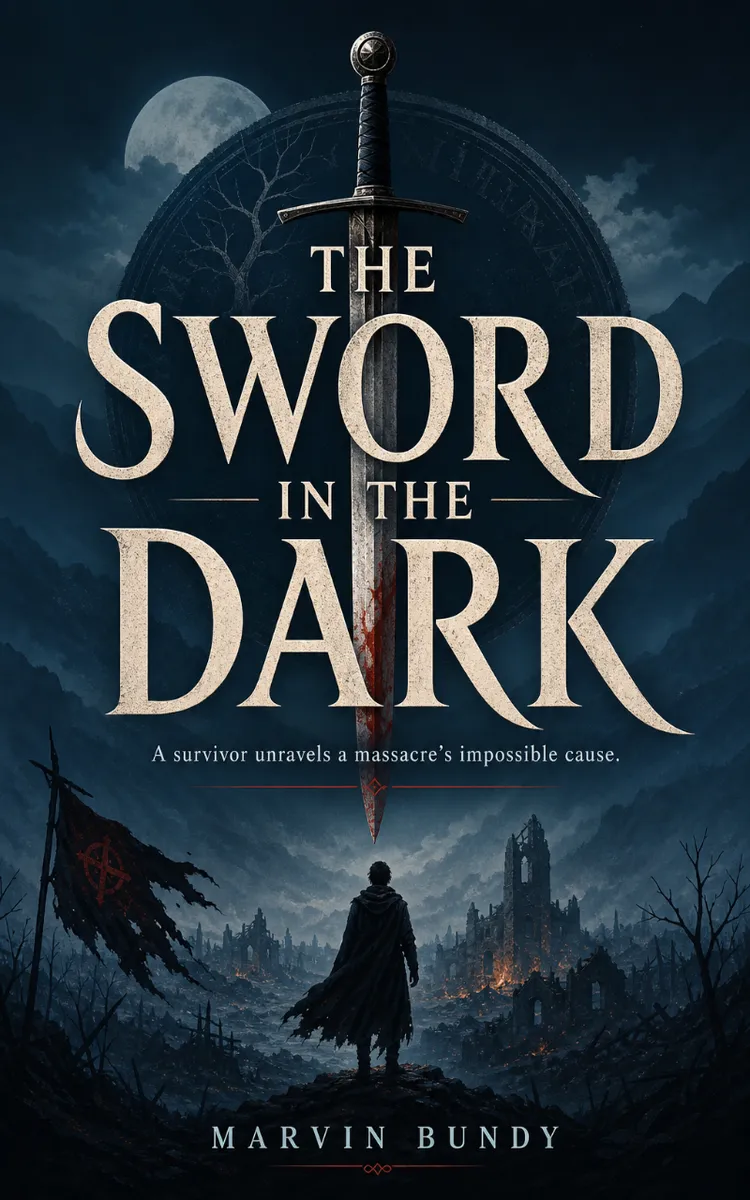
"The Sword In The Dark" is a fiction book by Marvin Bundy with 8 chapters and approximately 20,313 words. A survivor witnesses a room-to-massacre supernatural event..
This book was created using Inkfluence AI, an AI-powered book generation platform that helps authors write, design, and publish complete books. It was made with the AI Novel Writer.
Frequently Asked Questions
What is "The Sword In The Dark" about?
A survivor witnesses a room-to-massacre supernatural event.
How many chapters are in "The Sword In The Dark"?
The book contains 8 chapters and approximately 20,313 words. Topics covered include The Room That Kept You Waiting, Ten Corpses, One Missing Truth, The Hallway That Swallowed Footsteps, A Name Written in Darkness, and more.
Who wrote "The Sword In The Dark"?
This book was written by Marvin Bundy and created using Inkfluence AI, an AI book generation platform that helps authors write, design, and publish books.
How can I create a similar fiction book?
You can create your own fiction book using Inkfluence AI. Describe your idea, choose your style, and the AI writes the full book for you. It's free to start.
Write your own fiction book with AI
Describe your idea and Inkfluence writes the whole thing. Free to start.
Start writingCreated with Inkfluence AI


