
Best Low-Competition Ebook Niches for 2026
Where ebook demand outruns supply in 2026: AI workflows for specific professions, audience-specific finance, health micro-niches, certification guides, and emerging micro-niches, with a validation framework.
Quick Answer
The best low-competition, high-demand ebook niches for 2026 include AI productivity workflows, personal finance for specific demographics (freelancers, Gen Z), health micro-niches (gut health, sleep optimisation), career transition playbooks, and role-specific automation guides. The key is specificity - a niche with 10,000 desperate buyers outperforms a topic with 1 million casual browsers. This guide walks the niche families where that math holds in 2026, with a validation framework for testing your pick. Use an AI ebook generator to go from niche selection to first draft in under an hour.
Searching for the best ebook niches for 2026 - specifically topics with low competition and high demand? This guide shows you how to spot underserved angles, validate buyer intent, and pick a niche readers actually pay for.
Updated August 2026: Demand is shifting toward workflow-driven niches, micro-transformations, and role-specific AI guides. The core framework below still holds; the examples now skew toward faster-moving categories.
Need a score-based decision framework? Use the High-Demand Low-Competition Ebook Niches learn guide for weighted scoring, data snapshots, and Inkfluence execution blueprints.
Want to see what is trending right now? See the latest ebook trends for 2026.
Once you pick a niche, use Ebooks Search Engine Optimization (2025) to get the landing page ranking for that niche. If you want a fast outline-to-export path, start with the AI Ebook Workflow.
Popular playbooks: See niche ideas for entrepreneurs, content creators, coaches, and students.
Turn this niche list into a launch plan
- High-Demand Low-Competition Ebook Niches for niche scoring and first-book selection.
- Kindle Keyword Research for Beginners for the 7-field keyword workflow.
- Amazon KDP Categories for Beginners for category placement strategy.
- Self-Publishing on Amazon KDP for upload and launch sequencing.
- KDP Select vs Wide Distribution for channel strategy after launch.
- Ebook Marketing for post-publish growth.
Rising intent cluster (2026)
Two fast-growing search themes right now are fiction-first AI workflows and zero-friction book drafting:
- AI novel writer free unlimited workflow guide
- AI book writer free no sign-up playbook
- AI audiobook generator for text-to-audio expansion
The Golden Rule of Niche Selection
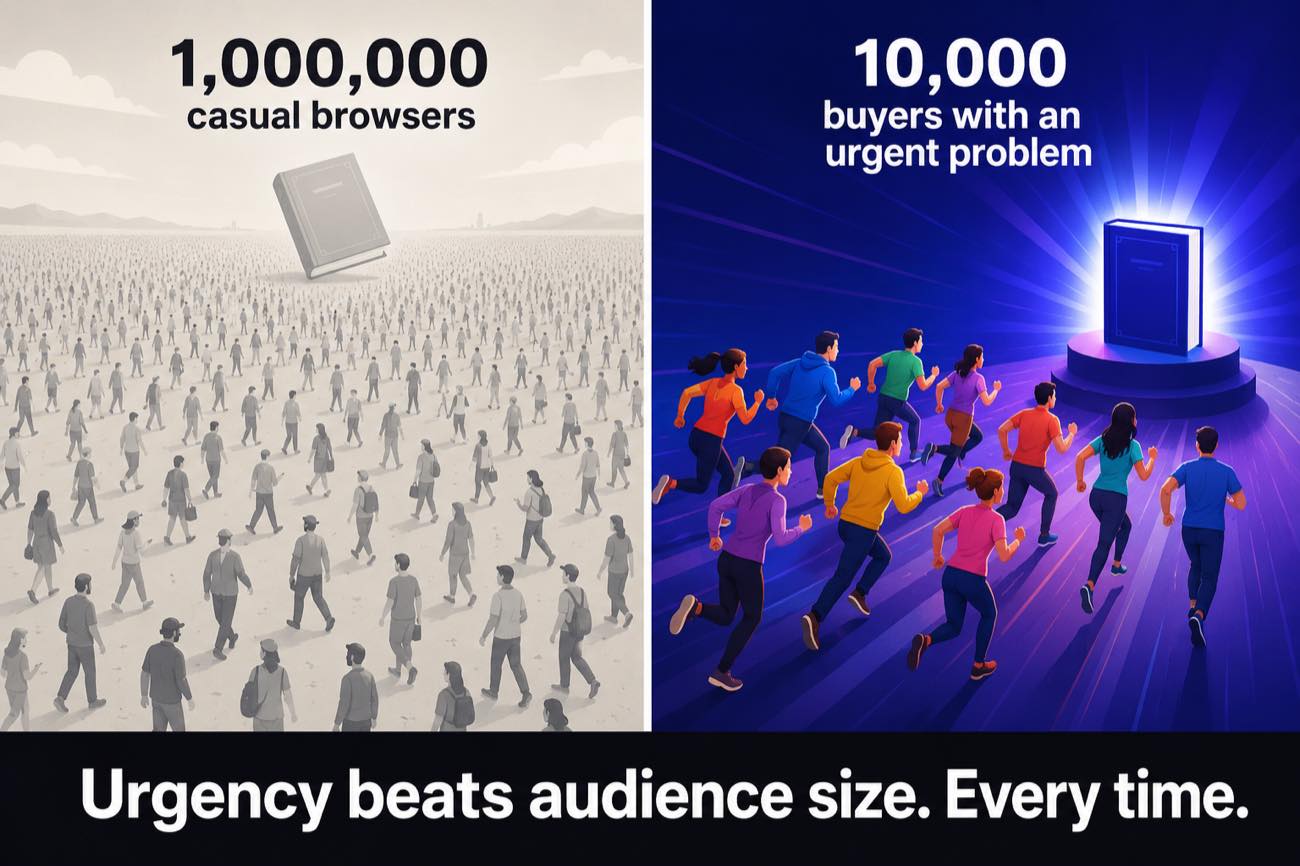
A niche with 10,000 desperate buyers beats a niche with 1 million casual browsers. Urgency and specificity trump audience size every time.
The Death of the Obvious Niche
In 2019, you could write a generic ebook about productivity and sell copies. In 2021, you could write about cryptocurrency and watch the money roll in. By 2023, even "AI for beginners" had become a crowded wasteland of indistinguishable titles.
Every obvious topic has been strip-mined. The gold rush is over.
But here is what the discouraged masses miss: the end of easy pickings is actually the beginning of real opportunity. Because when everyone abandons a field, thinking it is exhausted, the people left standing find something unexpected. They find that specificity is the new scarcity. They find that a narrow niche, done well, outperforms a broad topic done adequately. They find that readers will pay premium prices for ebooks that speak directly to their exact situation.
The question is no longer "what topic should I write about?" The question is "whose specific problem can I solve better than anyone else?" And once you answer that question, the actual writing process becomes almost secondary.
When you're ready to move from idea to draft, use Inkfluence to create a book with AI (or the Free Ebook Creator) to generate a structured first version, then use Ebook SEO to optimize the page you'll promote. For longer guides where you want chapter-level continuity, the full AI book writer takes the same niche idea and writes a complete book end-to-end. If you're building an opt-in asset, the Lead Magnet Generator turns the same topic into a high-converting download.
Why Generic Fails and Specific Sells
Consider two ebooks about meal planning. The first is titled "Healthy Meal Planning: A Complete Guide." The second is titled "Keto Meal Prep for Night Shift Workers."
The first competes with approximately 47,000 other titles. It speaks to everyone, which means it speaks to no one with urgency. A reader browsing this title thinks: "Maybe I will get to this later."
The second has perhaps twelve competitors. But more importantly, when a night shift nurse who has been struggling with keto discovers this title, she does not think "maybe later." She thinks "finally, someone who gets it." She buys immediately. She might even pay more than she would for the generic guide, because this one actually addresses her constraints: eating at 3 AM, meal prepping on random days off, staying in ketosis despite a schedule that fights her biology.
This is the psychology of niche selection that most guides miss. It is not just about low competition metrics. It is about creating the experience of being seen. The best niches create a moment of recognition in the reader: "This person understands my specific situation."
Generic Approach
"Healthy Meal Planning"
- 47,000+ competitors
- "Maybe later" response
- Race to the bottom on price
Specific Approach
"Keto Meal Prep for Night Shift Workers"
- ~12 competitors
- "Finally, someone gets it!"
- Premium pricing justified
The Overlooked Territories of 2026
What follows is not a list of niches to copy verbatim. It is a map of territories where demand exceeds supply, where the people asking questions have not yet found satisfying answers, where an ebook done thoughtfully will find an eager audience.
AI Integration for Specific Professions
Everyone knows AI is transforming work. Almost no one has written the definitive guide for their specific profession. The real estate agent knows ChatGPT exists but does not know how to use it for listing descriptions, client follow-ups, and market analysis in a systematic way. The therapist has heard that AI can help with session notes but worries about ethics and compliance. The accountant sees AI tools everywhere but cannot figure out which ones actually integrate with their existing workflow.
These are not people looking for "AI basics." They have moved past curiosity into frustration. They want someone who understands their profession AND understands AI to connect the dots. Most AI content is written by tech people who do not understand specific industries. Most industry content is written by professionals who understand their field but treat AI as an afterthought.
The opportunity is in the intersection. "AI Workflow Automation for Independent Insurance Agents" is not a sexy title, but it speaks directly to a specific person with a specific problem and disposable income to solve it. And with modern AI ebook tools, you can test these niche ideas faster than ever before. For 100 ready-to-use topics across 10 niches, see our ebook ideas that sell in 2026 list.
Certification Study Guides That Do Not Suck
Professional certifications are a peculiar market. The official study materials are comprehensive but dense and expensive. The free resources online are scattered and often outdated. What people actually want is something in between: focused, practical, current, and digestible.
The AWS Solutions Architect exam. The PMP certification. Google Analytics 4. The new AI-related certifications emerging constantly. Each of these has official resources that cost hundreds of dollars and free resources that are incomplete. Each has thousands of people searching for "cheat sheets," "study guides," and "exam prep" who would happily pay $15 to $30 for something well-organized and actually helpful.
The key insight is that these buyers are highly motivated. They are not browsing casually. They have a test date scheduled. They have career advancement riding on the outcome. They are the opposite of the "maybe someday" reader. They are the "I need this solved now" reader.
Financial Guidance for Non-Traditional Workers
The financial advice industry was built for W-2 employees with predictable incomes, employer-sponsored retirement plans, and straightforward tax situations. This describes an increasingly small percentage of how people actually work.
The content creator managing income from multiple platforms. The gig worker with fluctuating monthly earnings and no 401k. The person with a side business they have never properly incorporated. The remote worker who moved states and is not sure which one to pay taxes in. The person who made money in crypto and has no idea what to do when tax season arrives.
These people google their questions and find generic advice that does not apply, or they find professional advice that costs hundreds of dollars per hour. An ebook that speaks directly to their situation, written by someone who has navigated it themselves or who specializes in these cases, fills a genuine gap. These make excellent lead magnets for financial coaches looking to attract clients.
Mental Health for Specific Circumstances
Mental health content has exploded online, which sounds like a saturated market until you look more closely. Most mental health content is either professionally clinical (inaccessible to casual readers) or generically inspirational (unhelpful for specific situations).
The parent with ADHD trying to manage their symptoms while raising kids. The healthcare worker experiencing burnout after four years of pandemic-era stress. The remote worker whose anxiety has gotten worse without the structure of an office. The person going through divorce who also has depression. The caregiver experiencing anticipatory grief.
Each of these is a person with a compound problem that generic mental health advice does not address. They do not need another reminder to practice self-care. They need strategies that account for their specific constraints and circumstances.
Technical Skills for Non-Technical People
There is a persistent gap between technical documentation and what regular people actually need. The small business owner who needs to understand local SEO but finds most guides incomprehensible. The author who wants to set up a simple website but gets lost in the jargon. The parent who wants to set up reasonable digital boundaries for their kids but cannot parse the settings.
The mistake most people make here is writing "Tech Simplified" guides that are still too technical. The real opportunity is in radical simplification for specific use cases. Not "Local SEO Explained" but "Getting Your Plumbing Business to Show Up on Google." Not "Website Basics" but "A Website for Your Therapy Practice in an Afternoon."
Found Your Niche? Test It Fast
Use Inkfluence to generate a sample chapter in minutes. See if your niche idea has legs before committing weeks to writing.
Try the AI Ebook GeneratorThe Validation Question Most People Skip
Here is where niche selection usually goes wrong: someone identifies an underserved topic, assumes demand exists, writes the ebook, and discovers too late that no one was actually searching for it.
Low competition is meaningless without demand. A topic with zero competition and zero searches is just obscure, not opportune.
The validation process does not need to be complicated, but it does need to happen. Search for your proposed topic on Amazon's Kindle store. If the top results have fewer than fifty reviews and are several years old, you have found low competition. But also check if those books exist at all. If Amazon shows you tangentially related results rather than direct matches, ask whether that is because you have found an untapped niche or because no one is looking for this.
Use Google Trends to check if interest in your topic is growing, stable, or declining. Look at search volumes for related keywords. Browse Reddit, Quora, and Facebook groups to see if people are asking questions that your ebook would answer. Understanding how ebooks get ranked and discovered will help you evaluate whether a niche has room for new entrants. For a ranked list of niches with live demand signals right now, see our roundup of the 10 trending ebook topics for 2026.
The sweet spot is a topic where people are clearly asking questions, where existing answers are inadequate, and where you can provide something meaningfully better.
One pattern worth adding from the publishing side: the niches that actually get finished and published tend to be the narrow, practical ones. Broad, ambitious topics stall because the scope is endless, while a tightly scoped guide for a specific person with a specific problem has a clear finish line. A narrow niche is not only easier to rank for, it is easier to complete, and an unfinished book ranks for nothing.
Quick Niche Validation Checklist
The Specificity Multiplier
Whatever niche you are considering, ask yourself: can I make this more specific?
Not "meal planning" but "meal planning for a specific diet." Not "meal planning for keto" but "meal planning for keto for a specific lifestyle." Not "meal planning for keto for busy people" but "meal planning for keto for night shift workers."
Each layer of specificity narrows your potential audience but deepens the connection with the audience that remains. And here is the counterintuitive truth: a smaller, more passionate audience often generates more revenue than a larger, indifferent one. The night shift keto guide might sell to thousands rather than tens of thousands, but it sells at higher conversion rates, generates more referrals, and creates customers who actually implement what they learn.
There is a limit to this, of course. "Keto meal planning for left-handed night shift nurses who live alone with two cats" is too narrow. But most people err in the opposite direction, keeping their topic broad out of fear of missing potential buyers, and in doing so they become invisible in a sea of sameness.
What Actually Differentiates an Ebook
Finding the right niche is necessary but not sufficient. You also need to deliver something the existing options do not.
Currency matters. If the top results in your niche were published in 2021, you can win by simply being current. Tools change. Platforms update. Strategies that worked two years ago may be obsolete. "Updated for 2025" is a meaningful differentiator when your competitors are not.
Depth matters. Many ebooks in underserved niches are thin, clearly written quickly to capture an opportunity rather than genuinely serve readers. Going deeper, being more thorough, including more examples and case studies creates a product that generates word-of-mouth.
Usability matters. Include the templates, checklists, and worksheets that help readers implement what they learn. The ebook that comes with a ready-to-use spreadsheet is worth more than the ebook that just tells you to create a spreadsheet. Understanding ebook monetization strategies helps you build these value-adds into your product from the start.
Voice matters. This is harder to quantify but often the decisive factor. An ebook that sounds like a real person sharing hard-won knowledge connects differently than one that sounds like it was assembled from SEO-optimized fragments. Readers can tell the difference. They pay more for authenticity.
The 4 Differentiators That Win
Currency
"Updated for 2026" beats 2021 content
Depth
Go deeper than thin, rushed competitors
Usability
Include templates and worksheets
Voice
Sound like a real person, not a bot
The Long Game of Niche Selection
One final consideration that most niche guides ignore: you are going to live with this topic for a while. You will write the ebook. You will market it. You will answer customer questions. You might update it, create related products, build an audience around it.
Choosing a niche purely on market opportunity, without any interest in the subject, is a path to burnout. The best niche is one where demand exists and where you have some genuine connection to the topic. You do not need to be the world's foremost expert. You do need to care enough to do the work well and to sustain interest over time.
The people who build successful ebook businesses almost always have some combination of market insight and genuine interest. The market insight finds the opportunity. The genuine interest provides the energy to execute.
Starting From Where You Are
If you have read this far and still feel uncertain about which niche to pursue, start with what you know. What professional experience do you have that others might value? What problems have you solved in your own life that others face? What topics do you find yourself explaining to friends, colleagues, or strangers online?
The best ebook niches often come from intersection points: your professional background plus a personal interest. Your technical skills applied to a specific industry. Your hard-won knowledge from navigating a particular challenge.
The niche does not need to be discovered in the market first. Sometimes it is discovered in yourself, and then validated in the market.
The ebook gold rush is over. What remains is something better: the opportunity to create genuinely valuable content for people with specific needs. That is harder than chasing trends. It is also more sustainable, more rewarding, and ultimately more profitable.
Your niche is out there. It might be narrower than you expected. It might require more specificity than feels comfortable. But when you find the readers who have been waiting for exactly what you have to offer, you will understand why generic never worked anyway.
The Hidden Economics Behind Profitable Ebook Niches
To understand why certain ebook topics thrive, you have to understand what people actually pay for. Buyers aren't paying for information - they're paying for transformation. They want a shorter path to a goal, a clearer process, a reliable system, a faster outcome, a reduction in uncertainty, or relief from a specific frustration. High-demand niches provide all of this in one package.
Creators sometimes assume that the size of a niche determines profitability. But in today's market, the opposite is true. The profitability of an ebook niche comes from the urgency and intensity of the problem, not the number of people who have it. A niche with 10,000 people who desperately need a solution will always outperform a niche with one million people who feel mild curiosity.
In 2026, readers want actionable frameworks tailored to their exact situation. That's why niche guides for specific professions, workflows, and platforms are outperforming generic evergreen topics.
Most Profitable Ebook Niches in 2026
Profitability is a function of three variables: average selling price, repeat-purchase rate, and upsell path. The niches below score well on all three. The figures are the list-price ranges you will typically see for titles like these on Gumroad and Etsy; browse either marketplace for any of these categories and you can verify the going rates yourself.
- Role-specific AI automation guides ($29 to $79 per title). "AI for dental office managers," "ChatGPT for HVAC estimators," "Claude for junior corporate lawyers." Buyers are professionals solving a work problem, they pay business prices, and every title seeds a 2-3 book series.
- Certification exam study packs ($19 to $49 per title). AWS, PMP, CFA, NCLEX, Series 7. Candidates have a test date and a salary jump riding on passing, which is about the strongest buying urgency an ebook can have, and the niche refreshes every time exam content updates.
- Health micro-protocols ($15 to $39 per title). Gut health, sleep optimisation, chronotype-based routines, perimenopause-specific plans. Readers with a specific condition pay more than general-wellness browsers and often buy 2-3 books across related sub-topics.
- Career transition playbooks ($25 to $59 per title). "Teacher to UX designer," "accountant to product manager," "corporate to solopreneur." High urgency, high perceived-value, and natural upsell into coaching or community.
- Niche-platform creator guides ($15 to $35 per title). "Substack for coaches," "Kit for course creators," "Threads for B2B founders." Platform-specific playbooks convert better than generic "grow online" content and the audience is self-selecting.
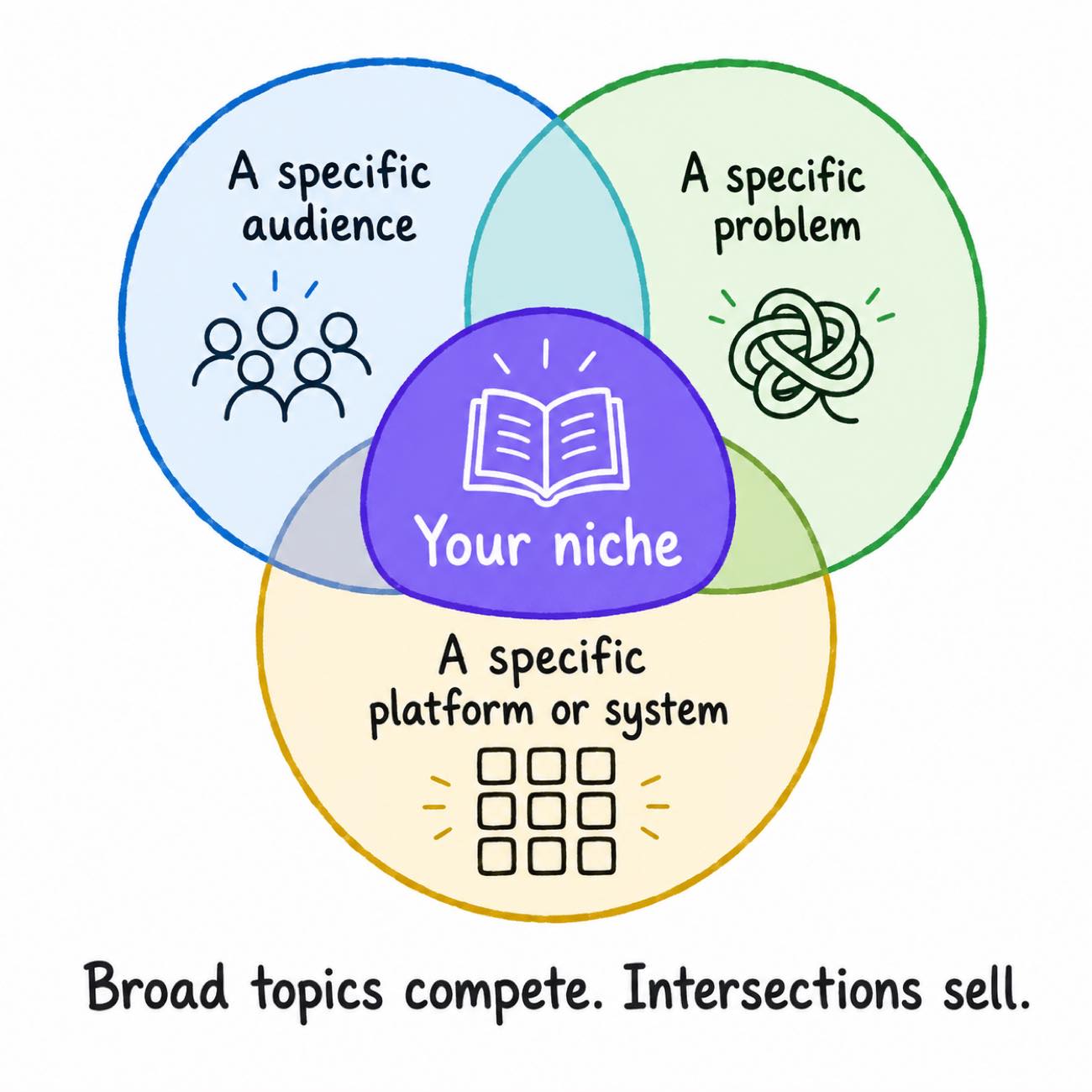
None of these are broad categories. They are all the intersection of a specific audience + a specific problem + a specific platform or system. That intersection is where the highest margins sit. For a fuller view of what's gaining search volume right now, compare this list against our trending ebook topics for 2026 roundup.
What Creation Data Shows About Competition (First-Party)
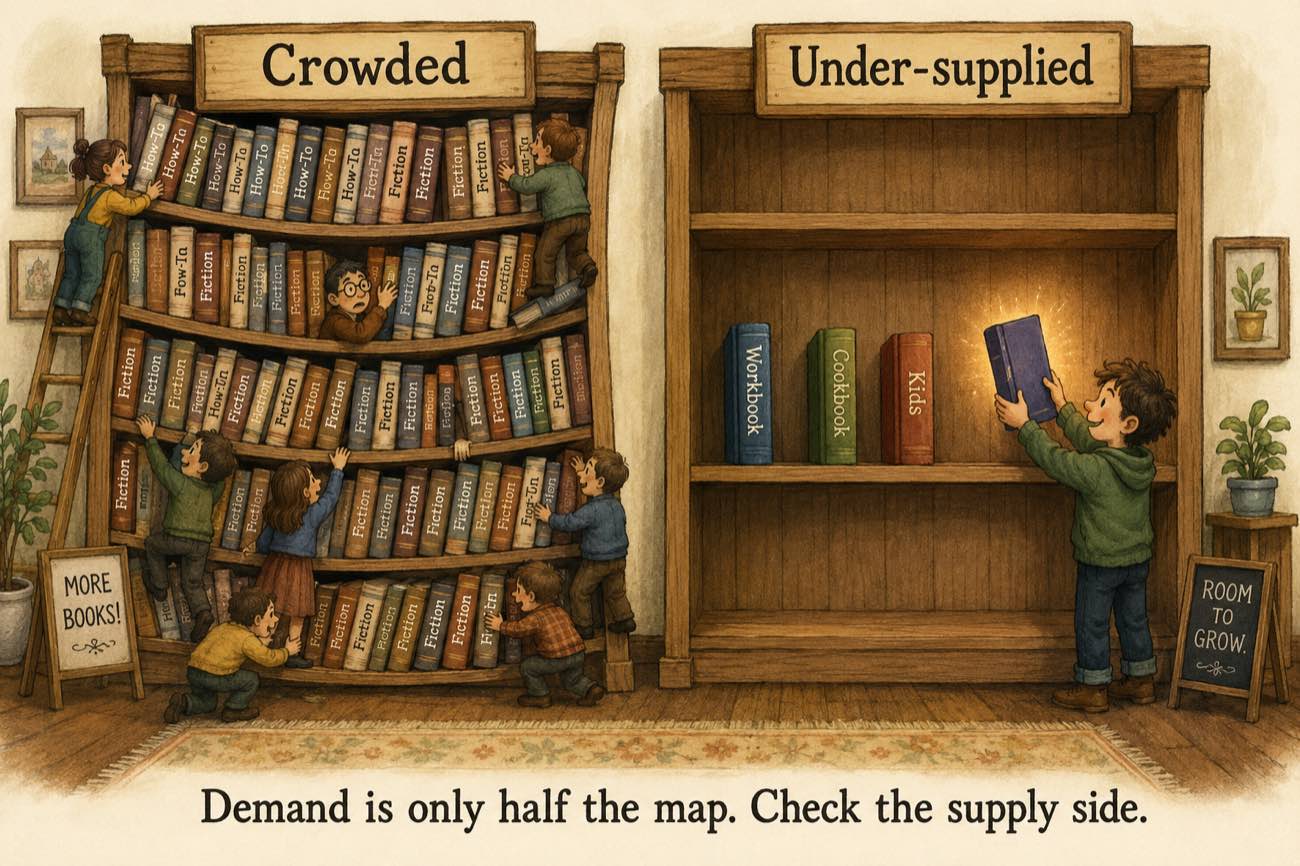
Search tools show you demand; creation data shows you supply, and supply is the half of the equation most niche lists ignore. Across the books created on Inkfluence AI, the crowded categories are exactly the ones you would guess: how-to guides and fiction each hold roughly 18% of everything made, with personal development and romance around 7% each. The practical formats sit far below that, workbooks at about 3%, cookbooks under 3%, and that gap is the low-competition signal this whole article is about: demand for those formats keeps growing while the supply of creators making them stays thin. Kids fiction is a live example, one of the fastest-growing categories on the platform through summer 2026 while still holding a small share of total titles.
The practical read: pick from the demand lists above, then check your pick against the supply side. A niche that scores well on urgency and sits in an under-supplied format is the intersection this article exists to find. Our niche scoring guide holds the full first-party distribution and a weighted framework for exactly this comparison.
What's Actually Selling Right Now (2026)
Three macro-categories dominate the current profitable niche landscape: AI-assisted workflows, creator-economy strategies, and career transformation. But within these categories are hundreds of micro-niches that traditional publishers are too slow to reach.
The strongest niches of 2026 share one thing in common: they exist where a fast-moving topic collides with a high-friction problem. People buy ebooks when they are stuck, overwhelmed, or transitioning into something new.
AI workflows fit this perfectly. Not because "AI" as a topic is unique, but because the demand for field-specific guidance is soaring. Teachers want AI lesson planning systems. Coaches want automated curriculum creation workflows. Business owners want AI marketing pipelines they can copy and paste.
The same is happening in the creator economy. People don't want to know how to "grow online" - they want the content system that works for a travel vlogger, a nutrition creator, a personal finance educator, or a micro-influencer with 800 followers. They want tactical steps that fit the platform, the format, and the audience they serve.
Emerging Micro-Niches With Almost No Competition
Several specific categories stand out for 2026. These niches combine rising search volume, low content saturation, and high purchase intent:
Micro-Skills Ebooks
One of the fastest-growing categories is the micro-skill format - short, transformational skill guides that help readers master one specific competency rather than an entire domain. People don't want a general guide on productivity; they want to learn how to build a one-page action system. They don't want a massive workbook on creativity; they want a compact method for generating ten new ideas a day. The competition here remains surprisingly low because most creators aim too big.
AI Guides for Non-Technical People
AI is everywhere, but most people still feel excluded from understanding how to use it meaningfully. This creates a vast unmet need: simple, reassuring, practical guides for non-technical audiences. These ebooks don't teach coding or complex systems. They teach people how to adapt - how to work alongside AI, how to solve everyday problems with it, and how to stay employable. Tech educators often write too academically. What readers want is someone who speaks at eye level, without jargon.
Digital Identity and Privacy
A rising concern in 2026 is online identity, how to manage it, protect it, reinvent it, or detach from it altogether. People are overwhelmed by the permanence of their digital presence. Competition here is almost nonexistent because the topic sits between technology, psychology, and personal development. Few writers feel comfortable covering all three.
Quiet Wealth and Financial Minimalism
While mainstream finance niches are saturated, a new subculture has emerged: readers who want calm, sustainable wealth practices instead of aggressive investing strategies. Ebooks covering long-term budgeting frameworks, sustainable investing habits, and minimalist financial planning are gaining traction without the competition of traditional financial markets.
Hot Micro-Niches for 2026 (Low Competition)
Evergreen Categories That Never Stop Selling
While emerging niches offer quick wins, evergreen categories provide long-term stability. These topics keep selling year after year because they address permanent human needs:
Health and Longevity: Readers wake up every day inside a body they are trying to understand or improve. They confront fatigue, weight gain, stress, anxiety, chronic discomfort, sleep issues, or lack of energy. An ebook that helps a reader understand what's happening in their body - and gives them a realistic way to improve it - holds intrinsic value indefinitely.
Personal Finance: Money affects every decision a person makes. Because financial literacy is under-taught in most education systems, millions of adults turn to ebooks as their primary source of knowledge. Every new generation of adults enters the workforce with the same questions the previous generation had.
Productivity and Focus: Modern life is built in a way that guarantees people will feel behind. Distraction is constant. Notifications are endless. Readers aren't looking for motivation - they're looking for systems they can follow on bad days.
Self-Improvement: Personal development is not one topic. It is hundreds of subtopics that each address a different psychological tension: confidence, resilience, anxiety management, emotional intelligence, decision-making, self-discipline. These are recurring questions that follow people throughout adulthood.
Selling on Etsy? Read these next.
If your niche selection is for Etsy specifically, we have two deep-dive guides:
- Best ebook niches to sell on Etsy in 2026: 18 specific categories with price bands and competition density
- How to sell AI-generated books on Etsy: the complete policy + disclosure + one-click publish playbook
Frequently Asked Questions
What are the best ebook niches for 2025?
The best ebook niches for 2025 combine low competition with high demand. Top categories include AI-assisted workflows for specific professions, creator economy playbooks, career transformation guides, and identity-based lifestyle systems. The key is specificity - instead of "productivity," target "productivity for remote workers with ADHD."
Are low competition ebook niches still profitable?
Yes - low competition niches are often more profitable than crowded markets. Profitability comes from urgency and buyer intent, not audience size. A niche with 10,000 people who desperately need a solution outperforms one with a million casual browsers. You also face less competition for search rankings and discovery.
How do I validate an ebook niche before writing?
Search for your topic on Amazon's Kindle store. If top results have fewer than fifty reviews and are several years old, you have found low competition. Use Google Trends to check if interest is growing or declining. Browse Reddit, Quora, and Facebook groups to see if people are asking questions that your ebook would answer. The sweet spot is a topic where people are clearly asking questions, existing answers are inadequate, and you can provide something meaningfully better.
What ebook niches sell best in 2026?
AI workflow guides for specific professions (real estate agents, teachers, coaches), career pivot roadmaps, creator economy playbooks, financial guidance for non-traditional workers, and mental health frameworks for specific circumstances are all selling exceptionally well. The common thread is transformation: helping people get somewhere they want to be.
How specific should my ebook niche be?
As specific as you can make it while still having a viable audience. "Meal planning" is too broad. "Meal planning for keto" is better. "Meal planning for keto for night shift workers" is excellent. Each layer of specificity narrows your potential audience but deepens the connection with the audience that remains - and smaller, passionate audiences often generate more revenue than larger, indifferent ones.
Can I write about ebook niches without being an expert?
Yes. Most readers want clarity and relatability over credentials. If you've experienced the problem, researched the solution, and can communicate it clearly, you have everything needed. Many successful ebook authors share lived experience rather than academic expertise. The best niche is one where you have genuine connection to the topic.
Ready to explore your niche? Start building with Inkfluence AI and generate your first chapters to test which direction resonates. Or continue learning with our guide on how to write your first ebook from scratch.

Founder, Inkfluence AI
Sam is the founder of Inkfluence AI. He built the platform to make book creation accessible to everyone - from first-time authors to seasoned publishers.
Helpful links
Ready to Create Your Own Ebook?
Start writing with AI-powered tools, professional templates, and multi-format export.
Get Started FreeRelated Articles
 Guides
 Selling AI Coloring Books on Amazon KDP: The 2026 Rules, Specs, and Math
Are AI coloring books allowed on KDP? Yes, with disclosure. The part nobody covers: the AI workflow that passes review, style consistency across 30 pages, the interior specs that cause rejections, and the royalty ladder that decides your price.
 Guides
 How to Make an Adult Coloring Book in 2026: From Idea to Printed Pages
The modern walkthrough: what makes line work read as "adult", the three ways to create pages (draw, convert, generate), how to assemble a real book instead of a stack of pages, and the fork between KDP paperbacks, Etsy printables, and printing at home.
 Guides
 Consistent Characters in AI Children's Books: Why They Drift, and Every Method That Fixes It (2026)
The fox on page 3 never matches the fox on page 7, until you understand why. The four methods for character consistency in AI illustration, compared honestly, plus the page-7 test to run before trusting any tool's claim.
Get ebook tips in your inbox
Join creators getting weekly strategies for writing, marketing, and selling ebooks.