
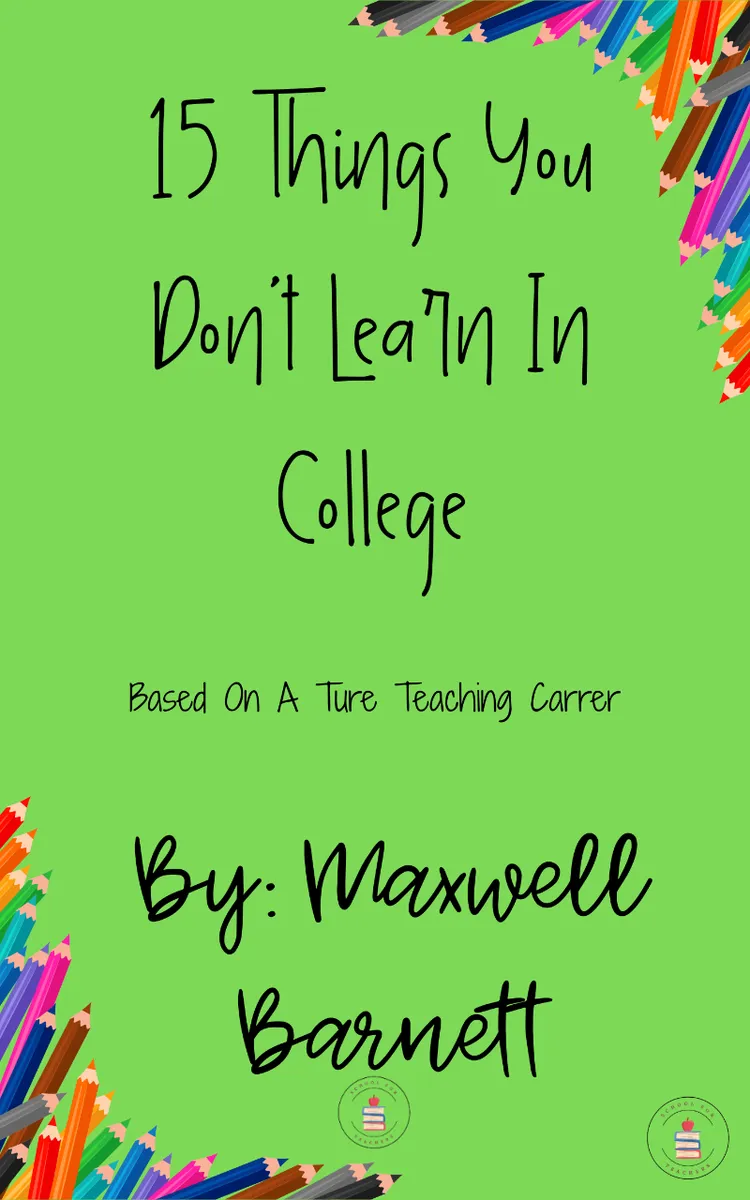
15 Things You Don’t Learn In College
Created with Inkfluence AI
Practical teaching career lessons across 15 chapters
Table of Contents
- 1. Your First Week Lesson Plan
- 2. Classroom Routines That Stick
- 3. How to Give Clear Instructions
- 4. Checking Understanding Without Stress
- 5. Managing Behavior With Systems
Preview: Your First Week Lesson Plan
A short excerpt from “Your First Week Lesson Plan”. The full book contains 5 chapters and 9,161 words.
Have you ever watched a class fall apart in the first ten minutes-not because you forgot the lesson, but because your students didn’t know what to do with themselves? That’s the problem a first-week plan fixes. Your first-week plan isn’t “extra work.” It’s the control panel for your classroom: it sets the tone, gives students a predictable routine, and stops confusion from turning into behavior issues.
For your first week, you need something simpler than a “perfect” schedule. You need a plan that runs on real days-late arrivals, short staffing, unexpected assemblies, and the moment you realize you planned an activity that takes twice as long as you thought. In this chapter, I’m going to show you how to build that plan with my First-Week Flow Map, using the exact steps I used when I was figuring out how to survive my first weeks and still feel proud of my teaching.
As you read, keep one question in mind: If a substitute walked in tomorrow, would my students know what to do without me talking nonstop? That’s the standard your first week should meet.
Why This Matters
Your first week teaches more than content. It teaches how the day works, how you respond when things go wrong, and what students can expect from you. When you skip the “how the day runs” part, students fill the gaps with their own plan-usually the loud one. And once that pattern forms, you spend the rest of the semester fighting habits you could have prevented in five minutes of planning.
A first-week plan also protects you. It helps you manage your energy because you stop improvising every transition. Instead of thinking, “What do I do next?” you follow a flow that you already decided. That means you can spend your attention on the real job: checking for understanding and correcting the small things before they grow.
After this chapter, you’ll be able to design a first-week plan that actually runs. You’ll set clear expectations, choose activities that fit the first-week reality, and build a simple day-by-day flow you can repeat. You’ll also know how to adjust when the plan meets real life-because it will.
Takeaway to hold onto: Your first week is where routine becomes trust. Build the routine on purpose.
How It Works
The First-Week Flow Map is a planning tool that forces you to map your day like a sequence, not like a list. You decide what students do when they walk in, what happens in the first five minutes, how you transition between activities, and what students do at the end of class. You also decide how you’ll communicate expectations without turning your class into a lecture.
Here’s the core idea: students need a predictable “start, work, check, finish” rhythm-and you need a plan for each part.
Use this map in order:
1. Write your “Start” routine (first 5-10 minutes)
Decide exactly what students do the moment they enter. Example: they pick up a folder, copy the warm-up prompt, and start the same type of task (like a short question) every day.
Why: Students settle faster when the first minutes have a job. You reduce chaos before it starts.
2. Pick one main “Work” activity type for the whole week
Don’t rotate wildly. Choose one activity format you can repeat with different questions-like “Read → Answer → Check with partner” or “Mini-lesson → Guided practice.”
Why: Repetition lowers confusion. Students learn the steps, and you spend less time re-explaining.
3. Build in a “Check” moment every class
Plan a quick way to see who gets it: a 3-question exit check, a quick whiteboard response, or a “turn in and I’ll sort” task.
Why: First-week teaching fails when you can’t tell whether students understand. A small check keeps you honest.
4. Design a “Finish” routine (last 3-5 minutes)
Decide how students wrap up: submit work, pack up, and answer a final prompt like “One thing I learned today.”
Why: Ending strong reduces lingering behavior and gives your class a clean close.
5. Add your expectation scripts in student-friendly language
Don’t just post rules-teach what they look like in actions. For example, instead of “Be respectful,” you write: “Use a quiet voice when someone else is speaking” and “Ask for help by raising your hand.”
Why: Students follow behaviors they can picture, not vague words.
6. Plan transitions as their own mini-routine
For every shift-seating, materials, group work, cleanup-write a one-sentence trigger and a one-sentence action. Example: “When the timer beeps, stop talking, look at me, and start the next step.”
Why: Transitions are where time disappears and behavior spikes.
If you’re wondering how this looks in real life, here’s a concrete example using Talia, 24, a new substitute teacher. Her biggest problem wasn’t teaching-it was walking into classrooms where students were already used to someone else’s routines....
About this book
"15 Things You Don’t Learn In College" is a how-to guide book by By: Maxwell Barnett with 5 chapters and approximately 9,161 words. Practical teaching career lessons across 15 chapters.
This book was created using Inkfluence AI, an AI-powered book generation platform that helps authors write, design, and publish complete books. It was made with the AI Ebook Generator.
Frequently Asked Questions
What is "15 Things You Don’t Learn In College" about?
Practical teaching career lessons across 15 chapters
How many chapters are in "15 Things You Don’t Learn In College"?
The book contains 5 chapters and approximately 9,161 words. Topics covered include Your First Week Lesson Plan, Classroom Routines That Stick, How to Give Clear Instructions, Checking Understanding Without Stress, and more.
Who wrote "15 Things You Don’t Learn In College"?
This book was written by By: Maxwell Barnett and created using Inkfluence AI, an AI book generation platform that helps authors write, design, and publish books.
How can I create a similar how-to guide book?
You can create your own how-to guide book using Inkfluence AI. Describe your idea, choose your style, and the AI writes the full book for you. It's free to start.
Write your own how-to guide book with AI
Describe your idea and Inkfluence writes the whole thing. Free to start.
Start writingCreated with Inkfluence AI


