
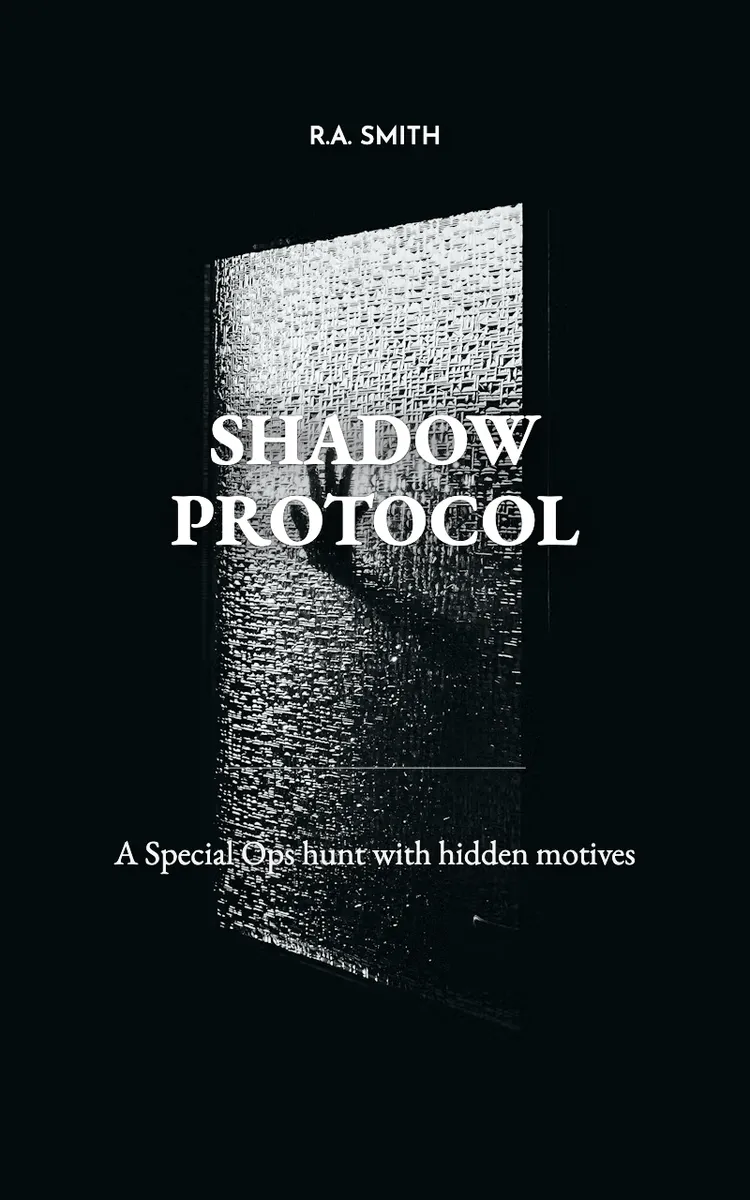
Read the first chapter
The whole of chapter one, free. About 9 min. Turn the pages with the arrows, your keyboard, or a swipe.
Chapter 1
Tehran Black Site Mission Brief
The rain in Tehran came down in hard, slanted sheets, turning the alley behind the British Cultural Office into a narrow ribbon of steam and runoff. Captain Raymond Squire watched it bead on the matte finish of his night-vision housing, then slid off in quick, bright drops that vanished as soon as they touched concrete. Radios whispered in clipped bursts inside the darkness of a borrowed sedan, the air inside smelling faintly of wet fabric and stale coffee. Across the street, a mosque loudspeaker carried a call that sounded both distant and too close, layered over the low grind of traffic and the occasional bark of a car alarm.
First Sergeant Jonathon Jefferson leaned in from the passenger side, close enough that Squire could see the moisture already gathering at the edges of his beard. “We’re late,” Jefferson said, voice flat. “Not by minutes. By the kind of hours that get people moved.”
Squire’s gaze stayed on the street. His knuckles tightened around the steering wheel though the car was off; he could feel the vibration of distant buses through the leather. The mission briefing had been clean - locate Major Thomas Gillian, confirm he was alive, extract him to a Black Site for medical attention and questioning. The Iranians had him. That was what mattered. That was what they’d been told. But the paperwork in Squire’s head didn’t hold the weight of the last message from their liaison: Gillian was connected to an Iranian woman named Zahra Amiri, and her disappearance wasn’t a footnote anymore. It was a blank space in the map.
“Gillian’s the priority,” Squire said. He kept his tone calm, as if calmness could keep the world from shifting under his boots. “We find him, we get out. We don’t chase ghosts.”
Jefferson’s eyes flicked to him. “Zahra isn’t a ghost. She’s the variable that changed the briefing.”
Squire felt that word - variable - press against his teeth. He’d watched men die for less certainty than he had right now. The alley outside shifted with movement: a pair of figures crossing, hooded against the rain, their steps measured, not hurried. He didn’t recognize them, but their body language belonged to people who were used to being watched.
A call came over the radio, the voice distorted by distance and wet interference. “Team, confirm your approach route. Contact with Iranian element reported near the northern side of the compound.”
Jefferson’s jaw tightened. “Compound?” he said. “We’re not going in through a compound.”
Squire clicked the mic. “Say again.”
The voice repeated, slower this time, as though that would make it less wrong. “Iranian element increased. British officer location may have shifted. Repeat: location may have shifted.”
Jefferson exhaled through his nose. “Moved him. Since when do Iranians move a prisoner like that unless they’re trying to bury something else?”
Squire forced his attention back to the street, to the hooded figures, to the way the rain seemed to make every sound travel farther. He could almost feel the capture in Gillian’s file turning into something else - an extraction target becoming a bargaining chip, a pawn becoming bait. If Gillian had been instrumental in developing psychological and information operations plans for control of Iran, then the capture wasn’t only about custody. It was about what could be pulled from him before anyone else did.
Squire spoke quietly, to Jefferson and to himself. “We go where they expect us to look. If they’re moving him, they’re moving him to a place they control.”
Jefferson’s hand hovered near the door handle. “Then we don’t give them the line they want.”
The rain hammered the roof. The sedan’s interior lights stayed off, but the windshield caught occasional flashes from passing headlights, painting the dashboard in brief, sickly rectangles. Squire made a choice - one he could justify in his head, even if it would look reckless on paper. He tapped Jefferson’s shoulder and nodded toward the alley’s far end, where a service stairwell rose into an apartment block.
“New approach,” Squire said. “We cut in through the building, not the street. We keep eyes on the exits. If Gillian’s been shifted, we’ll catch the trail before they decide we’re too late.”
Jefferson didn’t argue. He reached for the side pocket where their gear rode tight against his thigh, the movement practiced, efficient, soundless. “Copy,” he said, then added, softer, “And if Zahra’s still missing?”
Squire met his eyes for half a beat. In Jefferson’s face he saw the same question Squire couldn’t shake: why her, and why now, and why the disappearance felt like it had been timed rather than suffered. “We don’t let her absence change our mission,” Squire answered, though the words tasted like compromise.
They moved when the hooded figures turned their backs to the alley, vanishing into the rain-thickened street. Squire opened the sedan door just enough for cold air to slice through the cabin. Water slicked his sleeves as he stepped out, the concrete under his boots immediately slick with runoff. Jefferson followed, and the rest of the team ghosted into place behind them - boots quiet, breath controlled, shoulders angled to stay out of sightlines that didn’t exist yet but would.
Inside the stairwell, the smell of wet stone and old cooking oil clung to the back of Squire’s throat. The sound of rain softened, replaced by the sharper noises of their movement: fabric brushing fabric, a muted click as someone checked a suppressor alignment. At the landing, a small window let in a pale slice of daylight, and through it Squire saw the compound’s northern wall in the distance - its perimeter lit, its shadowed corners crowded with silhouettes that weren’t there a moment ago.
Jefferson leaned close as Squire raised a gloved hand to steady himself on the railing. “They’re guarding something,” he murmured. “Not just a prisoner.”
Squire felt the shift in his stomach before he understood it. The increase in Iranian element had been framed as urgency, but the formation suggested preparation. A place being defended wasn’t only holding someone. It was holding a story - one they meant to control before it could reach anyone else.
Squire looked again at the street below the stairwell window. One of the hooded figures reappeared at the edge of light, speaking to another, and then moving with purpose toward the northern perimeter. The rain kept falling, indifferent, while a small, dark shape - too compact to be a stretcher - was guided through an access point.
“Gillian,” Squire whispered, and this time the name didn’t sound like paperwork. It sounded like a door closing somewhere behind them.
He drew a breath and made the next decision without waiting for permission. “We move now,” he said, voice low but carrying. “Before they decide which direction the truth comes from.”
They dropped down the stairwell two at a time, boots whispering on damp concrete. The team spread like a living map around Squire and Jefferson - eyes, rifles angled for silence, fingers threaded through radio leads. Rain ricocheted off metal grates below; somewhere a dog barked and was shushed by a shout in Farsi. The smell of wet dust and frying oil shifted to diesel and disinfectant as they crossed into the building’s ground floor, where a back door led to a service courtyard bathed in sodium light.
A camera blinked at them from a rusty pole. Squire thumbed his earpiece and signaled to the tech with the phased array: blackout. The feed flickered and died, and for one thin second the courtyard felt as if it could be anything - a trap, an ambush, an empty room with a single chair and a man bleeding quietly in it. He didn’t like the not-knowing. He’d made a career of forcing answers.
“Stack and breach?” Jefferson said, but his voice was nearly a whisper; the compound’s northern wall pressed sound inward, like a cupped hand.
“Single-door push,” Squire answered. “Low profile. One team in, one team overwatch on the alley. If they pulled Gillian through that gate, there’ll be footprints and fresh tire tracks. We follow the smell of diesel and the shape of fear.”
They moved like a single organism, practiced and precise. The lead cleared the threshold, and the courtyard opened into a tangle of service roads and delivery bays. Under the sodium lights, tire tracks carved dark rivers in the wet concrete. A utility truck sat with its rear door cracked, a handkerchief caught in the latch. Squire crouched and brushed it with a gloved finger; the fabric smelled faintly of cologne and antiseptic, a mix that suggested hurry and hospital. He winced - those were the smells of someone moved under duress, not dignity.
“Two minutes, maybe less,” the tech murmured into Squire’s ear. “CCTV looped on that sector. They wanted us to think he might still be inside.”
“Then they wanted us outside of it,” Jefferson said.
A noise at the far end of the courtyard made them freeze: soft rubber on concrete, measured and deliberate. A silhouette peeled away from the shadow of a delivery container and moved toward an access gate. Not a guard’s gait, Squire thought; too careful, too practiced. Someone who’d spent nights learning how not to be seen.
Squire pivoted his focus. This was the obstacle - an unseen courier, a change in custody they hadn’t anticipated. If Gillian had been moved, then whoever handled him next would know the extraction routes, the choke points. If they met that courier now, all they could hope for was to recover a clue.
He whispered, “Intercept. Quiet. Two-man sweep. Jefferson, with me.”
They closed with the silence of water finding a seam. At four meters the figure stopped, turned, and for a heartbeat Squire thought they would be discovered. The hood dropped, and a face looked back - young, sunburned at the rims, eyes too calculated for a mere courier. The man spoke in English, clipped, foreign-accented.
“You are not from here,” he said.
Squire kept his rifle low. “Neither are you supposed to be in Tehran moving people,” he replied. “Where’s Major Gillian?”
The young man’s jaw worked. Behind him, the gate squealed - mechanical, hurried - and through it a narrow strip of road gleamed black under the rain. “He left here this morning,” the man said. “Not alone. You are late.”
Jefferson let out a breath that fogged in the sodium light. “Who’s he with?” he demanded.
The man’s eyes flicked to the street beyond the gate as if considering whether to buy time. “There was a woman,” he said finally, voice low. “Not Iranian. Not British. She moved with a purpose.”
A name rose unbidden in Squire’s chest and lodged there: Zahra. The possibility that her absence was a deliberate misdirection or a signal tightened like a wire.
“Which way?” Squire pressed.
The man smiled then, small and bitter. “North,” he said. “To the mountain roads. But be careful - there are checkpoints now where a month ago there were none.”
Squire felt the map in his head shift. North meant route options, Kurdish border arteries, routes shadowed by militias and checkpoints unrecorded in their feeds. It also meant time - time they might not have.
He made the call. “We move. Quiet, contact minimal. Jefferson - ready the truck. We follow north, and we find Gillian before anyone else buries him.”
The courier stepped back into shadow, and for a breath Squire thought the mission had lined itself up. Then the courtyard’s perimeter lights blinked, a staccato flash that was almost immediate and definitely deliberate. Footsteps answered from the direction of the northern wall - more than the courier’s solitary pace.
Squire’s mouth went dry. Whoever had shifted Gillian had anticipated movement. The trap, it seemed, was already closing.
End of chapter one. 4 more chapters in the full book.
Swipe or use the arrows to turn the page
What's inside: 5 chapters
- 1. Tehran Black Site Mission Brief
- 2. The Husband Zahra Vanished
- 3. MI6 Starts the Zahra Search
- 4. The Capture Wasn’t the Story
- 5. Zahra Guides Them Out
About this book
"Tehran Black Site Mystery" is a fiction book by R.A. SMITH with 5 chapters and approximately 6,095 words. US Special Operations team uncovers a deeper plot in Tehran.
This book was created using Inkfluence AI, an AI-powered book generation platform that helps authors write, design, and publish complete books. It was made with the AI Novel Writer.
Frequently Asked Questions
What is "Tehran Black Site Mystery" about?
US Special Operations team uncovers a deeper plot in Tehran
How many chapters are in "Tehran Black Site Mystery"?
The book contains 5 chapters and approximately 6,095 words. Topics covered include Tehran Black Site Mission Brief, The Husband Zahra Vanished, MI6 Starts the Zahra Search, The Capture Wasn’t the Story, and more.
Who wrote "Tehran Black Site Mystery"?
This book was written by R.A. SMITH and created using Inkfluence AI, an AI book generation platform that helps authors write, design, and publish books.
How can I create a similar fiction book?
You can create your own fiction book using Inkfluence AI. Describe your idea, choose your style, and the AI writes the full book for you. It's free to start.
Write your own fiction book with AI
Describe your idea and Inkfluence writes the whole thing. Free to start.
Start writingCreated with Inkfluence AI


