
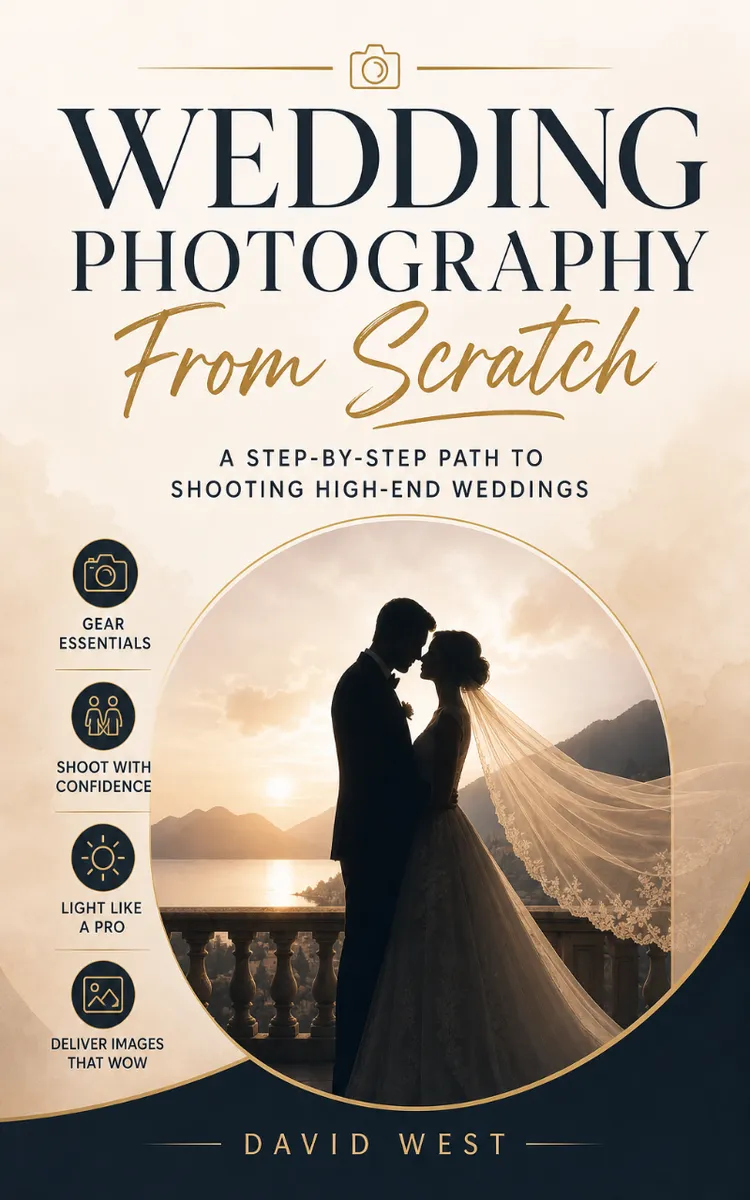
Wedding Photography From Scratch
Created with Inkfluence AI
Becoming a wedding photographer: gear, lenses, workflow, and shot list
Table of Contents
- 1. Choosing Your First Wedding Gear
- 2. Lenses for Every Wedding Moment
- 3. Camera Settings You Must Know
- 4. Planning the Shot List by Timeline
- 5. Groom Prep and Candid Storytelling
- 6. Bridal Prep, Details, and Room Shots
- 7. Formals, Bridal Party, and Guest Coverage
- 8. Cake Cut and First Dance Portraits
Preview: Choosing Your First Wedding Gear
A short excerpt from “Choosing Your First Wedding Gear”. The full book contains 8 chapters and 16,374 words.
What camera can you buy today that won’t hold you back at the altar, in the reception hall, or during fast-moving bridal party photos? If you pick wrong, you end up fighting your gear instead of photographing the story - especially when the light drops and everyone starts moving at once.
Talia started in wedding video and switched to stills because she kept seeing moments she couldn’t pause long enough to capture. She didn’t need a “dream setup.” She needed a practical camera, a short list of accessories, and lighting basics she could actually use without spending a week learning theory.
This chapter uses a simple approach called the Starter Kit Ladder: you start with one reliable camera body, you add a couple lenses that cover 90% of wedding needs, and you learn the smallest lighting moves that make your photos look intentional. After you finish, you’ll be able to choose a camera class, pick lenses that match real shot distances, pack the right accessories, and set up basic lighting for rooms without overspending.
Set the context: practical camera + accessories + lighting basics (without overspending)
Wedding photography punishes weak setups in three moments: (1) you need sharp faces fast, (2) you need clean files when the venue gets dark, and (3) you need to handle mixed lighting - window light near a wall, warm indoor lights near the dance floor, and sometimes harsh ceiling fixtures above. A beginner’s common problem isn’t taste. It’s that the gear can’t keep up with the pace.
This chapter solves that by turning “what gear should I get?” into a concrete buying and packing plan. You’ll learn what features matter for weddings, which accessories earn their space in your bag, and how to use on-camera flash (or simple off-camera flash) in a way that looks like you planned it. You’ll also avoid the trap of buying expensive extras before you can consistently get good exposures and focus.
By the end, you’ll know what to look for when you shop, what to mount on your camera for specific wedding tasks, and what to practice before your first paid wedding. Ask yourself as you read: can your camera handle low light without turning your photos into blurry messes or noisy soup? If you can answer that, you’re ready to build your Starter Kit Ladder.
Practical takeaway: Your first goal is not “high-end.” Your first goal is repeatable sharp, well-exposed faces across changing light.
Teach the core concept: build your Starter Kit Ladder (camera, lenses, and lighting)
A good starter setup gives you three things: (1) reliable focus on people, (2) lenses that cover the distances you’ll actually shoot, and (3) a lighting plan that works when the room gets dim. The Starter Kit Ladder keeps those parts separate so you don’t overspend on the wrong link.
Use this numbered ladder:
1. Pick a camera body that focuses reliably on people
- Look for fast autofocus (autofocus, or AF) and good performance in low light. You don’t need a top-tier sports camera; you need one that keeps finding eyes when people move.
- Why it matters: wedding photos often happen while subjects walk, turn, laugh, or get guided into position. If AF hunts, your photos miss the moment.
2. Choose two lenses that cover your most common distances
- Start with one “portraits + ceremonies” lens and one “details + group” lens.
- Why it matters: you’ll swap less, and swapping less means more consistent framing and faster shooting during the parts of the day that move quickly.
- A practical pairing for beginners:
- A 24-70mm f/2.8 (or similar) for ceremonies, couple portraits, and most general coverage.
- A 70-200mm (or similar) f/2.8 for groom/bouquet moments, tighter portraits, and formals when you can’t get close.
- If your budget forces you to compromise, prioritize focal range before chasing the fanciest lens brand.
3. Add one “details and rooms” lens or macro option only if you need it
- Details include rings, invitation cards, shoes, cufflinks, cake textures, and décor. Rooms include wide angles of the setup.
- Why it matters: you can still shoot details with your zooms, but a dedicated wider lens makes it easier to show context (where the scene sits in the room) without distortion.
- Beginner-friendly choice: a 16-35mm (full-frame equivalent) or a wide zoom for your system.
4. Learn flash basics as a tool, not a gimmick
- Start with one flash and learn to bounce it off a wall/ceiling.
- Why it matters: many venues have mixed lighting. Flash helps you control the exposure on faces so your images stay consistent and sharp even when the room drops in brightness.
- You don’t need to master studio lighting first. You need to learn how to aim light so it looks natural on skin.
5. Pack a small setup that covers power, stability, and quick backups
- Carry at least two memory cards and enough battery capacity for the day....
About this book
"Wedding Photography From Scratch" is a how-to guide book by David West with 8 chapters and approximately 16,374 words. Becoming a wedding photographer: gear, lenses, workflow, and shot list.
This book was created using Inkfluence AI, an AI-powered book generation platform that helps authors write, design, and publish complete books. It was made with the AI Ebook Generator.
Frequently Asked Questions
What is "Wedding Photography From Scratch" about?
Becoming a wedding photographer: gear, lenses, workflow, and shot list
How many chapters are in "Wedding Photography From Scratch"?
The book contains 8 chapters and approximately 16,374 words. Topics covered include Choosing Your First Wedding Gear, Lenses for Every Wedding Moment, Camera Settings You Must Know, Planning the Shot List by Timeline, and more.
Who wrote "Wedding Photography From Scratch"?
This book was written by David West and created using Inkfluence AI, an AI book generation platform that helps authors write, design, and publish books.
How can I create a similar how-to guide book?
You can create your own how-to guide book using Inkfluence AI. Describe your idea, choose your style, and the AI writes the full book for you. It's free to start.
Write your own how-to guide book with AI
Describe your idea and Inkfluence writes the whole thing. Free to start.
Start writingCreated with Inkfluence AI


