
Read the first chapter
The whole of chapter one, free. About 15 min. Turn the pages with the arrows, your keyboard, or a swipe.
Chapter 1
The Portal That Split a God
The portal didn’t open like a door. It tore the air the way lightning tears cloth, except there was no thunder-only a thin, high singing that made Mara’s teeth ache and her hands go slick on the stone ledge. She’d been sent to check the old shrine above the river, the one the villagers pretended had always been empty, and the wind there had always carried a cold taste of wet iron. Tonight the taste sharpened into something else: a clean, impossible brightness, like the inside of a bell struck too close.
The ledge vibrated under her boots. Pebbles lifted, rotated, and hung in a brief, weightless confusion before dropping again with a dull slap. Mara leaned forward despite herself, hair whipping across her cheeks, and saw the opening-an oval of moving light sunk into the rock. It was not fire. It was not water. It was a wound in the world, framed by pale runes that crawled as if they were trying to remember their own order.
Then the light came through.
A man fell out of it without a sound, straight as a spear and too solid to be a dream. For an instant Mara thought he was merely a corpse-dark, motionless, face turned toward her like a statue left in the rain. The portal pulsed once, the singing rising, and the man’s chest expanded. His breath steamed the air though the night was warm. His eyes snapped open.
Not human eyes. They were gold with a depth that made Mara feel as if she’d looked down a well and found no bottom.
He sat up, as if yanked by invisible cords, and the runes around the oval flared. The man’s gaze slid across the ledge, found Mara, and sharpened into recognition that wasn’t meant for her. His lips moved.
“-hold-”
The word tore off, replaced by a fracture of light. The man’s form shimmered, split down the middle like a reflection cut with a knife, and two more shapes unfolded from the same instant of brightness. The singing became a frantic, braided note. The air around the shrine went tight, as though the world had drawn its breath in.
Mara staggered back, one heel skidding over gravel. “What are you?” she managed, voice rough from shock.
The three figures looked the same and not at all. One wore a cloak that seemed made of shadowed water; another’s hands glowed faintly at the knuckles, as if he’d been holding a coal that refused to cool; the third-tallest, eyes still gold-stood with his palms open to the night like he was offering the sky something it had taken from him.
They turned toward each other with a syncronized urgency that made Mara’s stomach twist. Each one had the same face, the same brow, the same line of muscle where a god’s strength would set. Yet their expressions moved in different directions: hunger, restraint, grief.
The portal shrank, runes dimming, and with a final pulse it sealed. The oval of light collapsed into nothing, leaving only the shrine’s stone and the river wind and the ringing in Mara’s teeth.
The man-no, the god-fell forward onto his hands as if gravity had suddenly remembered him. The sound of his fall should have been heavy. It wasn’t. It was like a prayer hitting the ground too softly.
Mara backed toward the steps. “Stay back,” she said, though she didn’t know who she was warning: the three, or herself, or the night that had just split.
The one with shadowed water in his cloak looked up first. His gaze held Mara for a breath too long. Then his mouth opened, and the word that came out wasn’t a demand. It was a plea.
“Name,” he said.
Mara blinked. “What?”
“Say it.” His voice carried the clear weight of command, but under it lurked something raw, like a cut trying to close. He swallowed, and the motion rippled through the air as if the room had water in it. “Say the name. I must anchor.”
Mara’s throat tightened. She had no idea why she felt guilty, but guilt pressed on her the way cold presses on bone. “Mara,” she answered, because her mother had told her to never lie to anything that looked like it could turn lies into weather. “Mara of-”
He shook his head sharply. “Not that. The other name. The true one. The one you’ve been calling me without knowing.”
The phrase made no sense, and yet the gold in his eyes flared warmer, as if the question had found the correct latch. Mara heard the river below, heard its steady voice, and then-faintly-she heard something else, a chorus under the stone.
Prayer.
It wasn’t coming from the villagers’ houses. It was coming from the shrine itself, from cracks in the rock that should have been empty. Mara had scrubbed those cracks clean with her own hands last season. She knew the dust there. Tonight the dust sounded like voices.
The second figure-the one with coals in his knuckles-stepped forward. The air around him smelled briefly of charred cedar and rain on hot metal. His eyes were not gold. They were silver-gray, focused, as if his mind were counting.
“You’re wasting time,” he said to the water-cloaked one. His gaze flicked to Mara’s face. “You’re not the anchor. She’s only the first witness.”
Mara’s skin prickled. “Witness to what?”
He looked away, as if her question was a stone he didn’t want to pick up. “To the breach.”
The third-tallest, grief in every line-had not spoken yet. He stared at the sealed shrine opening, at nothing, as though he could still see the portal’s wound. His fingers twitched, and the air trembled with the urge to split again.
“My purpose-” he began, then stopped, teeth pressing together. His eyes went distant for a heartbeat. “It was supposed to arrive intact.”
Mara took another step down the shrine steps, her palms sweating. “If you’re gods,” she said, surprising herself with anger, “then why are there three of you?”
The silver-gray one smiled without humor. “Because the world is greedy.”
The water-cloaked one turned sharply toward him. “Because you grabbed it too hard.”
“I grabbed what I could,” the silver-gray one snapped. “The portal tore through the seam. It didn’t ask our permission.”
The grief-struck third finally moved. He stepped between them, blocking Mara’s view of their hands as if he could keep their arguments from spilling into the air. His voice dropped, low and shaking with something like rain held in a fist.
“We have one oath,” he said. “One truth. The three of us must speak it as one.”
Mara’s breath came shallow. Oaths were for mortals, bargains made with trembling mouths. Yet the way he said it made the shrine stones feel suddenly older. The prayer-voices under the rock swelled, a thin pressure at the edge of hearing.
The silver-gray one leaned toward the sealed stone, knuckles glowing brighter. “And if we can’t?”
“Then we fracture the rest of the world,” the water-cloaked one answered. His fingers curled, and dark water gathered in the hollow of his palm though there was no water nearby. “We already are.”
Mara felt it then-not in sight, but in the world’s behavior. The river wind changed direction without turning. The loose pebbles that had fallen earlier lifted again, hovering in a lazy circle above the steps, following no current. A moth beat its wings against the air and then, mid-flutter, its body blurred into two positions as if the night couldn’t decide where to place it.
Mara grabbed the railing. “Stop it,” she said, to all of them, to the shrine, to whatever had split.
The tall grief-struck one looked at her as though he’d forgotten she was there. His eyes softened for a heartbeat. “We can’t stop it by asking,” he said. “We stop it by aligning.”
He glanced down at his own hands. For an instant Mara saw something like writing crawling beneath his skin, luminous lines that sank and rose with his pulse.
“Align with what?” she demanded.
“With the first prayer,” he said. “With the name that opened the portal. With the belief that called us.”
The silver-gray one’s head snapped up. “The belief was corrupted.”
“The belief was-” water-cloaked began, and then the prayer-voices under the stone surged so suddenly Mara flinched. The shrine stones shuddered. Somewhere below, a lantern went out with a pop.
A sound answered it: a distant scream, not from the village but from the river bend where the shrine’s waterfed channel ran. It carried up through the night like a thread pulled tight.
The three gods turned toward the sound at once. Their expressions shifted-hunger, calculation, grief-each one grabbing at the same thread with different hands.
Mara’s fear sharpened into purpose of her own. She knew that channel. She’d hauled stones there when the water rose too fast, when a child went missing and the villagers blamed river spirits. She knew the mud there. She knew where the current snagged.
If something had gone wrong in the river, it would take bodies. It would take names.
“What are you going to do?” she asked, voice brittle but steady. “Just stand here?”
The water-cloaked one looked at her, as if tasting the idea of defiance. “We must decide who speaks first.”
The silver-gray one’s jaw tightened. “We must decide who speaks true.”
The grief-struck third exhaled, and the air around him cooled as if a shadow had passed over the moon. “We must decide who carries the cost.”
Mara didn’t like the way those words slid into each other. Cost. Carry. Oath. It sounded like the kind of bargain that ended with someone’s life pressed into someone else’s hands. She shoved her panic down and forced her voice into the shape of a command she didn’t believe she deserved.
“Then speak,” she said. “Choose. Now.”
For a breath the three of them didn’t move. The shrine’s sealed stone gleamed faintly, as though it remembered the portal’s heat. The hovering pebbles spun slower, then faster, like a thought trying to settle.
Then the silver-gray one lifted his glowing knuckles and pointed toward the river bend. “I will speak,” he said. “I will name the breach. I will bind the water to its original course.”
The water-cloaked one shook his head, dark water rippling in his palm. “No. If you name it, it will harden. It will become law. We need mercy first.”
The grief-struck third looked between them like a judge who’d been asked to choose between two wounds. “Mercy without truth is indulgence,” he said. “Truth without mercy is hunger.”
Mara felt the shrine stone under her fingers vibrate again. A crack appeared-thin as a hairline-then widened, not in the wall, but in the air itself. The night seemed to tear there, a seam of darkness opening and closing as if the world were breathing through a split lung.
The scream from the river bend rose again, closer now, carried by someone running or being dragged. The sound of wet feet slapped against rock.
The three gods moved at last, not together but in a rush toward action-each one toward the same river sound, each one pulling the air in a different direction. Mara caught a glimpse of their differences: the water-cloaked one’s fingers left droplets of darkness that fell and vanished before hitting the stone; the silver-gray one’s light made the shadows around his feet sharper and more threatening; the grief-struck one’s gaze slid over the world like he was reading a wound only he could feel.
Then they collided.
Not physically-there was no impact, no shove. The collision was in their purpose. Their words overlapped, and Mara heard them all at once, three versions of the same vow spoken with different emphasis.
“-hold-” “-bind-” “-return-”
The shrine’s air seam widened. The hovering pebbles burst outward like startled birds. Mara yelped and threw her arm up to shield her face, but the light that followed wasn’t bright; it was wrong. It bent the world’s edges. For a heartbeat, her shadow detached from her boots and stretched across the stones as if it belonged to someone else.
The prayer-voices under the rock turned into a single, furious chorus.
Mara stumbled down the last steps and ran toward the river bend, grabbing her cloak around her shoulders as the night whipped at her. Behind her, the three gods followed-one at her left, one at her right, one just ahead like a shepherd who couldn’t decide which direction the flock should go.
They didn’t speak again until they reached the water channel.
The river bend was a narrow cut through old stone walls, where water should have moved smooth and predictable. Tonight the channel churned as if it were remembering storms. The surface boiled in patches, forming loops that snapped shut before they could become waves. A boy lay half in the mud, half in the current, his mouth open in a silent scream. His hands clawed at the stone like he could drag himself out by force alone.
Mara dropped to her knees beside him. His skin was cold and slick. She pressed her palm to his cheek and felt the tremor there, the frantic vibration of a body being pulled apart from the world’s agreement.
“He’s alive,” she said, and the words came out as if she needed to convince herself.
The water-cloaked god leaned close. He didn’t touch the boy. His hand hovered over the mud, fingers spread. Darkness gathered around his palm like a net.
“Return,” he whispered, and the word tasted like river silt and dusk.
The silver-gray god stepped forward, knuckles glowing. He reached toward the water channel and drew a line through the air, as if tracing a rule only he could see. “Bind,” he said, and the air tightened. The churned water resisted him like a creature refusing a leash.
The grief-struck god knelt behind the boy without asking permission from anyone’s space. His face was pale, as if the effort of being three had drained him. He stared at the boy’s throat, at the frantic rise and fall.
“Hold,” he said, softer than the other two, and the sound of it made Mara’s ears ring. The boy’s head stopped jerking. His eyes fluttered toward the gods, confusion flooding his pupils.
Mara watched their hands, their words, their competing miracles. She understood something without knowing how: the portal had split them not just into bodies, but into angles of the same divine purpose. One wanted to return the world to what it had been. One wanted to bind it into a new order. One wanted to hold the fragile present together long enough for it to survive.
The boy’s lungs hitched. His fingers went slack for a heartbeat, then tightened again, desperate.
Mara grabbed the boy’s wrist. His pulse was there, frantic and thin. “Don’t let go,” she told him, though his eyes were too unfocused to hear it. “Don’t-”
The water-cloaked god’s gaze snapped to her hand. “You’re anchoring him,” he said, almost accusing.
Mara looked up. “He’s a person,” she said, voice shaking with the effort of anger. “Your purpose doesn’t get to eat him.”
The silver-gray god’s attention sharpened. “If you anchor with a human bond,” he said, “we risk misalignment. The world will choose the wrong law.”
The grief-struck god’s eyes flicked to Mara, and for an instant she saw his grief as something personal-like he’d been torn from a place that had known his name. “She’s not anchoring him,” he said. “She’s anchoring us.”
Mara didn’t understand the theology of it, but she understood the feeling: the boy’s life was a weight, and their hands were trying to carry it in three different ways. If they pulled in different directions, the boy would become the seam the world tore around.
The shrine’s prayer-chorus surged again, and Mara felt it in her bones now, a pressure building like a storm behind her ribs.
The grief-struck god looked down at the boy, then up at the others. “If we speak together,” he said, “we choose one outcome.”
The water-cloaked god’s dark water trembled. “If we choose one outcome,” he answered, “we doom the other.”
The silver-gray god’s glowing knuckles flared brighter. “Or we doom the whole channel.”
Mara heard the boy’s breath catch again, heard it in the wet silence between river churns. She could feel the cost approaching, not as punishment but as physics-something in the world already breaking, already deciding.
“Stop arguing,” she said, and the words surprised her with their authority. She didn’t know where it came from-maybe from desperation, maybe from the old habits of a girl who’d learned to keep a household from collapsing by sheer insistence. “Choose him.”
All three looked at her as if she’d spoken from inside their own throats.
The water-cloaked god inhaled, and for a moment Mara smelled wet stone and crushed herbs. “Return,” he said again, but this time the word sounded less like command and more like apology.
The silver-gray god’s shoulders tightened. “Bind,” he said, and the line he drew through the air softened at the edges, like a rule being rewritten rather than enforced.
The grief-struck god’s eyes closed. When he opened them, gold flared through the sorrow. “Hold,” he whispered, and his voice carried the weight of a hand placed under a chin.
They didn’t speak over each other this time. The words braided into one vow, and the seam in the air behind them tightened until the crack stopped widening. The prayer-voices under the stone softened, no longer furious but strained, as if they’d been forced to listen.
The river channel calmed in a single, astonishing moment. Water slid into a steadier flow. The mud released the boy’s limp grip. He coughed once, wet and harsh, and sucked in a breath that sounded real.
Mara pressed her forehead briefly to his shoulder, relieved so hard it hurt. “Breathe,” she rasped, though her voice broke on the last word.
The three gods went still.
For one heartbeat, their faces were all the same expression-exhausted wonder, like children who’d solved a puzzle without understanding why it had been solvable.
Then the portal’s singing returned, not from the shrine but from inside their bodies. It was faint, a thread of light tugging at their ribs, and Mara saw the water-cloaked god’s shadowed droplets gather again, the silver-gray god’s knuckles glow anew, the grief-struck one’s eyes flicker like a candle trying to decide whether to stay lit.
The world’s seam didn’t reopen. It waited.
The boy’s eyes fluttered open wider, and he stared past Mara at the three figures with terror and recognition tangled together. “They’re… me,” he whispered, and his voice sounded too old for his small mouth.
The grief-struck god flinched as if struck. The silver-gray god’s gaze snapped toward Mara, sharp with a new kind of fear. The water-cloaked one looked down at his own hands, as though seeing for the first time that the darkness in his palm might not be water at all.
Mara wiped mud from her cheek with the back of her wrist and tasted salt. She didn’t know whose tears those were yet.
The shrine’s prayer-chorus rose once more, not furious now, but insistent-calling, insisting, aligning its hunger to a single question the world had begun to ask.
“What name,” the gods murmured together, voices overlapping again despite their effort, “was it?”
Mara stood, knees trembling, and felt the boy’s pulse under her hand steadying like a drum learning its rhythm.
Behind them, the sealed stone of the shrine gleamed faintly, as if something still waited on the other side of the impossible seam.
End of chapter one. 22 more chapters in the full book.
Swipe or use the arrows to turn the page


What's inside: 23 chapters
- 1. The Portal That Split a God
- 2. Three Bodies, One Failing Prayer
- 3. The Earth That Demands a Name
- 4. When the Threefold Truth Breaks
- 5. Reuniting the God in One Breath
- 6. Names Between Waters
- 7. After the Breath
- 8. The Watchers at the Bend
- 9. Ledger of Soft Noise
- 10. Echoes Under the Mud
- 11. The Watcher's Measure
- 12. The Ledger's Breath
- 13. Between the Stones
- 14. The Ledger's Quiet Argument
- 15. River Names and Counting
- 16. The Watchers' Measure
- 17. Between the Stones
- 18. The Watch at the Ford
- 19. Between the Reed and the Name
- 20. Ledger of Quiet Water
- 21. Murmurs at the Ford
- 22. The Ledger's Last Witness
- 23. Ledger of One Breath
About this book
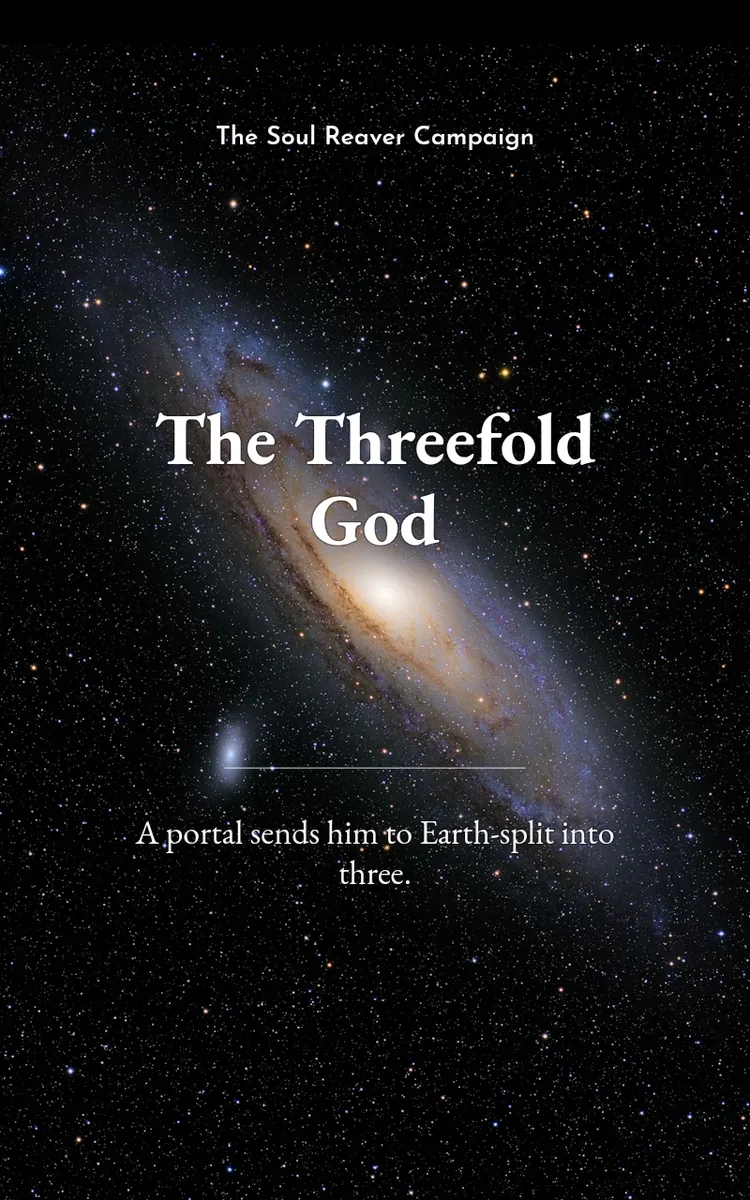
"The Threefold God" is a fiction book by The Soul Reaver Campaign with 23 chapters and approximately 61,046 words. A god sent to Earth via portal, split into three people.
This book was created using Inkfluence AI, an AI-powered book generation platform that helps authors write, design, and publish complete books. It was made with the AI Novel Writer.
Frequently Asked Questions
What is "The Threefold God" about?
A god sent to Earth via portal, split into three people
How many chapters are in "The Threefold God"?
The book contains 23 chapters and approximately 61,046 words. Topics covered include The Portal That Split a God, Three Bodies, One Failing Prayer, The Earth That Demands a Name, When the Threefold Truth Breaks, and more.
Who wrote "The Threefold God"?
This book was written by The Soul Reaver Campaign and created using Inkfluence AI, an AI book generation platform that helps authors write, design, and publish books.
How can I create a similar fiction book?
You can create your own fiction book using Inkfluence AI. Describe your idea, choose your style, and the AI writes the full book for you. It's free to start.
Write your own fiction book with AI
Describe your idea and Inkfluence writes the whole thing. Free to start.
Start writingCreated with Inkfluence AI


