
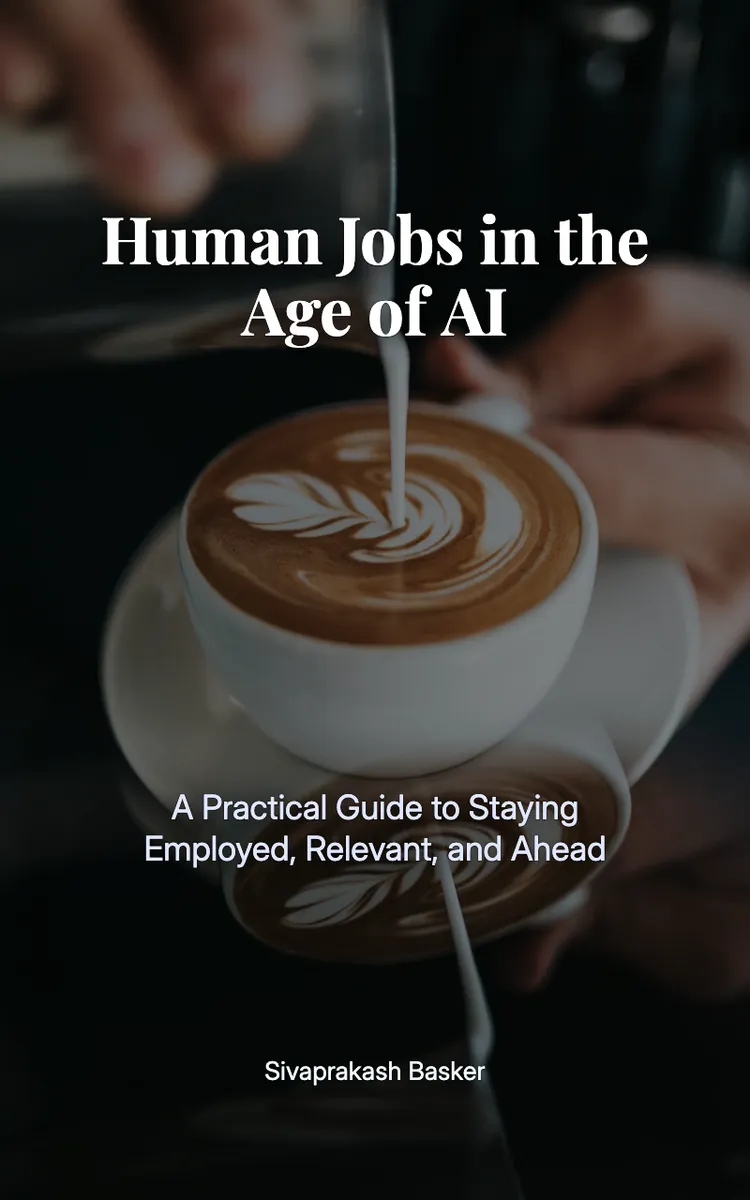
Human Jobs in the Age of AI
Created with Inkfluence AI
Table of Contents
- 1. The Jobs Aren't Gone Yet — But They're Changing Fast
- 2. What AI Is Really Good At (And Where It Falls Apart)
- 3. The Honest Self-Audit — How Exposed Are You?
- 4. The Skills AI Is Worst At
- 5. How to Use AI as a Multiplier, Not a Threat
- 6. From Executor to Owner — The Mindset Shift That Changes Everything
- 7. How Decisions About Layoffs Actually Get Made
- 8. Building Internal Reputation and Trust With Decision-Makers
- 9. Documenting Your Impact in an AI-Saturated Workplace
- 10. Building a Career Radar — Spotting the Next Wave Before It Hits
- 11. The 6-Month Skill Sprint
- 12. What Thriving at Work Looks Like in 2030
Preview: The Jobs Aren't Gone Yet — But They're Changing Fast
A short excerpt from “The Jobs Aren't Gone Yet — But They're Changing Fast”. The full book contains 12 chapters and 7,680 words.
Let's start with the truth: AI is not going to take your job tomorrow.
But it might take two years. Or five. Or it might not take it at all - if you do the right things now.
This book is not about scaring you. It is not about telling you that everything you worked for is about to disappear. It is about being honest with you, giving you a clear picture of what is happening, and then showing you exactly what to do about it.
Because the people who are going to be fine - and there are plenty of them - are not the ones who ignored AI. And they are not the ones who panicked. They are the ones who paid attention early and made smart moves.
That is what this book is for.
What Is Actually Happening Right NowAI tools have gotten very good, very fast. Things that used to take human hours - writing a report, summarising a meeting, answering customer questions, sorting through data - can now be done by software in minutes.
This is not science fiction. It is already happening in offices around the world. Companies are using AI to do more work with fewer people. Some roles that existed three years ago are already gone. Others are shrinking.
But here is what most people miss: the jobs that are disappearing are mostly jobs built around doing one thing, over and over. They are the jobs where someone takes information in, processes it in a predictable way, and sends it out. Those are exactly the kinds of tasks AI is best at.
The jobs that are sticking around - and growing - are the ones that require something harder to automate: good judgment, real relationships, creative problem-solving, and the ability to take responsibility when things go wrong.
The goal of this book is to make sure that describes you.
The Big Shift: From Doer to ThinkerFor most of the last century, a good employee was someone who could be relied upon to do their job consistently, follow the process, and deliver results. The emphasis was on doing.
That is still important. But it is no longer enough.
AI can do. What AI cannot do - at least not yet, and not reliably - is think in the full human sense. It cannot read a room. It cannot navigate a difficult conversation with a client. It cannot make a judgment call when the situation has never come up before. It cannot build trust with a colleague over months and years of working together.
The shift happening right now in the workplace is a shift from valuing people who do, to valuing people who think, connect, and decide.
If your job is mostly about doing predictable tasks in a predictable order, that is a warning sign worth taking seriously. If your job involves a lot of judgment, communication, and problem-solving - you are in a much stronger position.
This Is Not the First Time Work Has ChangedWhen spreadsheet software arrived in the 1980s, it did not eliminate the need for people who understood numbers - it made those people far more powerful. The ones who thrived were the ones who learned to use the new tools.
When the internet arrived, it did not wipe out business - it rewrote the rules of business. The people who adapted quickly pulled ahead. The ones who waited too long got left behind.
AI is the same kind of shift, but faster. The window to adapt is shorter. That is why it is worth starting now.
The good news is that you do not need to become a computer scientist. You just need to understand how AI is changing your workplace and how to make yourself more valuable inside that change.
How to Use This BookPart One helps you understand the threat clearly and honestly. Part Two shows you how to become harder to replace. Part Three covers how to be seen and valued inside your organisation. Part Four is about staying ahead long-term.
There are no shortcuts in this book. But there is a clear path. And if you follow it, you will be in a very different position than most of the people around you.
Let us get started.
Key Points
AI is already changing the workplace - repetitive, predictable tasks are most at risk.
Jobs built around judgment, relationships, and problem-solving are far more resilient.
The shift is from being a doer to being a thinker - from executing tasks to owning outcomes.
Technology has always changed work. The people who adapt early win.
You do not need to become a tech expert. You need to position yourself on the right side of the shift.
Next up - Chapter 2: What AI Is Really Good At (And Where It Falls Apart)
About this book
"Human Jobs in the Age of AI" is a general book by Sivaprakash Basker with 12 chapters and approximately 7,680 words. It covers key insights and practical takeaways on the topic.
This book was created using Inkfluence AI, an AI-powered book generation platform that helps authors write, design, and publish complete books.
Frequently Asked Questions
What is "Human Jobs in the Age of AI" about?
"Human Jobs in the Age of AI" is a general book by Sivaprakash Basker covering key insights and practical takeaways on the topic.
How many chapters are in "Human Jobs in the Age of AI"?
The book contains 12 chapters and approximately 7,680 words. Topics covered include The Jobs Aren't Gone Yet — But They're Changing Fast, What AI Is Really Good At (And Where It Falls Apart), The Honest Self-Audit — How Exposed Are You?, The Skills AI Is Worst At, and more.
Who wrote "Human Jobs in the Age of AI"?
This book was written by Sivaprakash Basker and created using Inkfluence AI, an AI book generation platform that helps authors write, design, and publish books.
Write your own book with AI
Describe your idea and Inkfluence writes the whole thing. Free to start.
Start writingCreated with Inkfluence AI


