
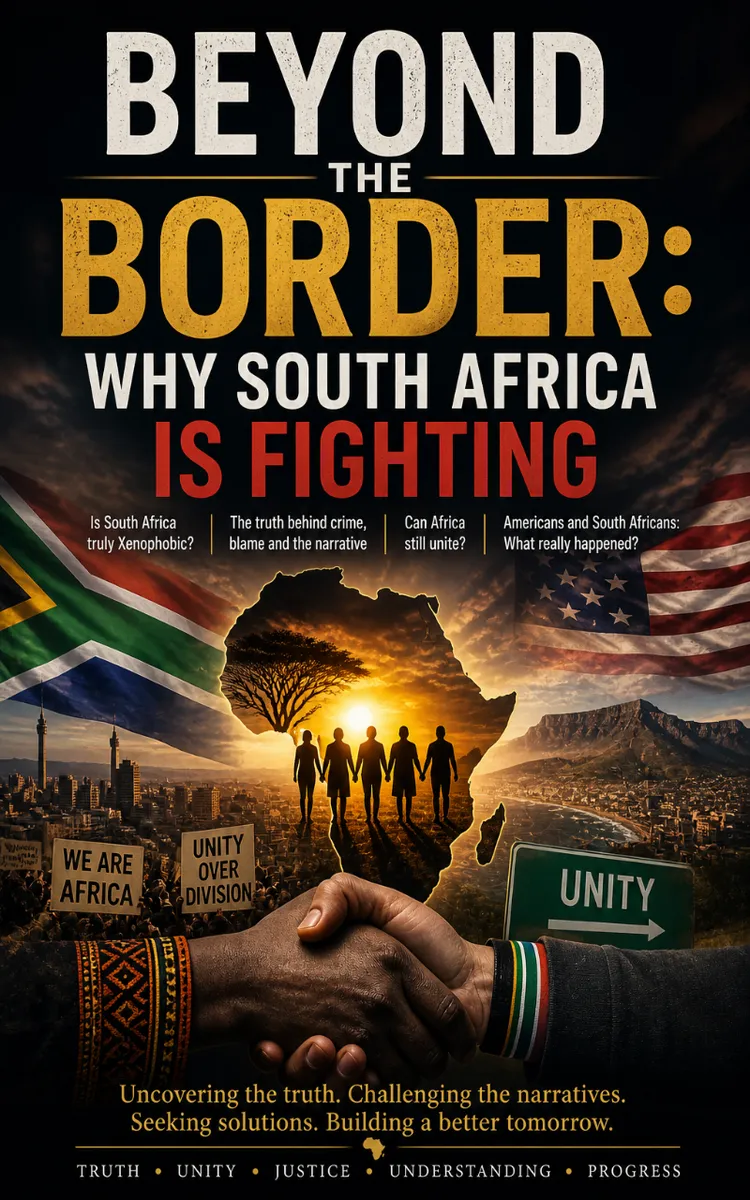
Beyond the Border: Why South Africa is Fighting
Created with Inkfluence AI
Table of Contents
- 1. The Anatomy of a Scapegoat
- 2. The Nigerian Scapegoat
- 3. The Thirty-Year Expiration Date
- 4. The American Mirror
- 5. The Fracture of the Dream
- 6. Conclusion: Disarming the Battlefield
First chapter preview
A short excerpt from chapter 1. The full book contains 6 chapters and 6,599 words.
To understand the battlefield of modern South Africa, you must first understand the geography of its pain.
If you stand in Sandton, a wealthy suburb of Johannesburg, you are standing in the richest square mile on the African continent. Glass skyscrapers pierce the sky, luxury German sedans idle on pristine streets, and the air smells of expensive coffee and economic power. It is a monument to the "Rainbow Nation" dream-a post-apartheid utopia of global integration.
But drive just ten minutes south. Cross the M1 highway, and the skyline vanishes behind a sea of corrugated iron roofs. This is Alexandra Township, or "Alex" as the locals call it. Here, the streets are narrow, unpaved, and choked with the smell of raw sewage and burning trash. Unemployment is not a statistic here; it is an oxygen-stealing reality.
This jarring juxtaposition-the opulence of Sandton looming over the penury of Alexandra-is the literal and psychological pressure cooker of South Africa. It is the ground zero of the battlefield. And when the pressure gets too high, the pot doesn’t just boil; it explodes.
But who gets burned?
In 2008, 2015, 2019, and again in recent years, that explosion has not been directed at the glass towers of Sandton. It has been directed inward, at the bodies and businesses of African foreigners living in townships just like Alex. Shops are looted, set ablaze. Men are dragged into the streets. Dozens are killed. Thousands are displaced.
The world watches in horror and asks a single, simplistic question: Is South Africa truly xenophobic?
The answer requires us to kill a sacred cow. To label South Africa as merely "xenophobic" is to misunderstand the disease entirely. It is a misdiagnosis that protects the real killers.
The Myth of the Irrational Fear
The word "xenophobia" comes from the Greek xenos (stranger or foreigner) and phobos (fear). It implies an irrational, psychological dread of the "other."
South Africans do not suffer from an irrational fear of foreigners. If they did, the violence would look vastly different. When an American tech executive moves to Cape Town, he is welcomed with tax incentives and wine tours. When a British expatriate opens a pub in Johannesburg, she is celebrated for bringing "investment." When French tourists walk the streets, they are protected by private security. There are no mobs burning down McDonald's or hunting down German engineers.
What South Africa suffers from is not xenophobia. It is Afro-phobia. It is a highly specific, economically driven rage directed exclusively at poor, black African immigrants. It is not an irrational fear; it is a terrifyingly rationalized misdirection of despair.
The Apartheid Hangover
To understand why South Africa’s poor turn on their African brothers and sisters, you have to look at the ghost of Apartheid.
When Nelson Mandela walked out of prison in 1990 and the African National Congress (ANC) took power in 1994, they achieved a political miracle. They dismantled the legal framework of white supremacy without a civil war. But a political revolution is not an economic one.
The ANC inherited a state designed by the white minority to enrich the white minority. Under Apartheid, the black majority was deliberately stripped of land, denied quality education, and physically relocated to barren "homelands" far from economic centers. The townships-like Soweto, Khayelitsha, and Alexandra-were built as holding pens for cheap black labor.
When democracy arrived, the new black political elite made a deal with the old white economic elite: We will take the keys to the state, but we will not redistribute the wealth.
For the masses in the townships, 1994 brought the right to vote, but it did not bring a job. It did not bring a house. It did not bring dignity. Thirty years later, South Africa remains one of the most unequal societies on planet Earth. The townships are overflowing. The social contract is broken.
The Pressure Cooker
Today, the numbers paint a picture of quiet catastrophe. The official youth unemployment rate hovers around 60%. In places like Alexandra, it is closer to 80%.
Add to this the total failure of the state. South Africa cannot keep the lights on. The national power utility, Eskom, implements rolling blackouts-known locally as loadshedding-for up to twelve hours a day. Without electricity, food rots in fridges, traffic lights fail, and small businesses die. Water systems are collapsing. Corruption is rampant at every level of government.
Imagine being a twenty-two-year-old black South African man in Alexandra. You have a high school diploma that is practically worthless. You cannot afford university. You send out a hundred CVs a month and hear nothing. You sit in the dark because Eskom has cut the power. You watch on a borrowed smartphone as politicians drive past in luxury convoys.
You are angry. You are humiliated. You feel a deep, existential threat to your survival.
You need someone to blame....
About this book
"Beyond the Border: Why South Africa is Fighting" is a general book by Anonymous with 6 chapters and approximately 6,599 words. It covers key insights and practical takeaways on the topic.
This book was created using Inkfluence AI, an AI-powered book generation platform that helps authors write, design, and publish complete books.
Frequently Asked Questions
What is "Beyond the Border: Why South Africa is Fighting" about?
"Beyond the Border: Why South Africa is Fighting" is a general book by Anonymous covering key insights and practical takeaways on the topic.
How many chapters are in "Beyond the Border: Why South Africa is Fighting"?
The book contains 6 chapters and approximately 6,599 words. Topics covered include The Anatomy of a Scapegoat, The Nigerian Scapegoat, The Thirty-Year Expiration Date, The American Mirror, and more.
Who wrote "Beyond the Border: Why South Africa is Fighting"?
This book was written by Anonymous and created using Inkfluence AI, an AI book generation platform that helps authors write, design, and publish books.
Write your own book with AI
Describe your idea and Inkfluence writes the whole thing. Free to start.
Start writingCreated with Inkfluence AI


