
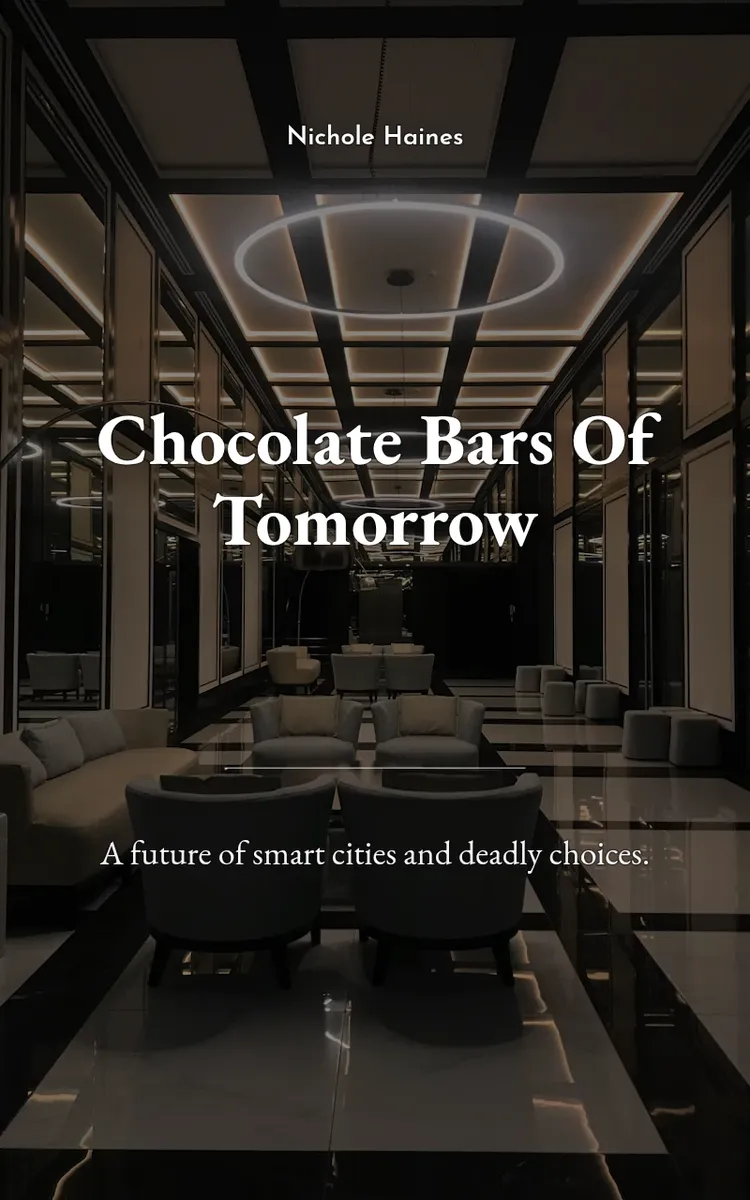
Chocolate Bars Of Tomorrow
Created with Inkfluence AI
Dystopian science fiction about population control and lethal rationing
Table of Contents
- 1. The Smart City’s Sweet Lie
- 2. Population Math Behind the Smiles
- 3. Chocolate Bars as Government Currency
- 4. The Ministry’s Selection Algorithm
- 5. Ration Gates and Silent Body Counts
- 6. The First Bar That Didn’t Kill
- 7. A Nurse Finds the Pattern
- 8. The Black Wrapper Protocol
- 9. When Smart Streets Start Watching
- 10. The Compliance Choir Broadcast
- 11. A Child’s Bar and a Missing Day
- 12. The Unlogged Death Certificate
- 13. How the Cities Control Hunger
- 14. The Underground Learns Your Name
- 15. A Translator for Poisoned Dreams
- 16. The Ministry’s Second Attempt
- 17. A Friend Refuses the Sweet Dose
- 18. The City’s Mercy Is a Trap
- 19. The Failed Bar’s Hidden Twin
- 20. A Trial Without a Courtroom
- 21. The Antidote List That Lies
- 22. Memory Editing in the Nutrition Ward
- 23. The Resistance Builds a Counter-Barcode
- 24. A Smart City Splits Into Factions
- 25. The Broadcast That Makes You Confess
- 26. The Night the Chocolate Went Missing
- 27. Who Gets the Spare Bar?
- 28. The Antidote Door Opens for One
- 29. A Betrayal Written in Wrapper Ink
- 30. The Government’s Population Theater
- 31. The Climax Bar: Choose to Live
- 32. Poisoned Chocolate as a Key
- 33. The Smart City’s Heartbeat Shutdown
- 34. The Global Feed Turns Against Them
- 35. A World Without Sweetness
- 36. The Resistance’s Last Antidote
- 37. Truth Broadcast from a Dead Wrapper
- 38. The New Selection: Who Survives Knowledge
- 39. Chocolate Bars Of Tomorrow, Rewritten
- 40. A Future That Still Tastes Like Control
- 41. The Last Recalculation
Preview: The Smart City’s Sweet Lie
A short excerpt from “The Smart City’s Sweet Lie”. The full book contains 41 chapters and 105,229 words.
The glass doors of the transfer station hissed shut behind Mara Venn, sealing her into the climate-controlled throat of New Eidon. A ribbon of light ran along the floor like a vein, projecting her arrival time in thin, polite numerals that vanished before she could read them twice. Overhead, the ceiling panels pulsed with soft daylight that never warmed - cool brightness, the kind that made her skin feel too exposed.
Her suitcase wheels clicked on the composite tiles as she followed the flow of bodies toward the food access kiosk. People moved with rehearsed ease, faces turned up toward the city’s glow. Somewhere behind the walls, a conveyor hummed, low and constant, like a machine dreaming. Mara tried to taste the air anyway, as if the city would betray itself through flavor, but the filters kept everything clean and neutral. No hint of rot. No hint of shortage. Only the faint metallic tang of regulated water and the steady thrum of security hidden so deep it felt like part of the building.
A woman in a gray uniform - more shadow than fabric - stopped in front of Mara without looking at her face. “New resident. Temporary housing corridor C. Food access is active on biometric confirmation.” The uniform’s collar glimmered with embedded sensors, and her voice carried the mild patience of someone who never had to wait for anything to be done.
Mara lifted her wrist. “I was told the city didn’t - ” She caught herself. The word she wanted, didn’t ration, sounded like a rumor you could get arrested for.
The woman’s gaze flicked to Mara’s eyes, then to her wrist, then past her shoulder as if the station itself were answering. “The city doesn’t ration,” she said, correcting without raising her tone. “The city manages.”
The kiosk beside them brightened, a smooth panel of interface glass. It displayed a smiling icon holding a chocolate bar the color of polished mahogany, with a tagline Mara couldn’t quite parse because the letters kept sliding into a different arrangement. When she leaned closer, the smile remained fixed, cheerful and unblinking, while the text rearranged itself into something that looked like celebration.
Stability dashboard. Live feed. Abundance metrics.
Mara’s throat tightened anyway. She’d come to New Eidon because it was advertised - quietly, through approved channels - as the safest place on Earth to start over. Her paperwork had promised access to “engineered abundance,” a phrase that had sounded like a joke someone told to keep fear from spreading. Now she stood in a station where no one looked hungry, where people flowed past her with full hands and relaxed shoulders, and she couldn’t shake the suspicion that the joke was aimed at someone else.
The kiosk chimed once, a sound like a spoon tapping a glass. A thin band of light spread around Mara’s wrist and tightened, not painful - just insistent. The woman in gray stepped back as the system processed her.
“Welcome,” the kiosk said, voice bright enough to be kind. Then, as if kindness had limits, it added: “Your allocation will reflect your needs and your compliance history.”
Mara’s wristband warmed. Not hot, not burning - warm like an affectionate lie.
“I don’t have a history,” Mara said. “I’m new.”
The uniform woman’s mouth twitched, not quite a smile. “Everyone has a history.” Her eyes shifted to the crowd behind Mara, to the way people kept glancing at their own wrists as if checking their pulse. “Sometimes it just hasn’t been used yet.”
Mara wanted to argue. She wanted to demand specifics, to pry open the city’s perfect face and find the seams. But the station moved on without her. A man in a work jacket brushed past, his shoulder warm through his shirt, and Mara caught a faint scent of cocoa on his breath - real cocoa, not the antiseptic chocolate-flavored aroma she’d tasted in older blocks. He held a branded bar in both hands like a gift, the wrapper emblazoned with an eagle-shaped symbol and the words Eidon Sweet Reserve.
“Is that - ” Mara pointed before she could stop herself.
The man didn’t look at her. He didn’t need to. “It’s fine,” he said, and his voice had the casual confidence of someone repeating what he’d already accepted. “They say there’s plenty. They say it’s all monitored. No waste.”
Mara followed the movement of his eyes as he glanced down at his wristband again. The band pulsed once, then displayed a small green number that meant nothing to her and everything to him. He tucked the bar into a pocket, adjusted his jacket, and walked away, disappearing into the crowd like he belonged to the city’s rhythm.
Mara turned back to the kiosk. The interface glass still held the smiling icon, but beneath it, hidden in the corners, she saw a second layer of text flicker - too fast to read, too deliberate to be accidental. She leaned in and focused until her vision narrowed to the edges. For a split second, the flicker aligned into something coherent:
Scheduled consumption window.
Enforcement tier.
...
About this book
"Chocolate Bars Of Tomorrow" is a fiction book by Nichole Haines with 41 chapters and approximately 105,229 words. Dystopian science fiction about population control and lethal rationing.
This book was created using Inkfluence AI, an AI-powered book generation platform that helps authors write, design, and publish complete books. It was made with the AI Novel Writer.
Frequently Asked Questions
What is "Chocolate Bars Of Tomorrow" about?
Dystopian science fiction about population control and lethal rationing
How many chapters are in "Chocolate Bars Of Tomorrow"?
The book contains 41 chapters and approximately 105,229 words. Topics covered include The Smart City’s Sweet Lie, Population Math Behind the Smiles, Chocolate Bars as Government Currency, The Ministry’s Selection Algorithm, and more.
Who wrote "Chocolate Bars Of Tomorrow"?
This book was written by Nichole Haines and created using Inkfluence AI, an AI book generation platform that helps authors write, design, and publish books.
How can I create a similar fiction book?
You can create your own fiction book using Inkfluence AI. Describe your idea, choose your style, and the AI writes the full book for you. It's free to start.
Write your own fiction book with AI
Describe your idea and Inkfluence writes the whole thing. Free to start.
Start writingCreated with Inkfluence AI


