
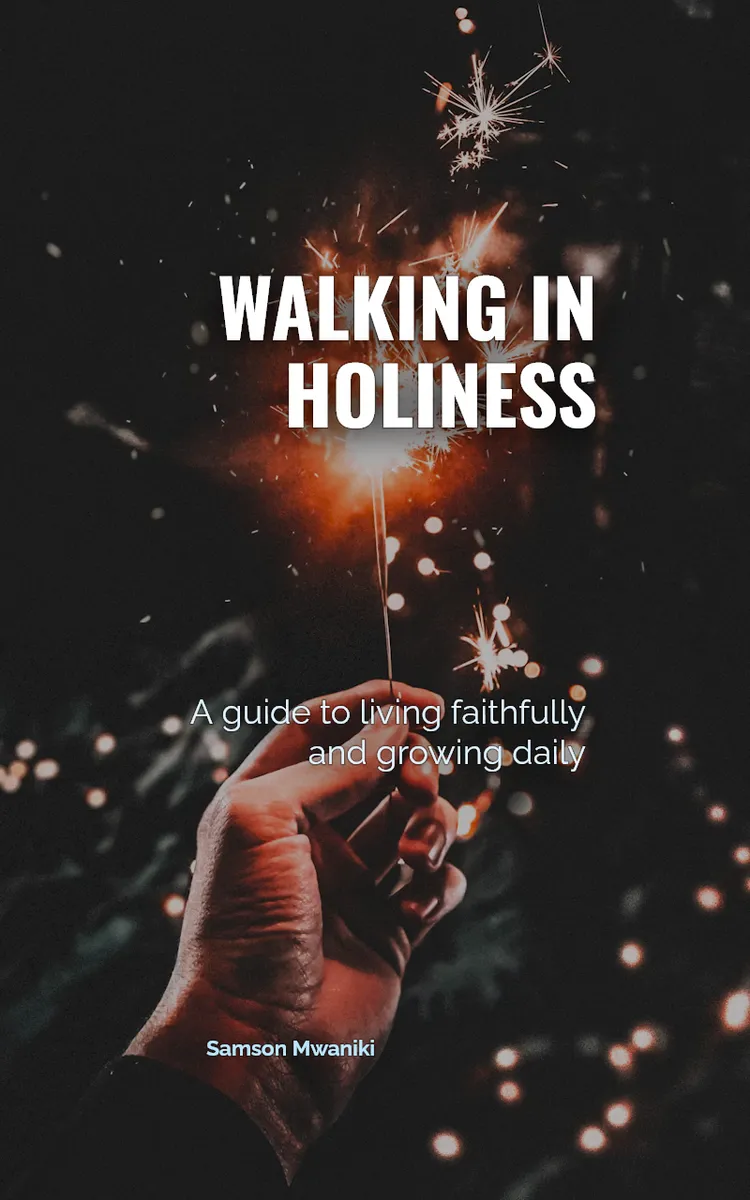

Read the first chapter
The whole of chapter one, free. About 4 min. Turn the pages with the arrows, your keyboard, or a swipe.
Chapter 1
Step One: Trusting God’s Hand
Scripture Focus
Proverbs 3:5-6
“Trust in the LORD with all your heart, and do not lean on your own understanding. In all your ways acknowledge him, and he will make straight your paths.”
When you can’t see the road ahead, faith isn’t guessing harder - it’s trusting God’s character and timing one step at a time.
Have you ever had a moment where your mind starts sprinting - trying to solve everything at once - while your heart feels stuck? Maybe it’s a decision about work, money, relationships, or your health. Maybe it’s the same temptation showing up again and again, and you’re tired of fighting in your own strength. In those moments, leaning on yourself can feel like the only option. But Scripture doesn’t ask you to “figure it out” first. It invites you to trust God first, even when your understanding is limited (which, if we’re honest, is most days).
Reflection
Replacing self-reliance with faith sounds simple until you actually live it. Self-reliance says, “If I can’t control it, I can’t handle it.” Faith says, “I can’t control it, but God can - and He’s good.” That’s the shift Proverbs is aiming at. “Do not lean” doesn’t mean you stop thinking. It means you stop making your understanding the final authority. Your brain is a tool; it’s not a throne.
Here’s what that looks like in real life. Let’s say you’re trying to walk in holiness, but you’re constantly tempted to talk yourself into compromise. You might tell yourself, “I’ll stop later,” or “No one will notice,” or “This is just how things are now.” Self-reliance kicks in by trying to manage consequences instead of trusting God’s promises. Faith does something different: it anchors you in what God says is true, then helps you take the next right step - cleanly, quietly, and consistently.
The key insight is this: trusting God isn’t passive - it’s choosing His way while you wait. Waiting doesn’t mean doing nothing. It means you keep acknowledging Him in “all your ways,” including the boring ones: how you respond when you’re tired, how you spend when you’re stressed, how you speak when you’re tempted to exaggerate, and how you handle your private thoughts when no one else is watching. God’s guidance often comes as steady direction, not lightning-bolt clarity. And that’s where many of us struggle, because we want the whole map before we move.
You might notice how Proverbs connects trust and direction. “He will make straight your paths” doesn’t always mean the road becomes smooth immediately. Sometimes it means your steps become steady enough to keep going without spiraling. Sometimes it means God corrects your direction along the way. Sometimes it means you realize the path was never about you proving your wisdom; it was about you learning to depend on Him. Either way, faith is training your heart to stop treating uncertainty like an emergency.
A helpful picture: self-reliance is like driving while staring only at the dashboard, trying to interpret every warning light. Faith is driving while looking down the road - knowing the One who built the road is not surprised by your next turn. You don’t need to see every mile to trust the Driver.
Practice for Today
• Do a “Trust Check” before you make your first decision (5 minutes).
Grab a notebook and write one sentence at the top: “Today, I tend to rely on myself when…” Then list one real example from this week - something specific, like “when I’m asked to cut corners at work” or “when I’m tempted to keep scrolling instead of praying.”
After that, write: “God, I choose to trust You with…” Fill in the rest with the exact thing you’re trying to manage alone. This isn’t a vague exercise. Use one situation you actually faced.
• Practice a timed “acknowledge Him” prayer (3 rounds of 1 minute).
Set a timer for 3 minutes total. Each minute, pray one simple line that matches your moment:
• Round 1: “God, I don’t understand everything, but I trust Your character.”
• Round 2: “God, help me acknowledge You in what I’m doing right now.”
• Round 3: “God, make my path straight today - one step at a time.”
If your mind wanders (it will), just bring it back. Faith isn’t perfection; it’s returning.
• Choose one “faith step” that costs you a little control (10-20 minutes).
Pick one action that shows you’re trusting God more than your usual go-to. For example:
• If you’re tempted to respond sharply in a text, write the message once, then pause 10 minutes before sending and pray for a clean tone.
• If you’re tempted to hide something, set up a humble conversation or ask for accountability - small, honest, and respectful.
• If money stress drives you to impulsive decisions, pause before a purchase for 24 hours and ask God to guide your next choice.
After you do it, journal this prompt: “What did trusting God look like in my hands today? Where did I feel resistance, and what did I do anyway?”
Closing Prayer
Lord, I’m tired of trying to steer everything with my own understanding. Teach me to trust You with my whole heart, especially when I can’t see the path ahead. Make my next steps straight, and help me acknowledge You in the small moments that shape my holiness. I choose Your way today. Amen. \
End of chapter one. 4 more chapters in the full book.
Swipe or use the arrows to turn the page
What's inside: 5 chapters
- 1. Step One: Trusting God’s Hand
- 2. Step Two: Prayer That Aligns the Heart
- 3. Step Three: Hope in the Middle of the Process
- 4. Step Four: Surrendering What You Control
- 5. Step Five: Walking Forward in Holy Living
About this book
"Walking In Holiness" is a religious devotional book by Samson Mwaniki with 5 chapters and approximately 4,533 words. Christian guidance on living a holy life.
This book was created using Inkfluence AI, an AI-powered book generation platform that helps authors write, design, and publish complete books.
Frequently Asked Questions
What is "Walking In Holiness" about?
Christian guidance on living a holy life
How many chapters are in "Walking In Holiness"?
The book contains 5 chapters and approximately 4,533 words. Topics covered include Step One: Trusting God’s Hand, Step Two: Prayer That Aligns the Heart, Step Three: Hope in the Middle of the Process, Step Four: Surrendering What You Control, and more.
Who wrote "Walking In Holiness"?
This book was written by Samson Mwaniki and created using Inkfluence AI, an AI book generation platform that helps authors write, design, and publish books.
Write your own religious devotional book with AI
Describe your idea and Inkfluence writes the whole thing. Free to start.
Start writingCreated with Inkfluence AI


