
Read the first chapter
The whole of chapter one, free. About 9 min. Turn the pages with the arrows, your keyboard, or a swipe.
Chapter 1
Flatulence Demons, Explained by Scholars
Flatulence Demons, Explained by Scholars: When “Gas” Was a Ghost With a Doctor’s Degree
A woman in medieval Europe could be told, with a straight face, that what rose from her belly wasn’t just air - it was something like a visitor. A spirit could be blamed for the “passage,” a humor for the timing, and a bodily sign for the mood. The paradox is that these explanations were often wrong in mechanism, yet eerily good at noticing a real bodily truth: digestion really does produce gas, and it really does have patterns.
For this chapter, we follow the medieval logic trail: scholars and healers didn’t treat flatulence as a private inconvenience. They treated it as evidence - clues about inner balance, moral weather, and the state of the organs. Then we compare that worldview to what modern physiology actually says about where gas comes from, why it smells, and why the body sometimes seems determined to gossip.
Matilda of Bruges - nineteen, apothecary apprentice, and old enough to have opinions about her own stomach - doesn’t get a lab report. She gets a theory. And theories, medieval ones included, are how people make sense of sensations they can’t hold in their hands. The mystery that keeps this subject alive isn’t whether people farted (they did), but what they thought the fart meant.
If a smell can be “explained” by demons - or by microbes - what exactly is the body telling us, and who gets to translate it?
The Humor-Physics of Medieval “Passage”: Spirits, Humors, and Clues From the Belly
Medieval “gas” talk didn’t start as a cranky misunderstanding of plumbing. It came from a whole medical language built around humors - the idea that the body is run by mixtures like blood, phlegm, yellow bile, and black bile. Health was balance. Illness was imbalance. And the body, being dramatic, showed imbalance through visible signs: skin color, urine qualities, fever, sleep patterns - and yes, the noises and pressures of digestion.
So when someone had flatulence, it wasn’t merely a symptom. It was a sign that the stomach and intestines were misbehaving in a way that could be read. Depending on the healer’s school and the patient’s story, the cause might be described in terms of coldness or heat, excess moisture, or an overabundance of a particular humor. Gas became a kind of messenger: if it was frequent, it suggested the digestion process was “stirring” the wrong substance; if it was foul, it hinted that the material being processed had gone bad - again, in the language of humors.
There’s also the spirit layer. In many medieval settings, bodily events weren’t sealed off from the supernatural. Even when people used medical terms, they often kept spiritual explanations nearby like a coat you might need later. Some traditions treated certain internal sensations as the work of demons or other invisible forces - especially when the symptom came with distress, shame, or a sense of being out of control. Importantly, this wasn’t necessarily “belief without observation.” It was belief attached to interpretation.
A telling detail: medieval medical texts often treated digestion as a sequence of transformations - food cooked, cooked again, then refined. If the process went wrong, the “wrong” matter could ferment, and fermentation in the body is exactly the kind of mechanism that produces gas. Medieval authors didn’t have microbiology, but they had a workable concept: certain substances can ferment. They just placed the blame in the wrong place.
Modern readers may picture the medieval stomach as a haunted cauldron. That’s not entirely fair. The medieval stomach was also a theory machine: it converted messy sensations into a story that could be acted upon - by diet changes, medicines, and ritual. The point isn’t that the story was right; it’s that it was consistent enough to organize daily life around.
What “Gas” Actually Is: Fermentation, Swallowing Air, and the Chemistry of Smell
Here’s the blunt comparison: medieval scholars could explain the experience of flatulence better than the underlying biology. In modern physiology, most intestinal gas comes from two main sources: swallowed air and gas produced by gut microbes.
Swallowed air arrives when we eat and drink, especially with fast eating, talking while chewing, carbonated beverages, or chewing gum. That gas tends to be more common early in digestion because it’s literally entering the system from outside.
The more interesting part - the one that explains why the smell can be intense - is microbial fermentation. In the large intestine, bacteria break down parts of food we can’t digest ourselves, like certain carbohydrates. During this breakdown, microbes generate gases such as hydrogen, carbon dioxide, and methane (not everyone produces methane). These gases expand, accumulate, and eventually move out - often with the timing and frequency that make people swear their body has a schedule.
Now for the stink, the part medieval people really loved to interpret. The odor of flatulence is largely tied to sulfur-containing compounds, including substances produced when microbes process proteins. The smell can shift dramatically depending on what’s in the diet: more protein in the gut can increase the production of odor-heavy compounds. That’s why a meal that changes your digestion can change your odor, even if your digestion “feels” the same.
One counterintuitive element here is that the body can produce gas without “something evil” happening. Gas is normal. The colon is an active fermentation chamber. The medieval view treated gas as a sign that something was off; modern science treats it as a normal byproduct of digestion and microbial life. The difference isn’t that modern people “ignore” signs. It’s that modern people read them differently: your body is not necessarily reporting a demon - often it’s reporting chemistry.
And yet, there’s a curious overlap. Medieval healers often linked foulness with the “quality” of internal matter. Modern biochemistry doesn’t talk about humors, but it does talk about the quality and type of substrates reaching the colon. Diet affects which compounds are available for microbial breakdown, and that affects both the amount and the smell of gas. In other words, the medieval interpreter was looking at the right phenomenon - just handing out the wrong culprit.
The Humor-to-Howl Checklist: How to Read Medieval Explanations Without Getting Fooled by Them
To keep this from turning into “medieval people were silly,” we need a method for sorting what’s observation and what’s interpretation. Here’s the Humor-to-Howl Checklist - not a diet plan or a moral system, but a way to watch how explanations are built.
The first check is what the symptom is actually describing. With flatulence, people noticed frequency, pressure, odor, and sometimes timing after meals. Those are real, and they map cleanly onto modern factors like swallowing air, fermentation, diet composition, and individual microbiome differences.
The second check is what the explanation changes about the world. If a healer says the cause is a humor imbalance, the “how” stays fuzzy, but the “what to do” follows: adjust food, change regimen, choose remedies aimed at restoring balance. If the cause is a demon, the logic pushes toward spiritual remedies, warnings, and fear management. Either way, the explanation becomes a tool for decision-making.
The third check is whether the explanation predicts anything specific - not “it’s bad,” but something more concrete like “after certain foods it will worsen” or “when the body is overheated it changes.” Medieval accounts sometimes made consistent claims tied to diet and bodily states. But they rarely had a correct mechanism for smell and gas chemistry. Their predictions were often shaped by the framework they started with: humors and spirits.
Finally, the checklist asks what survives contact with modern evidence. The part that survives is the sensory reality: gas is produced, smell varies, diet matters. The part that doesn’t survive is the mechanism ascribed to it: demons and humors can be decorative metaphors, but microbes and digestion chemistry are the actual drivers of gas formation and odor.
This is where the surprising connection lands. Medieval “gas” talk wasn’t pure nonsense; it was an early attempt to connect internal bodily events with causes that could be understood at the time. When you strip away the demons and humors, you can still see the bones of a real idea: food and bodily state change what happens in the gut. The difference is that modern science replaces the story’s invisible agents with measurable processes.
That reframing matters because it changes what we’re judging. We’re not grading medieval people on microbiology. We’re watching humans do the same thing humans still do: take a private sensation, turn it into a public explanation, then build a worldview that tells you what the sensation means.
Matilda of Bruges and the Smell Problem: How an Apothecary Apprentice Learned to Translate Bodily Signs
Matilda of Bruges is the kind of person history leaves half-lit. We don’t get her diary with her own words in the margins. What we do have are the everyday worlds of apothecary apprentices in medieval and early modern Europe - training that mixed observation, recipe knowledge, and reading the body through established frameworks.
In Bruges, like other bustling towns, an apothecary wasn’t just a shop; it was a translation hub. People brought symptoms - headaches, fevers, digestive complaints - and apprentices learned how to match those stories to remedies. The training emphasized that bodily signs carried meaning. The stomach wasn’t only a stomach; it was an interpretive stage.
Matilda’s age - nineteen - matters because apprentices were often learning hands-on while still young enough to be unsettled by their own body. Flatulence, for many people, is not a distant medical curiosity. It’s humiliating, frequent, and deeply tied to daily food. That makes it the perfect symptom for a framework that treats bodily signs as readable messages.
In a practical sense, an apothecary apprentice would have been exposed to the “gas explanations” circulating among healers: humors run too hot or too cold, digestion ferments, the wrong matter needs correction. Even if Matilda didn’t fully believe every spirit story, she would have learned which explanations were persuasive in her community. In other words, she would have learned the social life of medical ideas. Her world didn’t separate “science” from “meaning” the way we prefer to imagine it.
So what did she do with this? She didn’t need a microscope to see that diet changes digestion. She could observe that certain meals were followed by more gas, or worse odor, and that remedies and regimen advice sometimes coincided with improvement. The medieval frameworks interpreted those changes as balance returning - or spirits quieting - or matter being corrected.
Modern readers might want evidence that Matilda personally blamed demons for her own flatulence. We don’t have that kind of specific record. What we can say with confidence is that her trade environment trained people to treat gas as a sign with causes, and that “causes” in her world often included both humors and spirits. The human story here is not “Matilda’s exact belief system.” It’s the lived reality that bodily sensations were translated into medical and moral language by people whose work depended on being understood.
And that returns us to the central theme: gas isn’t just air. It’s a phenomenon that provokes explanation. In Matilda’s Bruges, the explanation was often a blend of physiology-as-they-knew-it and meaning-as-they-needed-it.
What This Tells Us: Why We Assign Meaning to Bodily Noise
The medieval “gas” theories show something stubbornly human: when the body produces an embarrassing, involuntary signal, people reach for a story that makes it legible. Sometimes that story is poetic. Sometimes it’s religious. Sometimes it’s medical in the old sense - an attempt to map internal events onto a coherent universe.
Modern science doesn’t remove meaning; it changes the translator. Where medieval scholars might have said the belly was negotiating with spirits or humors, we say the belly is negotiating with digestion chemistry and gut microbes. The wonder is that both approaches can start from the same raw material - pressure, smell, timing - and then build wildly different worlds around it.
So the mystery isn’t only why medieval people thought demons were involved. It’s why, even with better tools now, we still treat our bodies like message boards. The next chapter in this book will keep following that collision between explanation and evidence - because the strangest part of history isn’t what people believed. It’s how hard they worked to make belief feel like knowledge. *
End of chapter one. 7 more chapters in the full book.
Swipe or use the arrows to turn the page
What's inside: 8 chapters
- 1. Flatulence Demons, Explained by Scholars
- 2. Bloodletting’s Sacred Numbers
- 3. Magnet Cures and the Lure of Sympathy
- 4. Why Earthworms Were “Living Tools”
- 5. The Philosopher’s Stone: Real Chemistry or Theater?
- 6. Astrology as Diagnostic Technology
- 7. Toads, Tinctures, and the Medicine Cabinet of Myths
- 8. The Demon-Test: How to Spot Pseudoscience
About this book
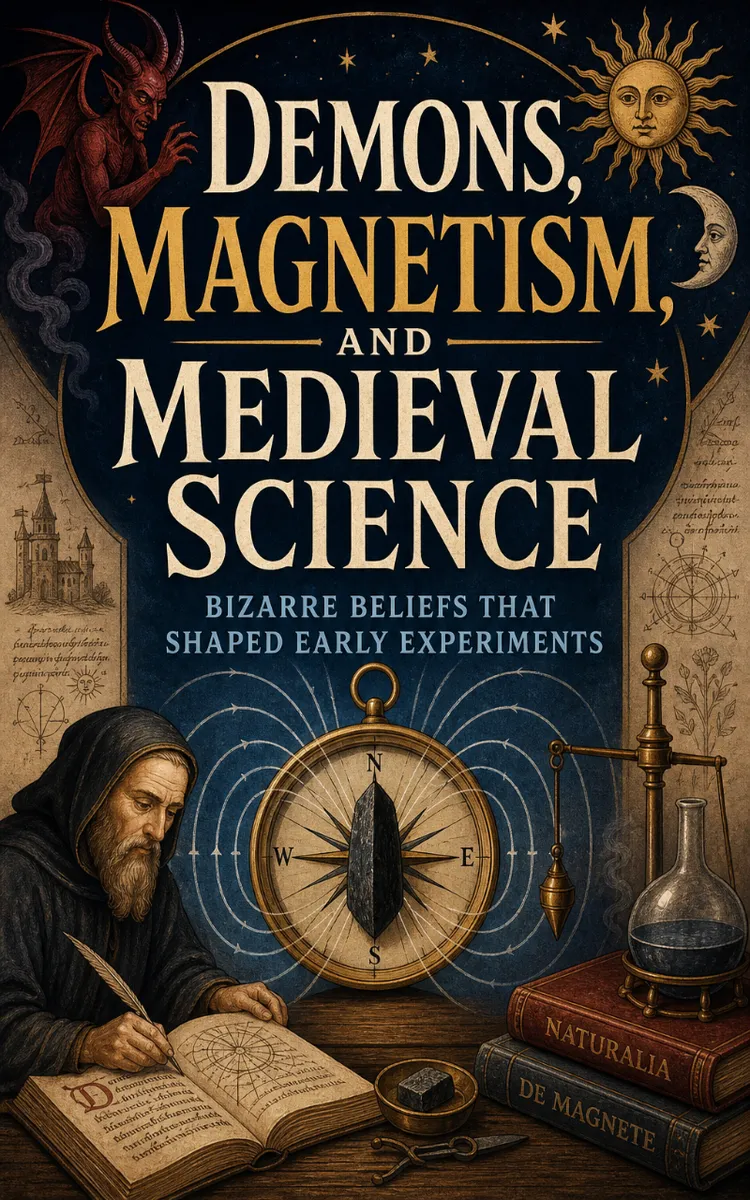
"Demons, Magnetism, And Medieval Science" is a curiosity book by Philippe Bertrand with 8 chapters and approximately 15,148 words. Medieval scholars’ strange scientific beliefs mixing faith, folklore, and early science.
This book was created using Inkfluence AI, an AI-powered book generation platform that helps authors write, design, and publish complete books.
Frequently Asked Questions
What is "Demons, Magnetism, And Medieval Science" about?
Medieval scholars’ strange scientific beliefs mixing faith, folklore, and early science
How many chapters are in "Demons, Magnetism, And Medieval Science"?
The book contains 8 chapters and approximately 15,148 words. Topics covered include Flatulence Demons, Explained by Scholars, Bloodletting’s Sacred Numbers, Magnet Cures and the Lure of Sympathy, Why Earthworms Were “Living Tools”, and more.
Who wrote "Demons, Magnetism, And Medieval Science"?
This book was written by Philippe Bertrand and created using Inkfluence AI, an AI book generation platform that helps authors write, design, and publish books.
Write your own curiosity book with AI
Describe your idea and Inkfluence writes the whole thing. Free to start.
Start writingCreated with Inkfluence AI


