
Preview: Credit Report Audit and Disputes
A short excerpt from “Credit Report Audit and Disputes”. The full book contains 5 chapters and 9,942 words.
Your credit report can look “fine” at a glance, but one wrong late payment code, one account mixed up under the wrong name, or one balance that never updated can quietly drag your score down for months. If you have ever applied for a card or a car loan and gotten a “credit score too low” response, you already know the frustration: you feel like you paid your bills, yet the report says otherwise.
This chapter shows you how to audit your credit reports like you would check receipts before tax time. You will learn how to read each part of your report, spot the errors that actually matter, and file targeted disputes that move inaccurate items off your credit history. After you finish, you will know exactly what to look for, how to document it, and how to submit disputes in a way that forces the credit bureau and the furnisher (the company that reported the data) to investigate the specific problem you named.
We will use Tanya (34), a retail manager re-entering the workforce, as a realistic case study for what this looks like in real life: a busy schedule, a few accounts that don’t match what she remembers, and a plan to clean things up without wasting time on vague or generic dispute letters.
Credit Report Audit: How to Find the Errors That Actually Move Your Score
Most people treat a credit report like a single number - good or bad - then they react when they get denied. The problem is that credit reports tell a story with details: account status, payment history, balances, dates, and who reported the information. When one detail is wrong, your score can get hit even if the rest of your history looks strong.
This chapter solves a specific problem: you do not know how to read your reports deeply enough to catch the mistakes that lead to score drops, and you do not know how to dispute them in a targeted way. A targeted dispute names the exact issue (for example, “This account shows a late payment on 02/14/2024, but I paid on time”), includes proof, and asks for the bureau to correct or remove the inaccurate data.
You will also stop making one of the most expensive mistakes in credit repair: disputing the wrong thing. If you dispute something that is accurate, the item stays and you waste time. If you dispute something too general (“remove this account”), you often get a slow response with no meaningful change. Instead, you will audit the report and focus on the entries that can realistically come off.
Finally, you will learn how to use a framework called the 3-Bucket Report Audit. It helps you sort what you see into three groups: items that are clearly wrong, items that might be wrong but need proof, and items that are accurate but just not helping you yet. That sorting step keeps your disputes sharp and your effort focused.
The 3-Bucket Report Audit: Read, Sort, and Target What to Dispute
The 3-Bucket Report Audit turns a confusing credit report into a clear checklist. You will not just “look for errors.” You will place every questionable item into one of three buckets so you know what to dispute, what to research, and what to leave alone for now.
Use this framework on each credit report you have access to (from each credit bureau). Credit bureaus do not always show the same data, so you want to audit them separately.
1. Bucket 1: Clearly Wrong (Dispute Now)
Place an item here when you can point to a mismatch you can prove. Examples include a late payment that shows “30 days late” when you paid on time, an account that lists the wrong balance, an account that is not yours, or an account that shows the wrong open/close date.
After you put it in Bucket 1, you file a dispute tied to that exact field.
2. Bucket 2: Possibly Wrong (Gather Proof First)
Place an item here when it looks off, but you cannot prove it yet. Examples include “Payment status: current” when you think you missed a month, or an account that shows a balance that might not reflect your payoff date.
After you put it in Bucket 2, you collect documents (receipts, bank statements, account history screenshots, payoff letters) before you dispute.
3. Bucket 3: Accurate but Not Fixable Yet (Plan Separately)
Place an item here when the report likely reflects reality but it still hurts your score. Examples include accounts that show legitimate late payments from years ago or high balances that you have not paid down yet.
After you put it in Bucket 3, you do not waste dispute filings. You plan payment actions, and you revisit disputes only if you find new evidence of inaccuracy.
To make this concrete, look at the payment history section for each account. That section usually shows months with codes like “On time,” “30 days late,” or “60 days late.” If you see a late mark on a month you paid, you have a strong Bucket 1 candidate. If you see a late mark but you cannot find your proof for that month yet, you treat it as Bucket 2.
...
What's inside: 5 chapters
- 1. Credit Report Audit and Disputes
- 2. Hard Inquiries and Timing Strategy
- 3. Utilization Targets and Payment Scheduling
- 4. Settlements, Pay-for-Delete, and Negotiation
- 5. Building Long-Term Credit Wealth Habits
About this book
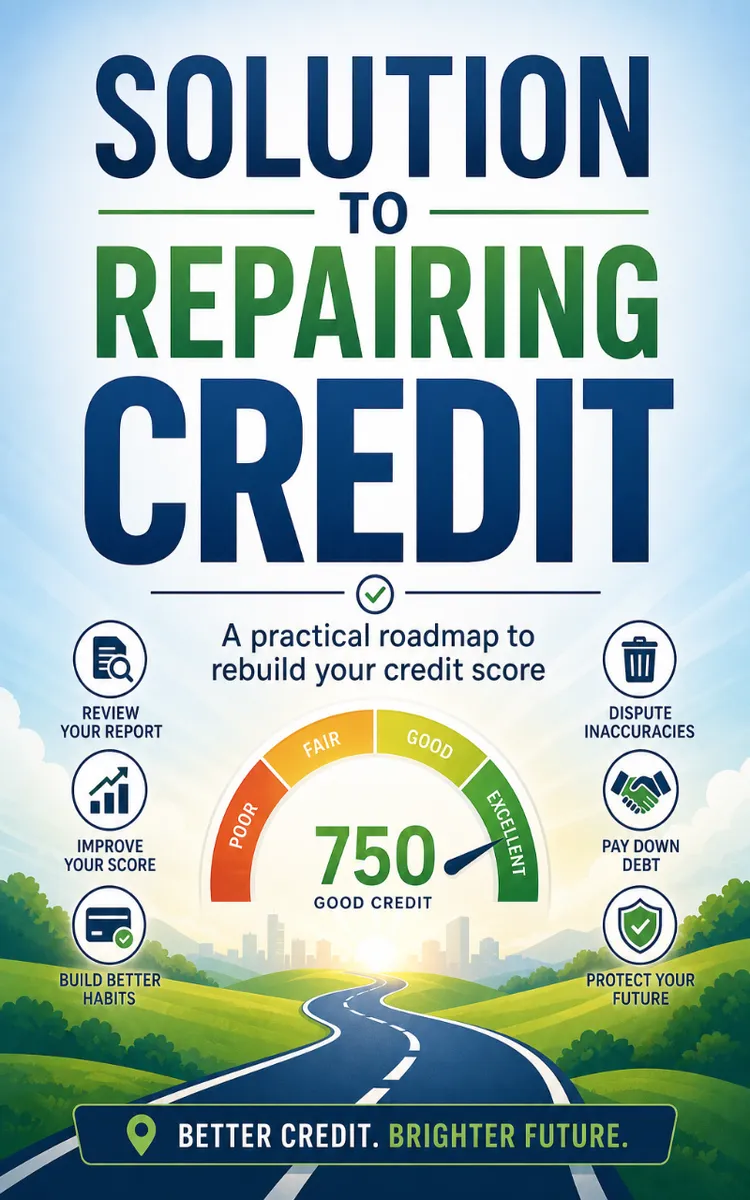
"Solution To Repairing Credit" is a finance book by Anonymous with 5 chapters and approximately 9,942 words. Credit repair strategies to improve credit scores.
This book was created using Inkfluence AI, an AI-powered book generation platform that helps authors write, design, and publish complete books. It was made with the AI Ebook Generator.
Frequently Asked Questions
What is "Solution To Repairing Credit" about?
Credit repair strategies to improve credit scores
How many chapters are in "Solution To Repairing Credit"?
The book contains 5 chapters and approximately 9,942 words. Topics covered include Credit Report Audit and Disputes, Hard Inquiries and Timing Strategy, Utilization Targets and Payment Scheduling, Settlements, Pay-for-Delete, and Negotiation, and more.
Who wrote "Solution To Repairing Credit"?
This book was written by Anonymous and created using Inkfluence AI, an AI book generation platform that helps authors write, design, and publish books.
How can I create a similar finance book?
You can create your own finance book using Inkfluence AI. Describe your idea, choose your style, and the AI writes the full book for you. It's free to start.
Write your own finance book with AI
Describe your idea and Inkfluence writes the whole thing. Free to start.
Start writingCreated with Inkfluence AI


