
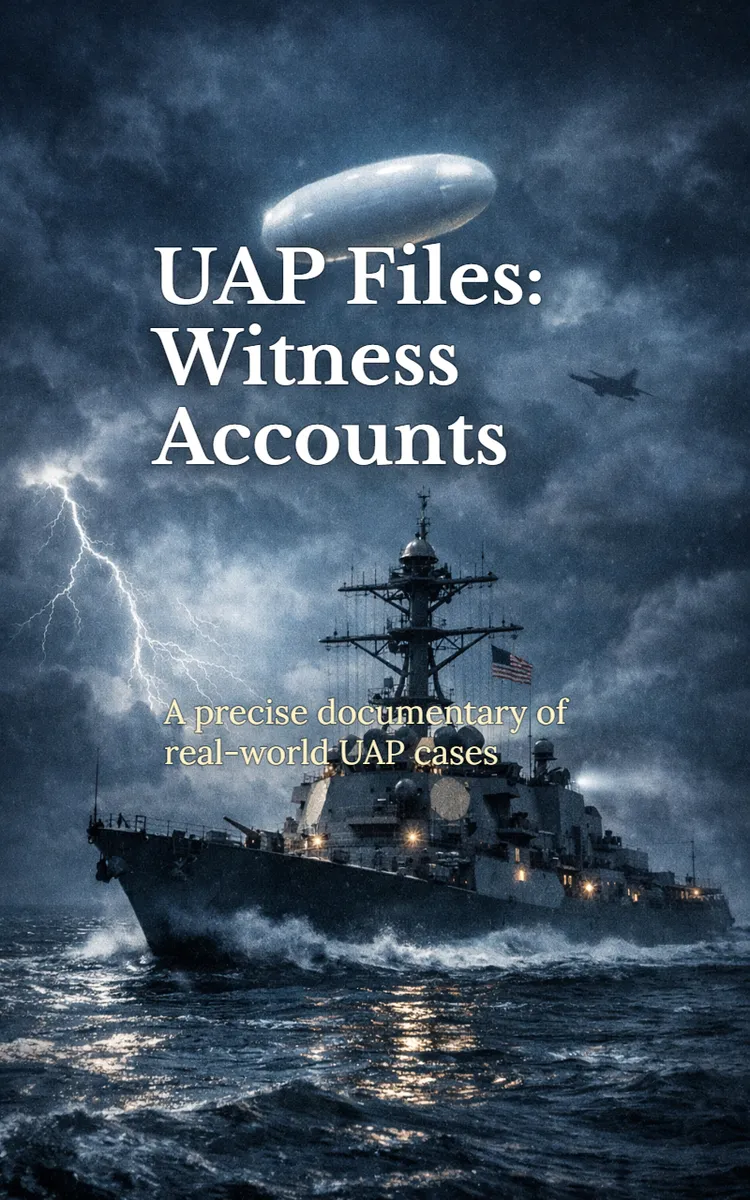
Read the first chapter
The whole of chapter one, free. About 9 min. Turn the pages with the arrows, your keyboard, or a swipe.
Chapter 1
Tic-Tac: The Nimitz Witness Timeline
The Strange Part About the Nimitz Tic-Tac: Speed Without Sound (and Sight Without Certainty)
The most counterintuitive thing about the 2004 “Tic-Tac” encounter isn’t that people reported an object in restricted airspace - it’s that multiple trained observers described a craft that moved unlike any known machine, and left almost nothing behind that radar, radio, or the human senses could cleanly “lock onto.” The paradox is simple: the more seriously you treat the sightings, the more unusual the explanations become.
This chapter reconstructs that moment using the exact witness statements associated with the USS Nimitz carrier strike group. We’ll walk through the timeline as the witnesses laid it out, then set those statements alongside the practical realities of shipboard operations - what radar crews do, what pilots say when they’re trying to describe a moving target, and why “clear” doesn’t always mean “understood.”
To do that, I’m using a framework I call the Witness-Statement Timeline Ladder: a way of climbing from one witness account to the next, without skipping the gaps. Each rung is a statement - what was seen, what was heard, what was done - so the story stays tethered to the people who were there.
If the Tic-Tac was visible enough to argue about, why does the record keep slipping away from a single, satisfying explanation?
Reconstructing the USS Nimitz Tic-Tac Encounter With the Witness-Statement Timeline Ladder
The encounter is anchored to a specific setting: the USS Nimitz and the air operations around it in 2004, with aircraft coordinating in the Atlantic theater as part of carrier strike group activities. The witnesses are not casual observers. They’re personnel trained to interpret what they see through the lens of aviation safety and shipboard command - meaning their statements are often shaped by procedures, not imagination.
The reason this event keeps recurring in UAP discussions is also why it’s hard to summarize without flattening it. The “Tic-Tac” reports don’t behave like one clean event with one clean instrument readout. Instead, they come as a chain of observations - some tied to pilot visual contact, some tied to radar tracking, some tied to how controllers and crew described what was happening in real time. That’s where the Witness-Statement Timeline Ladder matters. Without merging accounts too quickly. You let the timeline show where the witnesses agree, and where they do not.
A key case study for this reconstruction is Lt. Commander Hale, 41, an experienced Navy air operations officer working within the carrier’s operational rhythm. The value of using Hale as a primary lens isn’t that he “solves” anything; it’s that his role sits right at the intersection of cockpit and command reality. When you read his statements alongside those from the pilots and the ship’s operational side, the same pattern shows up again and again: people describing an object with the language of observation - shape, movement and relative position - while the instrumentation picture refuses to settle into something simple.
The Opening: What the Witnesses Said Was Happening, in Order
The timeline begins with the first reported sighting of an object that personnel in the USS Nimitz carrier strike group described in a way that later observers would nickname “Tic-Tac.” The statements matter more than the nickname, because “Tic-Tac” is a shorthand; the witnesses gave details that were closer to mission language.
As the witness accounts are laid out, the early portion of the chain emphasizes visual contact and tracking. Pilots and other observers reported a target that looked unusual compared to ordinary aircraft or known atmospheric phenomena. The witnesses did not frame it as a vague glow in the sky. They described a distinct object, including its apparent (Tic-Tac) shape and its movement relative to the aircraft trying to engage with it.
This is where the Timeline Ladder really matters. Squash the event into one paragraph and it becomes a mystery; keep the witnesses in order and you get a jagged, real-time sequence of hard-to-sync sightings - what one pair of eyes saw, compared to another, and how pilots and controllers reacted when the target’s behavior matched none of the usual categories. Those reactions often line up with the five observables coined by Luis Elizondo: Sudden and Instantaneous Acceleration, Hypersonic Velocities Without Signatures, Low Observability Cloaking, Trans‑Medium Travel, and Anti‑Gravity/Positive Lift - a set of flight and performance traits that make these encounters so baffling.
And then comes the first friction point: statements that indicate the object was not behaving like something that would be comfortably explained as a familiar aircraft maneuver. Even when witnesses did not claim to know what it was, the way they described the motion - how it related to the aircraft’s approach, how it held position or changed relative geometry - suggested they were watching something that didn’t play by the usual rules.
The Deep Dive: How the Witness Statements Map Onto Shipboard Reality
Once the object is on the table in the witness record, the question becomes: how do trained Navy observers describe a target they can’t fully categorize?
In shipboard air operations, the practical goal is always the same - maintain safe separation, maintain awareness, and coordinate tracking. That’s why the witness accounts consistently sound like they’re trying to do two jobs at once: describe what’s happening and keep the operation stable. The moment the target’s behavior makes standard expectations fail, the shifts toward what can still be said with confidence: relative motion, timing, and what the observers believed they were tracking.
In the statements tied to the USS Nimitz encounter, the object is repeatedly described as something that could be followed visually and discussed operationally in a way that implies more than a fleeting misperception. The “Tic-Tac” account is often told as a single visual moment, but the witness record - when kept in sequence - reads like a set of overlapping attempts to keep the target in view while coordinating with the broader operational picture.
Hale’s perspective matters here. In an air operations role, he’s tied to the operational context: what aircraft were doing, how controllers were managing the airspace, and what it means when multiple people report the same kind of target while still struggling to pin it to a known identity. When you read his statements in that context, you get the sense of someone trying to keep the encounter inside the box of procedure - while the encounter keeps forcing the box to expand.
A surprisingly revealing detail is how the witnesses - again, not inventing explanations - still managed to communicate a coherent “shape of reality.” They were not just saying “we saw something.” They were describing it in a way that suggests an object with persistent characteristics. That persistence is important, because many ordinary misidentifications are “one-off” events: a flash, a reflection, a brief alignment. The witness statements here point toward something that stayed relevant to the operation long enough to become a shared problem.
What You Did Not Expect: The Record’s Biggest Clue Is the Mismatch, Not the Motion
Here’s the counterintuitive finding that tends to get lost when people retell the Tic-Tac story: the most meaningful evidence in the witness record is not the object’s odd movement - it’s the mismatch between how the witnesses describe what they’re seeing and how the rest of the system behaves around it.
In plain terms, the witnesses describe a target that seems visually coherent and operationally persistent, while other parts of the picture don’t lock into a single clean identification. That matters because it changes what kind of explanation is even plausible. If the story were only about “fast-moving objects,” you could chase a long list of familiar causes. But when the statements indicate something that seems trackable and yet refuses to produce a tidy, consistent confirmation across operations, the event starts to look less like a simple misread and more like a problem of incomplete observability.
That reframing is why this encounter keeps surviving the cultural churn around UAP claims. It doesn’t rely on a single headline claim. It relies on the stubbornness of the witness statements: they describe a target in enough detail to be taken seriously, and they do so while staying honest about what they can’t conclude.
The Human Story: Lt. Commander Hale and the Problem of Describing the Unfamiliar
To make this real, place yourself inside the role Hale represents - an officer embedded in the operational rhythm of the carrier. In that world, you’re constantly translating sensory input into actionable information focusing on accuracy.
Hale’s statements, read alongside the other witness accounts from the USS Nimitz group, show what that translation effort looks like when the target won’t cooperate with the usual categories. The witnesses were working with a mix of visual observation and operational coordination, and they still had to communicate clearly enough for others to understand what was happening. That’s why their wording tends to stay close to measurable impressions: relative motion, the timing of maneuvers, and what they believed the object was doing in relation to their own aircraft.
There’s also a community element here. A carrier strike group is not a single observer looking at one sky. It’s a system of people who share airspace responsibilities. When multiple witnesses describe a target in broadly compatible terms - without turning it into a fantasy story - it adds a different kind of weight. Not “proof,” not certainty, but credibility of process. Their accounts feel like they belong to the same world, using the same constraints, even when the underlying identity remains unresolved.
In the human story of the Tic-Tac encounter, the core tension is that the witnesses are doing their best to keep the operation grounded while facing something that doesn’t fit what they expected to see. That tension is exactly what the Witness-Statement Timeline Ladder tries to preserve: it doesn’t throw differences away, and it doesn’t let any one statement become an excuse to ignore the rest.
What This Tells Us: When Witnesses Agree, the Mystery Changes Shape
The witness record from the USS Nimitz Tic-Tac encounter leaves a distinctive impression: agreement on the fact of observation does not automatically produce agreement on explanation. That’s not a weakness of the story; it’s a characteristic of how humans experience rare events under real constraints.
Human beings are good at noticing anomalies, but we’re not built to “see” the unknown or the way we see the known. The witnesses described something that demanded attention, and their statements show the effort to keep that attention disciplined - through time order, operational language, and the limits of what they could responsibly claim. When the system around them didn’t snap cleanly into a single identity, the mystery didn’t vanish; it became more specific.
What stays with you after climbing the Witness-Statement Timeline Ladder is a quiet but unsettling idea: the most credible UAP accounts may not be the ones that give you the answer - they may be the ones that show you, in sharp witness detail, exactly where the world stops behaving like it should.
If trained observers can describe the same odd thing yet still fail to converge on a single explanation, what does that say about the kind of “truth” we’re actually able to measure?
End of chapter one. 8 more chapters in the full book.
Swipe or use the arrows to turn the page
What's inside: 9 chapters
- 1. Tic-Tac: The Nimitz Witness Timeline
- 2. The Radar-Video Mismatch That Won’t Die
- 3. Why Pilots Say “Not a Plane”
- 4. Rendlesham Forest: The Doorway to USOs
- 5. Travis Walton: The Abduction Statement Set
- 6. Jellyfish Footage: What the Frame Shows
- 7. USO Claims: The Subsurface Witness Problem
- 8. The Pattern That Outlasts Explanations
- 9. Foam and Residue: Witness Accounts of a Foamy Patch on the Water
About this book
"UAP Files: Witness Accounts" is a curiosity book by Anonymous with 9 chapters and approximately 20,301 words. Documentary-style compilation of real UAP/UFO witness files.
This book was created using Inkfluence AI, an AI-powered book generation platform that helps authors write, design, and publish complete books.
Frequently Asked Questions
What is "UAP Files: Witness Accounts" about?
Documentary-style compilation of real UAP/UFO witness files
How many chapters are in "UAP Files: Witness Accounts"?
The book contains 9 chapters and approximately 20,301 words. Topics covered include Tic-Tac: The Nimitz Witness Timeline, The Radar-Video Mismatch That Won’t Die, Why Pilots Say “Not a Plane”, Rendlesham Forest: The Doorway to USOs, and more.
Who wrote "UAP Files: Witness Accounts"?
This book was written by Anonymous and created using Inkfluence AI, an AI book generation platform that helps authors write, design, and publish books.
Write your own curiosity book with AI
Describe your idea and Inkfluence writes the whole thing. Free to start.
Start writingCreated with Inkfluence AI


