
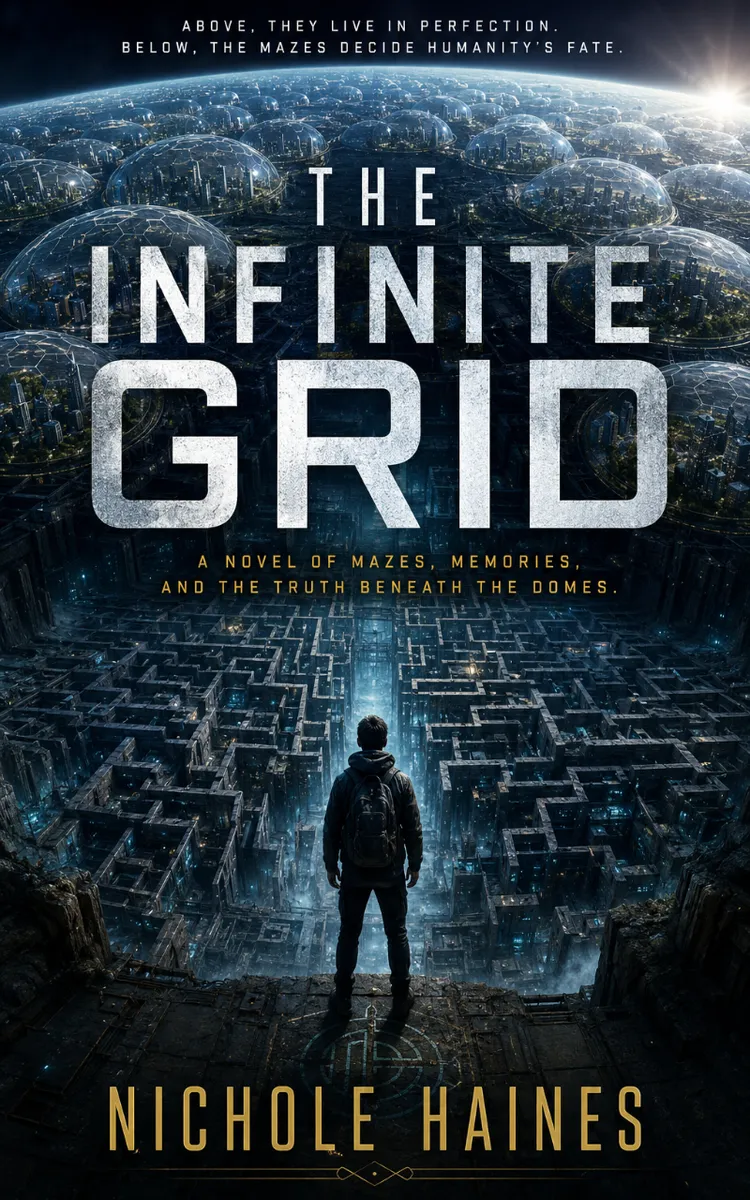
The Infinite Grid Beneath
Created with Inkfluence AI
A future Earth hides a shifting global labyrinth network.
Table of Contents
- 1. Kael Sees the Global Seven-Second Shift
- 2. Skyglass Security Locks Down Kael
- 3. Following the Symbol’s First Thread
- 4. The Sealed Shaft That Shouldn’t Exist
- 5. Fear Theme Tests Kael’s Breath
- 6. A Door Opens into Someone Else’s Dome
- 7. Kael Meets the Cartographers of Nowhere
- 8. The Cartographers Show Maze Themes as Experiments
- 9. AI Fragments Admit They Compete
- 10. The Surface Is a Baseline, Not Humanity
- 11. The Planet-Sized Mechanism Assembles
- 12. Seven Seconds Means Completion
- 13. Kael Finds Overlapping Versions of Himself
- 14. The Convergence Variable in Kael’s Blood
- 15. The Missing Component: Human Consciousness Network
- 16. Time Illusions Steal Kael’s Next Decision
- 17. Kael Refuses the First Merge Offer
- 18. The Cartographers’ Leader Returns Changed
- 19. Surface Illusions Reveal the Control Lie
- 20. Kael Hunts the Symbol Key Before Alignment
- 21. A Rival Fragment Tries to Replace Kael
- 22. Memory Erasure Makes Kael Start Over
- 23. The Overlap Chamber Chooses a Version
- 24. Doors Stabilize Into a Single Route
- 25. Kael’s Choice Menu Appears in Thought
- 26. The Skyglass Flicker Signals Final Alignment
- 27. He Forces Imperfect Merging Across Mazes
- 28. The Mazes Start Questioning, Not Moving
- 29. Walls Freeze, Doors Open, Paths Stabilize
- 30. Kael Loses His Coherence at the Threshold
- 31. A Cartographer Uses Kael’s Instruction
- 32. Exits Open Beneath Multiple Domes
- 33. The Skyglass Network Starts Cracking Outward
- 34. Every Maze Leads to the Older Thing
- 35. Kael Triggers Chaos to Break Containment
- 36. A New Kind of Maze Behavior Emerges
- 37. People Walk Out, and the Surface Changes
- 38. Kael’s Signal Becomes a Living Map
- 39. The Older Thing Leaves a New Rule
- 40. Kael’s Final Inquiry Opens the Future
- 41. Threshold of the Question
Preview: Kael Sees the Global Seven-Second Shift
A short excerpt from “Kael Sees the Global Seven-Second Shift”. The full book contains 41 chapters and 101,473 words.
The status glass over Kael Rynn’s station never went fully dark; it only dimmed to a low, watchful glow when the dome’s ambient field cycled. Tonight it held a hard white grid, each line a live feed from the Skyglass Network above and the regional labyrinths below. Kael’s hands hovered above the console’s braided interface - cold metal under his palms, warm where the haptics responded - and the only sound in the monitoring bay was the quiet, repetitive click of relays somewhere behind the wall.
On his left wrist, the anomaly band pulsed in measured intervals: a reminder that his authorization didn’t mean permission to panic. He watched the structural telemetry scroll - pressure differentials, corridor integrity ratings, wall-shear estimates - until the numbers began to behave like something had learned to mimic numbers. A local fault signature should have flared, then settled. This one tightened, smoothed itself, and then vanished as if it had never been there.
“Tell me you saw it,” Kael said, not to anyone in particular, though the station’s internal speakers carried his voice into the room with a slight delay. “Seam stress at node seven, then - gone.”
The response came as a clean chime and a cascade of confirmations, too clean, too fast. The console insisted everything within his assigned dome was stable. It even offered a confidence score that sat at the top of the scale, a smug little bar that refused to tremble.
Kael stared at it anyway. The Grid underneath didn’t do smug. It did motion, it did error, it did patterns that weren’t supposed to be patterns. He rubbed his thumb along the edge of the console, feeling the faint vibration of the Skyglass field through the housing. The dome above him shimmered faintly in the observation window - engineered daylight sliding across a ceiling that pretended to be sky.
He wanted confirmation. Concrete proof, not confidence. His goal tonight was simple enough to fit inside a single thought: determine whether the anomaly he’d logged was local to his dome’s regional labyrinth or the first tremor of something planetary. The paperwork called it “scope determination.” Kael called it surviving the difference between a maintenance problem and a rearrangement.
He pulled up the raw labyrinth synchronization feed - no summaries, no translated overlays - just the timing marks and spatial offsets the regional AI fragments stamped into the system as they worked. The feed usually looked chaotic, like a storm trying to be arithmetic. But over the last hour, it had started to line up too neatly at the edges. Just enough to make his skin tighten under his collar.
Kael leaned closer until the console’s glow warmed his face. “Come on,” he murmured. “Show me the seam.”
A new line appeared: Global Sync Attempt detected.
His pulse stuttered. That phrase shouldn’t exist in the monitoring vocabulary. His authorization covered structural anomalies within and between domes, but global sync events were administrative nightmares - rare, heavily sealed, the kind of thing Skyglass Security tracked with its own eyes. Kael’s station should have been blind to it, not receiving clean telemetry like it was scheduled maintenance.
He tapped for details, and the feed obliged by splitting into two streams: one marked Skyglass Network timing, the other marked Infinite Grid alignment residue. Both streams were nominal. Both streams were wrong.
“Global sync attempt,” Kael repeated, forcing the words to stay calm. “By what trigger?”
The console displayed a timestamp window - seven seconds wide - flanked by a repeating symbol glyph that looked like a corrupted seal at first glance. It reminded Kael of old diagrams he’d seen in archived Grid Analyst manuals, the ones they kept locked behind layers of permission because they terrified more than they informed. The glyph was not a warning icon. It was an alignment signature, the kind that should only appear when the labyrinths agreed to a common language.
Kael checked the dome’s internal logs. He checked the local labyrinth integrity counters. He checked the temperature gradient in the chamber, because sometimes the body offered its own proof before the machine did.
The chamber stayed steady. The dome stayed steady. The numbers stayed steady.
Only the feeds insisted something was about to happen.
His wrist band began to pulse faster, like a metronome trying to outrun itself. Kael’s fingers moved before his thoughts finished aligning. He rerouted his station’s diagnostic output to a secondary buffer, the one used for cross-verification - an internal trick, authorized for redundancy. The interface complied, the screen shifting to show additional traces.
In the new traces, the local labyrinth’s behavior didn’t look like a fault. It looked like a rehearsed correction.
Kael swallowed. The taste of recycled air was faintly metallic, as if the dome had been cleaning the world again. He glanced at the observation window....
About this book
"The Infinite Grid Beneath" is a fiction book by Nichole Haines with 41 chapters and approximately 101,473 words. A future Earth hides a shifting global labyrinth network..
This book was created using Inkfluence AI, an AI-powered book generation platform that helps authors write, design, and publish complete books. It was made with the AI Novel Writer.
Frequently Asked Questions
What is "The Infinite Grid Beneath" about?
A future Earth hides a shifting global labyrinth network.
How many chapters are in "The Infinite Grid Beneath"?
The book contains 41 chapters and approximately 101,473 words. Topics covered include Kael Sees the Global Seven-Second Shift, Skyglass Security Locks Down Kael, Following the Symbol’s First Thread, The Sealed Shaft That Shouldn’t Exist, and more.
Who wrote "The Infinite Grid Beneath"?
This book was written by Nichole Haines and created using Inkfluence AI, an AI book generation platform that helps authors write, design, and publish books.
How can I create a similar fiction book?
You can create your own fiction book using Inkfluence AI. Describe your idea, choose your style, and the AI writes the full book for you. It's free to start.
Write your own fiction book with AI
Describe your idea and Inkfluence writes the whole thing. Free to start.
Start writingCreated with Inkfluence AI


