
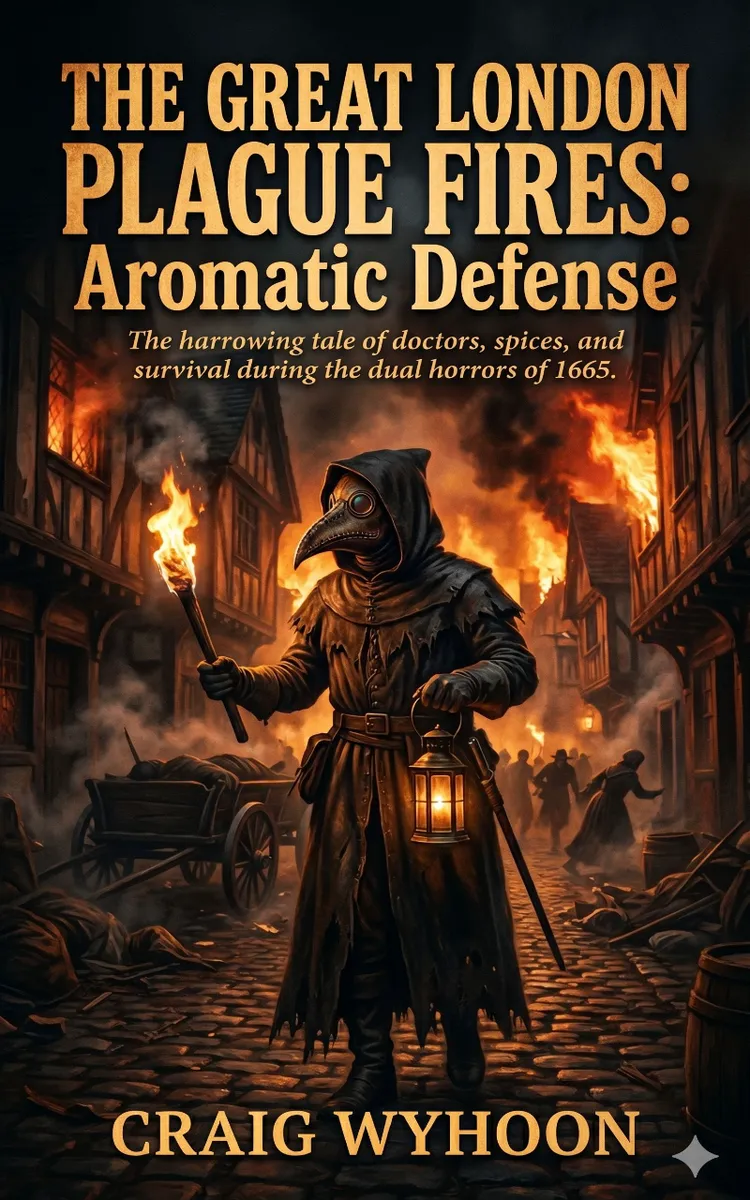
The Great London Plague Fires
Created with Inkfluence AI
London 1665 plague, doctors’ spice masks, and miasma theory
Table of Contents
- 1. Bird Masks and Spiced Breath
- 2. How Bad Air Became Germs
- 3. The Fire That Promised Clean Air
- 4. What the Mask Really Meant
- 5. Handkerchiefs, Vinegar, and Everyday Ritual
- 6. Stench, Status, and Blame
- 7. When Smoke Filled the Evidence
- 8. The Legacy of Aromatic Defense
Preview: Bird Masks and Spiced Breath
A short excerpt from “Bird Masks and Spiced Breath”. The full book contains 8 chapters and 14,815 words.
The Opening
The strangest part of the Great Plague wasn’t only that London fell ill-it was that many people tried to stay well by filling their air with perfume. In 1665, a doctor might step through the smoke and fog wearing a bird-like mask packed with strong-smelling spices, as if the right scent could block contagion at the doorway of the body.
That idea sounds like superstition until you remember what London looked and smelled like on a typical day: coal smoke hanging low over streets, middens and chamber pots emptied too near the living spaces, and the river-used for power, waste, and trade-moving its stink through the city’s moods. The plague arrived inside that sensory world, and then Miasma Theory-the belief that “bad air” and foul odors carried disease-gave people a way to interpret what they were seeing, even when the explanation was wrong.
This chapter follows that sensory logic into the spice masks and the wider practice of aromatic defense. We’ll trace how “smell” became a medical instrument, why the approach made sense to people who lived with constant filth, and what the science of disease later revealed about the limits of the nose.
If the air was the enemy, why did the cure so often look like fragrance?
The Deep Dive
London in 1665 was a city of chimneys and narrow lanes, where smoke could turn daylight into something the colour of tin. Even when the weather was kind, the city’s everyday grime didn’t vanish; it gathered. Streets were not sealed with asphalt. Waste wasn’t treated and piped away. People lived alongside the evidence of life and work-tanneries, slaughter, public privies, the river’s commerce and its refuse. Odour was not an occasional nuisance; it was a regular feature of the environment.
Into that world came the plague, and with it the human habit of fitting the new to the old. When illnesses spread, people sought a pattern they could recognize. Miasma Theory offered one: disease came from the air, especially air that seemed corrupted-air that smelled “wrong.” The theory didn’t need microscopes to feel convincing. If a foul area seemed to coincide with sickness, it was easy to conclude that the foulness was the cause rather than the companion.
The bird mask and the spice as medical technology
The most famous image of the plague doctor is the bird-like mask-a long beak, often with openings for scent, paired with gloves and a dark coat. The mask is sometimes treated like theatre, but it was meant to be practical within the medical logic of the time. The beak-shaped front could hold materials believed to purify the air. Strong scents-spices and aromatic substances-were thought to counteract the “bad” effluvia.
Here’s the key point: within miasma thinking, you weren’t trying to sterilize the air in the way we might imagine with modern germ theory. You were trying to change the character of the air near the face. The mask created a small, sheltered zone where the doctor’s breathing would meet a curated smell rather than the surrounding odour.
That sounds like mere smell, but in a world without antibiotics and without the concept of airborne pathogens as we understand them today, smell was one of the few signals people had. It was immediate. It was measurable by experience, not by instruments. If foul air seemed to make people ill, then a barrier of “good” smell looked like protection.
And the barrier wasn’t only for doctors. Aromatic practices were widespread. Fires were lit to “sweeten” the air, and substances were burned or carried as a defense. Even if the specific recipe varied from place to place, the underlying assumption stayed consistent: disease travelled on the waves of bad air, so you could fight it by altering those waves.
A single-sentence fact cuts through the romance: the spice mask worked only as a scent delivery system, not as a proven barrier to infection. Its design reflects what medical people believed at the time about where illness came from-not what biology would later show about how it spreads.
Why people believed the air did the harm
Miasma Theory wasn’t stupid; it was a product of its environment and its evidence. Consider how people experienced sickness in 1665. Households watched illness move from room to room. Neighbours noticed that some streets or houses seemed cursed while others appeared less affected. When people lived close to waste and smoke, “foulness” was a constant variable-easy to point to, hard to ignore.
Smell also had a cultural authority. Perfume and incense had long been associated with cleanliness and protection in many societies. If a scent could be made to stand for purity, then it was a short step to make scent stand for health. In that sense, plague practice didn’t appear from nowhere. It grew from habits of sensory interpretation that were already in the culture.
There’s another piece that often gets missed: bad air was not only a matter of odour....
About this book
"The Great London Plague Fires" is a curiosity book by Anonymous with 8 chapters and approximately 14,815 words. London 1665 plague, doctors’ spice masks, and miasma theory.
This book was created using Inkfluence AI, an AI-powered book generation platform that helps authors write, design, and publish complete books.
Frequently Asked Questions
What is "The Great London Plague Fires" about?
London 1665 plague, doctors’ spice masks, and miasma theory
How many chapters are in "The Great London Plague Fires"?
The book contains 8 chapters and approximately 14,815 words. Topics covered include Bird Masks and Spiced Breath, How Bad Air Became Germs, The Fire That Promised Clean Air, What the Mask Really Meant, and more.
Who wrote "The Great London Plague Fires"?
This book was written by Anonymous and created using Inkfluence AI, an AI book generation platform that helps authors write, design, and publish books.
Write your own curiosity book with AI
Describe your idea and Inkfluence writes the whole thing. Free to start.
Start writingCreated with Inkfluence AI


