
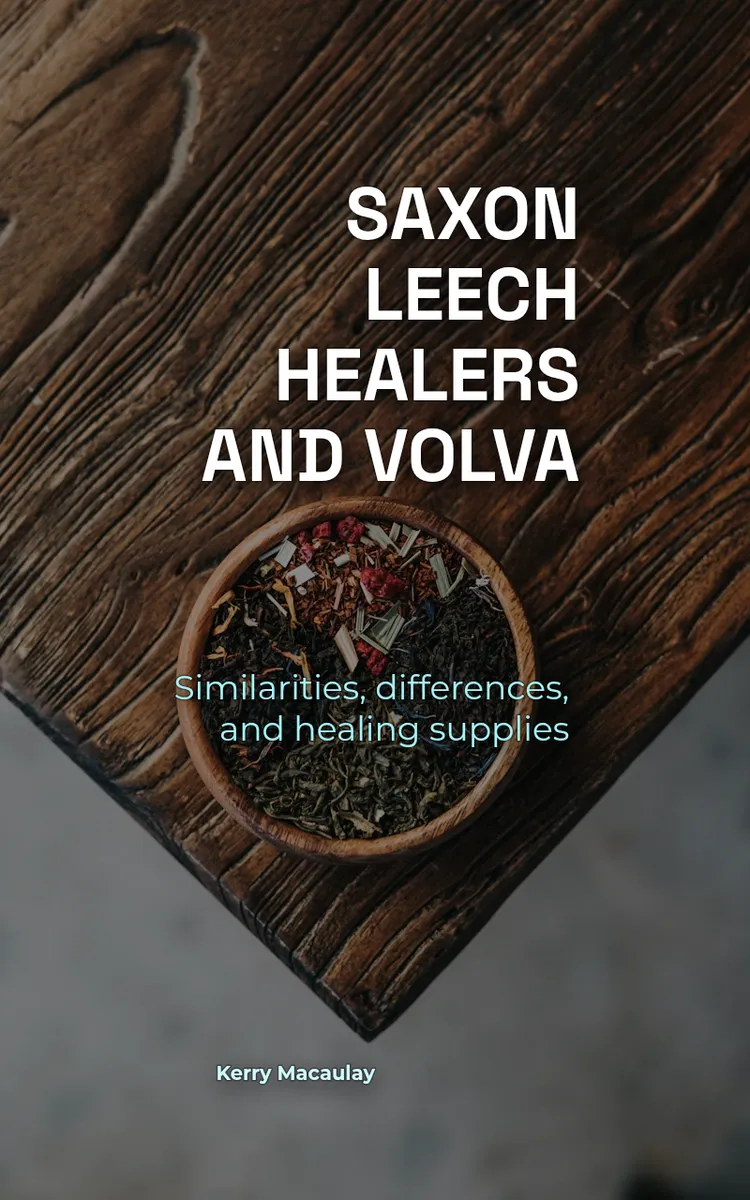
Read the first chapter
The whole of chapter one, free. About 9 min. Turn the pages with the arrows, your keyboard, or a swipe.
Chapter 1
Leeches, Charms, and Quiet Authority
The Opening
A leech healer and a Viking volva could look wildly different on the surface-one with a cutting instrument and stained hands, the other with a voice that carried through a room-but both were working with the same raw material: trust. The surprising part is that trust wasn’t just a feeling patients had; it was something these healers performed, through tone, procedure, and the careful staging of authority.
Think about what it means to be ill in a world without antibiotics, without lab tests, and without a doctor on every corner. When your fever won’t break or your wound won’t clean, you’re not choosing between treatments the way we do today. You’re choosing between people, methods, and explanations-between who seems steady enough to guide you through uncertainty.
This chapter follows a single question using a simple framework I’ll call the Trust-Performance Loop: what a patient expects, how a healer signals authority, and how those signals settle into belief long enough for the treatment to “work” in the only way it can-inside the body and inside the mind. We’ll compare how Saxon leech healers and Viking volva healing ladies built that belief, and we’ll do it by looking at voices, rituals, and the practical details that made authority feel real.
If illness was the crisis, then why did so much of healing depend on what people believed before anything was even touched?
The Deep Dive
When authority is part of the medicine
In both Saxon and Viking settings, the patient’s confidence didn’t sit politely outside the treatment like a separate comfort blanket. It was braided into the whole process. A healer’s authority showed up in small, repeatable ways: the calm pace of the work, the certainty of a statement, the way questions were handled, and the order in which things were done.
For the Saxon leech healer, authority often looked like competence with hands and tools. “Leech” in this context doesn’t mean an animal; it’s an old word for a medical practitioner, tied to the idea of a learned healer. The leech’s world included remedies made from plants and minerals, but it also included procedures-incisions, cautery, and the use of bloodletting. Even if a patient didn’t understand the theory, the healer’s measured routine could still signal, “This is handled.” In a time when most people had limited contact with professional medicine, that steadiness mattered.
For the Viking volva, authority came through something closer to ceremony. The volva-often described in sources as a specialist in seiðr (a term frequently translated as “magic” or “seiðr-practice”)-was not simply someone who “knew remedies.” She was someone whose knowledge was delivered in a recognizable pattern: set phrases, ritual movements, and a performance that made the unseen feel addressable. In other words, the authority wasn’t only in the outcome; it was in the way the healer made meaning.
There’s a scientific reason these differences both point to the same human mechanism. Modern research on pain and healing repeatedly shows that expectation can change how strongly the body reacts-especially for pain, nausea, and stress responses. Even when the underlying cause can’t be fixed by belief alone, the body’s reaction to stress chemicals and attention can shift. Long before anyone had the language for “placebo” or “nocebo,” people were still living in a world where expectation altered experience.
The Saxon leech: order, materials, and the feel of expertise
The Saxon leech world is often described through surviving medical texts and remedy collections, where healing appears as a combination of substances and instructions. Those manuscripts don’t just list what to use; they imply a process. A practitioner is expected to move through a remedy in a way that makes it look legitimate-gathering the right materials, preparing them, applying them, and doing so in a sequence that suggests the work has been done before.
That matters for trust. When a healer produces something that looks prepared-an ointment with a particular consistency, a cloth applied with purpose, a mixture that has been heated or filtered-patients can “read” competence with their eyes. A remedy doesn’t need to be understood chemically to be recognized as deliberate. In a society where many households could grow herbs but not always process them reliably, a professional’s ability to produce consistent materials could be a trust signal all by itself.
Supplies also carried authority. Even when the basics were local-common plants, animal products, simple minerals-the healer’s access to certain items could mark them as connected beyond the household. Some drugs were imported or traveled. Honey, wine, and certain resins or spices show up repeatedly in European medical practice because they were used in multiple ways: as carriers, preservatives, or ingredients that changed texture and shelf-life. When patients saw a healer bring in materials that looked “proper,” they were seeing evidence of reach.
The volva: ritual language and the staging of the unseen
The volva’s authority worked differently, but it still mapped onto the same Trust-Performance Loop. Patients who sought a volva were not only asking for a remedy; they were asking for interpretation-why this happened, what it meant, and what could be addressed. That’s crucial, because many illnesses are frightening not just physically but socially. They create uncertainty about risk, fate, and sometimes blame.
In the sources that discuss volvas and seiðr, performance is central. The volva is described as someone who can speak to powers beyond ordinary sight. Even if you don’t share the belief system, you can understand why this would build trust: ritual creates boundaries. It tells everyone what this moment is for. It gives the patient a structured experience where the healer seems to occupy a role that ordinary people cannot perform.
There’s also a voice element. A ritual specialist isn’t likely to speak like a neighbor. The cadence, the repetition, and the sense of speaking “as someone” rather than “as a person” can change how listeners process what they hear. Once a patient’s mind is held by that structure, the healer’s statements about what’s happening-what’s causing the sickness, what must be done-become more believable. The body then has something coherent to react to.
The shared loop: expectation meets performance
Here’s the core comparison: Saxon leech healers built trust through procedural authority, while volvas built trust through symbolic authority. But both were doing the same job-making an uncertain situation feel manageable. Patients likely arrived with fear, pain, and a hunger for certainty. They left, at least for a while, with a story that fit and a process that felt overseen.
In both cases, the Trust-Performance Loop probably moved like this: first, the patient expected a particular kind of response from a healer-hands that know what they’re doing, words that carry meaning. Second, the healer performed authority in a way that was consistent enough to be recognized. Third, that recognition shaped the patient’s attention and emotional state. Finally, the treatment-whether a physical procedure or a ritual shift-happened inside that frame.
One detail that helps the comparison stay grounded is the role of time. Physical treatments often required direct interventions-preparation, application, maybe repeated visits. Ritual interventions also required time, but the “work” was in holding a sequence of gestures and words long enough for the patient to experience it as real. In both systems, healing wasn’t a quick event; it was a time-bound process that demanded patience. That shared rhythm can itself strengthen trust: if something is happening in a defined order, it feels less random.
What You Did Not Expect
The counterintuitive finding is that the most important “medicine” in both traditions may not have been the substance or the spell-it may have been the relationship between patient expectation and healer performance. It’s easy to think the leech’s authority was mostly about cutting and the volva’s authority was mostly about mystery. But the trust signals-the voice, the ritual structure, the steady handling of materials-work like a bridge that lets the patient’s mind and body cooperate with the treatment.
That matters because it changes what we look for when we compare traditions. If we only compare ingredients and techniques, we miss the mechanism that made those ingredients and techniques persuasive. When you see healing as a trust-built process, differences in worldview become less of a barrier and more of a clue: each tradition found a culturally acceptable way to stage authority so the patient could endure uncertainty.
And it also helps explain why some people could swear by remedies that don’t map neatly onto modern biology. Not because they were “wrong” about everything, but because healing experiences are shaped by what the patient believes is happening while the healer is acting.
The Human Story
To see this trust-building in a human way, picture Eadric, 19, an apprentice on a farm where health problems are rarely treated as private. A cough that lingers isn’t only an individual problem; it threatens work schedules, family stability, and the fear that something might spread. When Eadric’s community talks about illness, it’s usually in plain terms: what changed, who got sick next, whether the sick person can still do tasks.
In that setting, a healer’s authority can’t stay hidden. A Saxon leech healer would have been judged in front of others-how they spoke to the patient, whether they seemed hurried or confident, whether they brought supplies that looked right for the complaint. If the leech took time to prepare materials, if the work followed a recognizable order, the community would notice. Trust here is social. Even if Eadric is the one lying down, the village is watching how the healer moves.
The volva’s authority in a neighboring context would also be public, but the “proof” would look different. The volva’s power would be judged by whether the ritual made the situation feel named and directed-whether the words and actions aligned with what people feared and hoped. The patient’s family would listen not only to the content, but to the structure: the sense that this was a practiced role, not a random attempt at comfort.
Whether the healer used hands or words, Eadric’s likely expectation would have been similar: that the specialist could impose order on chaos. The Trust-Performance Loop would tighten as the healer performed-materials prepared in a steady sequence, or ritual language delivered in a way that made the unseen feel less slippery. Either way, trust becomes the bridge between a problem that feels too big and a process that feels manageable enough to endure.
What This Tells Us
What this comparison reveals is that healing has always been more than a chemical exchange. It’s also a social event where authority is performed in culturally familiar ways, and where the patient’s attention becomes part of the treatment. People don’t just seek relief from pain; they seek a frame that makes pain understandable and therefore bearable.
The deeper mystery is how often the “effective” part of medicine is the part we’d overlook if we only counted ingredients. When a leech healer prepares a remedy or a volva speaks in ritual sequence, both are doing something that medicine still does today-guiding what a person expects, so the body can respond. And the question that keeps moving under the facts is simple: if trust can steer the body, what else in human health is being shaped by the stories we’re given while help is arriving?
End of chapter one. 4 more chapters in the full book.
Swipe or use the arrows to turn the page
What's inside: 5 chapters
- 1. Leeches, Charms, and Quiet Authority
- 2. What They Treated: Wounds vs Wyrd
- 3. Supplies on the Move: From Herb to Bowl
- 4. How Far Did the Medicine Travel?
- 5. Shared Healing Logic Beneath Differences
About this book
"Saxon Leech Healers And Volva" is a curiosity book by Kerry Macaulay with 5 chapters and approximately 8,529 words. Comparison of Saxon leech healers and Viking volva healing practices.
This book was created using Inkfluence AI, an AI-powered book generation platform that helps authors write, design, and publish complete books.
Frequently Asked Questions
What is "Saxon Leech Healers And Volva" about?
Comparison of Saxon leech healers and Viking volva healing practices
How many chapters are in "Saxon Leech Healers And Volva"?
The book contains 5 chapters and approximately 8,529 words. Topics covered include Leeches, Charms, and Quiet Authority, What They Treated: Wounds vs Wyrd, Supplies on the Move: From Herb to Bowl, How Far Did the Medicine Travel?, and more.
Who wrote "Saxon Leech Healers And Volva"?
This book was written by Kerry Macaulay and created using Inkfluence AI, an AI book generation platform that helps authors write, design, and publish books.
Write your own curiosity book with AI
Describe your idea and Inkfluence writes the whole thing. Free to start.
Start writingCreated with Inkfluence AI


