
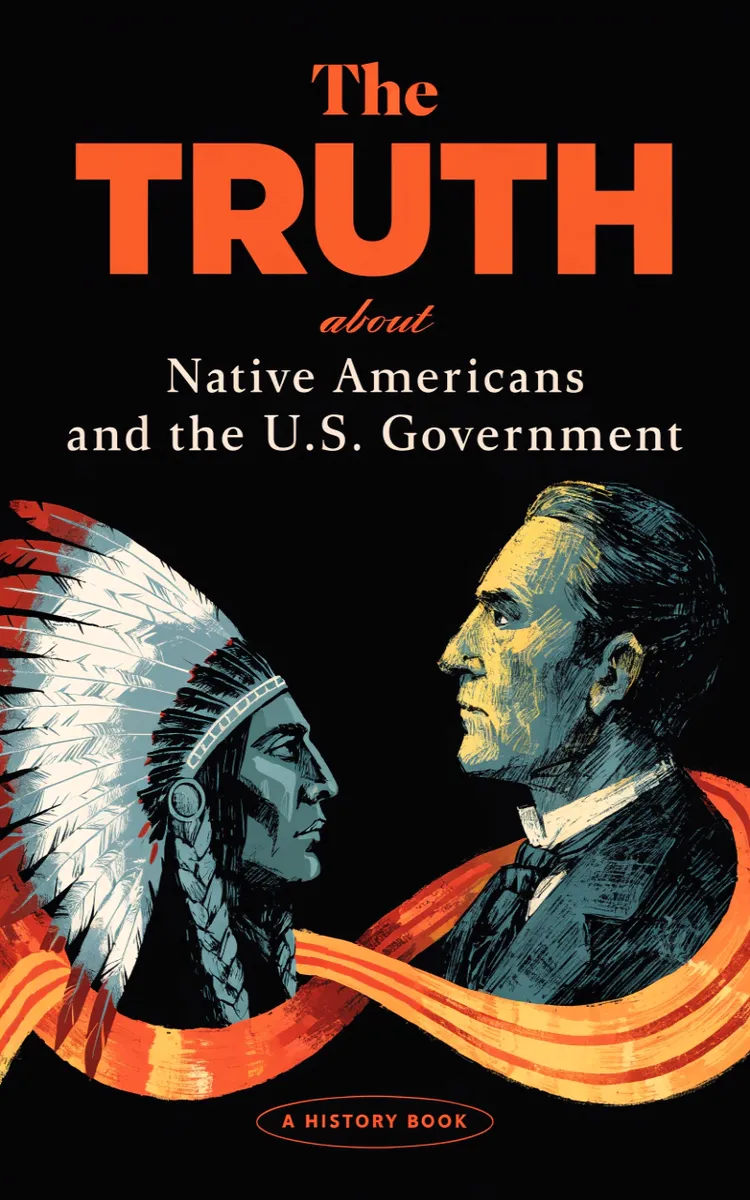
Read the first chapter
The whole of chapter one, free. About 9 min. Turn the pages with the arrows, your keyboard, or a swipe.
Chapter 1
The Boarding-School Lie That Worked
A schoolhouse can be a kind of weapon when the goal is not learning but replacement. In the late 1800s and well into the 1900s, the United States supported boarding schools for Native children with a blunt promise: if you removed a child from Native language, dress, and family life, you could remake the child into someone else. The paradox is that the policy was sold as “education,” complete with classrooms and rules-while its real engine was identity extraction.
Rosa, 19, volunteers at her community museum, and she remembers the first time she saw a photograph that made her stomach tighten. One of the faces in that old image belonged to a relative she’d heard about only in fragments-someone described as “quiet,” someone whose name was spoken carefully. The picture showed a child standing in uniform-like clothing in front of a school building, the kind of setting that looks ordinary until you understand what it cost to get there. Rosa’s job as a volunteer is to help visitors connect artifacts to people, but those photographs are different: they don’t just show the past. They show a system designed to make the past harder to recognize.
This chapter follows the story behind that system: how U.S. policy used schooling to erase Native identity, and what that reveals about government power. It’s also about the everyday mechanics-haircuts, schedules, punishments, and paperwork-that turned a cultural attack into an institution people could point to and call “official.” And the central mystery is this: how did the country manage to make the erasure of Native identity feel like a normal part of education?
How do you turn a child’s language into “discipline,” and still call it learning?
The Deep Dive
The boarding-school idea didn’t arrive fully formed from nowhere. The United States had long pushed a broad goal: to reduce Native nations’ independence and reshape Native life to fit a settler society. By the mid-1800s, federal leaders and agencies increasingly treated culture itself-Native languages, spiritual practices, kinship structures, and community authority-as obstacles to “progress.” In that worldview, education wasn’t simply a service. It was a lever, and children were the part most easily moved.
Federal policy leaned on the language of assimilation, a word that sounds gentle until you notice what it demands. Assimilation meant something specific: Native people were expected to become like non-Native Americans. Boarding schools became a practical tool because they offered a controlled environment where daily life could be supervised from the moment a child woke up until lights out. A classroom is one thing; an all-day, all-week environment where every habit is monitored is another. The policy treated separation from family as a necessary ingredient, not a tragedy.
A key part of how this worked was the way boarding schools were tied to federal objectives through contracts and oversight. Many schools were operated by non-Native institutions, often religious organizations, under arrangements that were supported by the federal government. The details varied from place to place, but the pattern held: children were taken far from home, placed under strict rules, and pressured-sometimes violently-to abandon languages and cultural practices. Even when a school offered reading, arithmetic, and basic vocational training, the identity goal shaped everything around those subjects.
Schooling as control: the logic of separation
To understand why boarding schools were so effective at identity extraction, it helps to look at what they removed. A child’s sense of belonging usually lives in routines: who tells stories, which language is used at meals, how relatives address one another, what songs mark seasons, what clothing signals community. When policy put children in dormitories and classrooms away from those routines, it didn’t just change where a child slept. It changed what the child learned to trust.
There’s a reason control of time matters. Boarding schools ran on schedules-bells, work assignments, and “order” enforced through discipline. The goal was to make one set of habits feel normal and another feel wrong. When a child’s language is treated as a problem to be corrected, the child learns not only to speak differently but to associate their own community’s way of life with shame or punishment. That lesson can be stronger than any textbook.
Haircuts are often remembered because they were visible. Many Native children had long hair cut short, and clothing that looked different from what they wore at home was required. These aren’t small details. They are signals. When you change a child’s appearance and surround it with rules, you send a message that belonging is conditional-conditional on looking and acting a certain way.
“Kill the Indian, save the man”: the language behind the policy
The clearest window into the policy’s intent comes from the rhetoric used by federal officials and policymakers. One phrase-often quoted though its exact wording and attribution are debated in different retellings-captures the blunt logic: “Kill the Indian, save the man.” Whether people repeated it verbatim or in spirit, the idea was the same: Native identity was treated as something to be eliminated so a “better” person could be produced.
That rhetoric matters because it exposes the mismatch between the surface and the motive. The policy wasn’t simply about schooling in the modern sense. It was about changing who Native children were allowed to be. When officials framed Native culture as something to be eradicated, they made it easier to justify harsh measures as necessary “corrections.”
The scientific grounding here isn’t about whether people learn-of course they do. It’s about how learning is shaped by environment and repetition. Psychologists and educators have long understood that repeated cues and consequences carve habits into the brain. If a child hears their language punished every day, the child’s learning system starts to treat that language as dangerous or inferior. In that sense, boarding schools weren’t only teaching; they were training responses-through fear, through control, and through relentless repetition.
The irony is that the schools could also teach useful skills. Reading and writing, basic trades, and literacy in English were real outcomes. But the policy’s design meant those skills often came with a cost: the child was expected to exchange community identity for acceptance in the outside world.
The paperwork of erasure: policy, funding, and oversight
Boarding schools weren’t isolated experiments. They were part of a government-backed structure. Federal agencies created systems for funding and managing Native schooling, and they used the schools as instruments of broader goals. Even when schools were run by particular organizations, they operated within federal expectations and reporting. That administrative layer-contracts, inspections, and directives-helped turn identity extraction into something durable.
One reason the strategy “worked” in the narrow sense is that it built an infrastructure. It wasn’t just a few bad actors. It was a policy that could recruit children, transport them, and hold them in place long enough for patterns to take root. Transportation itself could be traumatic: children were separated across vast distances, meaning family influence was interrupted. Once a child’s daily life is controlled by an institution, it becomes easier to enforce cultural change.
A lesser-known detail that sharpens the picture is how school rules often extended beyond the classroom. The expectation was that children would live the policy, not just learn under it. That could include restrictions on language use, limits on cultural practices, and enforcement of a standardized identity. The point wasn’t only to teach English; it was to make the child’s original identity feel like something that had to be managed, corrected, or hidden.
And that’s where government power becomes visible. Power doesn’t always look like a riot or a battlefield. Sometimes it looks like a schedule, a ledger, and a building that keeps doors open long enough for a plan to sink into daily life.
What You Did Not Expect
The surprise is how ordinary the mechanism can look once it’s in place. Boarding schools were often staffed by adults who believed they were improving children, and the day-to-day environment could resemble the era’s mainstream schooling-timetables, lessons, chores. What made it different was the purpose built into the system: the institution was structured to extract identity, not merely to instruct.
This matters because it changes how we judge harm. If we expect oppression to be obviously cruel, we miss the way it can arrive dressed as normal public service. The boarding-school strategy shows that government power doesn’t only act through force; it can also act through legitimacy-through the ability to label coercion as education and to make that label feel official enough to be tolerated.
It also reframes the word “assimilation.” In everyday speech, assimilation can mean blending. In the boarding-school policy, assimilation functioned more like a one-way door. Learning happened, but it was paired with a demand to surrender parts of self that the policy treated as unacceptable.
The Human Story
Rosa first encountered the boarding-school story not through a textbook but through a museum display: a stack of old photographs, some with handwritten names on the back, some with dates that made the timeline feel painfully real. She had always known that her community faced pressure to change, but the images gave that pressure a face and a location. The child in the photo wasn’t a distant “Native American” from history; it was someone whose relatives could still point to a home, a family line, and a later generation shaped by what happened to them.
When Rosa volunteers, she talks about the images with visitors who often ask the same question: how could a school do this? She tries to answer without turning the museum into a courtroom. She focuses on what the documents and artifacts show-how children were placed in institutions, how rules governed their daily lives, how separation from home was treated as part of the plan. The museum doesn’t just preserve objects; it preserves relationships. And boarding-school artifacts disrupt relationships by showing how policy tried to sever them.
Her own family story mirrors what many communities describe: the aftereffects lingered even after the schools closed or changed. The loss isn’t only about what was taken in one year; it’s about what became harder to pass on afterward. Language, stories, and cultural practices are not like a coat that can be recovered later. They are lived things, and they need community repetition to survive.
That’s the theme connecting Rosa to the larger policy story. The boarding-school strategy wasn’t only about an institution; it was about shaping the next generation’s sense of what is safe to be. In that way, identity extraction is not a single act. It’s a long pattern, enforced through daily life.
What This Tells Us
What the boarding-school story reveals is that governments can use the language of improvement to justify control, especially when they can claim authority over children. Humans tend to trust institutions that look familiar-classrooms, schedules, official paperwork-so the machinery of power can hide in plain sight. The deeper lesson is unsettling: when the state gains the power to define what “good education” means, it can also define which parts of a culture are treated as acceptable.
The boarding schools show how identity can become a policy target, not an individual choice. And once you see that, you start noticing the same pattern in other places: the moments when a society calls change “progress” while quietly demanding someone else’s disappearance. The question that keeps pulling at the edges is whether any “normal” institution can be trusted when its purpose is to remake people into something more convenient.
End of chapter one. 7 more chapters in the full book.
Swipe or use the arrows to turn the page
What's inside: 8 chapters
- 1. The Boarding-School Lie That Worked
- 2. Why “Treaties” Became Paper Promises
- 3. The Reservation Economy Trap
- 4. The Map That Moved Borders Overnight
- 5. Citizenship Without Real Consent
- 6. Termination: The Policy Nobody Wanted
- 7. Self-Determination, With Strings Attached
- 8. The Pattern Behind Every Policy
About this book
"The Truth about Native Americans and the U.S. Government" is a curiosity book by Anonymous with 8 chapters and approximately 13,170 words. History of U.S.
This book was created using Inkfluence AI, an AI-powered book generation platform that helps authors write, design, and publish complete books.
Frequently Asked Questions
What is "The Truth about Native Americans and the U.S. Government" about?
History of U.S. government policies toward Native Americans
How many chapters are in "The Truth about Native Americans and the U.S. Government"?
The book contains 8 chapters and approximately 13,170 words. Topics covered include The Boarding-School Lie That Worked, Why “Treaties” Became Paper Promises, The Reservation Economy Trap, The Map That Moved Borders Overnight, and more.
Who wrote "The Truth about Native Americans and the U.S. Government"?
This book was written by Anonymous and created using Inkfluence AI, an AI book generation platform that helps authors write, design, and publish books.
Write your own curiosity book with AI
Describe your idea and Inkfluence writes the whole thing. Free to start.
Start writingCreated with Inkfluence AI


