
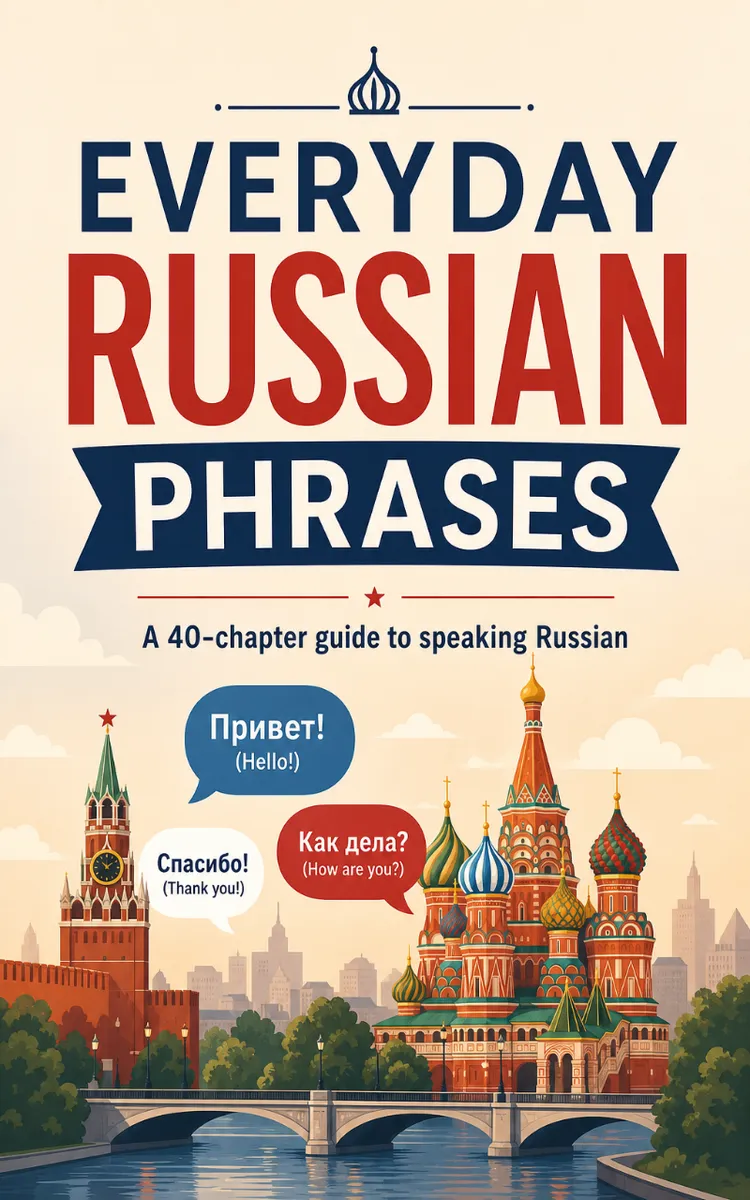

Read the first chapter
The whole of chapter one, free. About 6 min. Turn the pages with the arrows, your keyboard, or a swipe.
Chapter 1
Hello and Goodbye Basics
Hello and Goodbye Basics: Everyday Russian Greetings and Parting Phrases
The easiest way to sound “friendly and understandable” in Russian is not by using fancy words - it’s by getting the basic greetings and goodbyes right. Think of the first 5 seconds at a shop counter, a school hallway, or a clinic desk: the tone of your first phrase sets the tone for everything that follows. And because these phrases repeat all day long, you can practice them until they feel automatic.
In many classrooms and training sessions, the same pattern shows up: learners can memorize single words, but they stumble when the whole greeting comes out too long, too soft, or with unclear endings. This chapter fixes that with clear, usable phrase sets plus pronunciation guidance you can immediately model. It also connects to the earlier chapters’ idea of building from “chunks” (short, repeatable units) rather than isolated vocabulary - here, those chunks are greetings and parting lines you’ll use daily.
Learning Objectives - Learn common Russian greetings and goodbyes for everyday encounters, with clear pronunciation. - Use the right phrase for common situations: meeting, answering a greeting, leaving. - Practice pronunciation so endings sound natural, not guessed.
What to Say When You Meet and When You Leave (and How to Sound Natural)
Russian greetings are usually short and situation-based. You’ll often hear a “time-neutral” greeting, plus a more formal “good day” style option. For parting, Russian typically uses an equivalent of “goodbye” that works in most daily settings, plus a couple of “see you” options.
Here are the core terms you’ll use in this chapter:
• Greeting - a phrase you say when you meet someone or when you enter a place. - Parting phrase - a phrase you say when you end an interaction (leaving, finishing a call, closing a visit). - Pronunciation cue - a simple guide to help you say sounds clearly (not a full phonetics course).
Main greeting patterns (practical meanings) 1) Neutral “Hello” - Здравствуйте (zdráv-stvuy-tye) - “Hello/Good day” in a standard, polite way. Common in shops, offices, and with strangers. - Привет (pri-VYET) - “Hi” in an informal setting. Use with people you know (friends, classmates).
2) “Good morning / good afternoon / good evening” - Доброе утро (DOH-bra-ye OO-tra) - “Good morning” (morning hours). - Добрый день (DOH-bry den’) - “Good day/Good afternoon.” - Добрый вечер (DOH-bry VE-chehr) - “Good evening.”
3) Answering a greeting Russian often mirrors the greeting with a simple response. For example, if someone says Здравствуйте, you can respond with Здравствуйте as well, or with a short Здравствуйте! and a nod. In many training settings, that mirroring is exactly what learners need first - fast success, low risk.
Main parting patterns (practical meanings) 1) Everyday “Goodbye” - До свидания (da sví-da-nee-ya) - “Goodbye.” It’s polite and widely usable. - Pronunciation note: the stress is on сви (sví). Keep the “sv” sound clean: sví.
2) “Bye / See you” - Пока (PAH-ka) - “Bye” / “See you” in informal contexts. - Увидимся (oo-VEE-deem-sya) - “See you” (more like “We’ll see each other again”). Often friendly and works with people you know.
3) Leaving politely - Всего доброго (fsyó-va DOH-bra-vah) - “All the best.” Common when you want a slightly warmer, polite closure.
A quick pronunciation reality check (for teachers) Ask yourself: when your learners say a phrase, do you hear clear endings? In Russian, endings carry meaning (“who,” “how,” “when”), even in greetings. For example, Здравствуйте ends with -тье sounds; if that part disappears, the phrase can feel “unfinished.” In classroom modeling, exaggerate endings just enough to be heard, then gradually reduce to natural speed.
Practical takeaway: Pick one neutral greeting (Здравствуйте) and one neutral parting (До свидания) as your “default set.” Use time-based greetings (Добрый день) when the setting makes it natural.
Worked Example: Choosing the Right Greeting and Goodbye for a Counter Interaction
Let’s take a common everyday encounter teachers often practice: a learner enters a shop and then leaves after paying. The interaction is short - so the phrase choice has to be simple and reliable.
We’ll use a step-by-step decision path and end with the final phrase set.
Scenario (real-world, classroom-friendly) Your learner walks up to the counter, gets help, pays, and leaves. The shop worker is polite and professional. The learner wants to sound respectful without overthinking.
1) Decide the formality level - You’re speaking to a stranger or professional worker. - Choose a polite greeting: Здравствуйте.
2) Choose the greeting timing - The learner enters and starts the interaction. - Say the greeting right away, before asking questions or confirming details.
3) Decide the parting style - After payment and thanks, the learner is leaving the counter. - Choose a neutral polite goodbye: До свидания.
4) Add one “connector” word only if needed - Russian often works without extra filler, but in training you may want one simple connector like Спасибо (spah-see-ba) - “Thank you.” - If you already practiced “Thank you” in an earlier resource, you can place it before the goodbye: greeting → request → thank you → goodbye.
5) Practice the phrase rhythm as chunks - Chunk 1: Здравствуйте (zdráv-stvuy-tye) - Chunk 2: До свидания (da sví-da-nee-ya)
Final answer (use this in the shop interaction): Здравствуйте! … Спасибо. До свидания!
Pronunciation cue to coach: - Здравствуйте: keep zdráv crisp, then flow: zdráv-stvuy-tye (don’t stop after “zdrav”). - До свидания: emphasize sví in sví-da-nee-ya.
Practical takeaway: For most daily counter interactions, a two-phrase set - Здравствуйте + До свидания - covers you cleanly. You don’t need a different greeting every time.
Check Your Understanding: Quick Practice for Real Daily Encounters
Use these questions to practice choosing the right phrase and saying it clearly. After each prompt, try saying the phrase out loud once slowly, then once at normal speed.
1) You enter a classroom hallway and a teacher you don’t know yet says “Hello” first. What do you say back? - Hint: Use the polite, neutral greeting that works with strangers: “Hello/Good day.”
2) A colleague you know well texts you and you want a casual “Hi.” What phrase fits? - Hint: Think informal “Hi,” not the polite “Good day.”
3) You want to say “Good afternoon” specifically. Which phrase should you use? - Hint: Look for the one that matches “day/afternoon,” not morning or evening.
4) You finish a business-like conversation and you’re leaving the desk. What’s a safe, polite goodbye? - Hint: Choose the common neutral goodbye used in professional settings.
5) You’re leaving a friend after a short visit. What’s a natural informal goodbye? - Hint: Think “Bye/See you,” casual and short.
Answer Key: 1) Здравствуйте! 2) Привет! 3) Добрый день. 4) До свидания. 5) Пока.
Practical takeaway: Don’t just memorize - decide. Each prompt asks you to match the phrase to the situation (stranger vs. friend, formal desk vs. casual goodbye).
Closing: Your “Default Pair” Makes Russian Easier
If you only remember one thing from this chapter, make it this: Russian daily life runs on a small set of reliable greeting and parting phrases. When your learners have a default pair - Здравствуйте for meeting and До свидания for leaving - they stop losing time to decision-making and start focusing on the next piece: the question, the request, the explanation.
In the next practice topics, you’ll build outward from these anchors. You’ll add small variations for timing (morning/afternoon/evening) and closings (like warmer “all the best” or “see you again”). But the foundation stays the same: clear pronunciation, correct formality, and phrase chunks that you can deploy on the spot.
End of chapter one. 42 more chapters in the full book.
Swipe or use the arrows to turn the page


What's inside: 43 chapters
- 1. Hello and Goodbye Basics
- 2. Polite Thank-You and Please
- 3. Introducing Yourself and Your Name
- 4. Asking How Someone Is
- 5. Small Talk Starters for Any Day
- 6. Saying I’m Sorry and Excuse Me
- 7. Basic Yes, No, and Maybe
- 8. I Don’t Understand and Repeat Please
- 9. Can You Speak More Slowly?
- 10. Where Is the Bathroom?
- 11. Asking for Directions Simply
- 12. At the Train or Bus Stop
- 13. Ordering Coffee and Tea
- 14. At a Restaurant: Table and Menu
- 15. Ordering Food You Can Pronounce
- 16. Asking About Price and Payment
- 17. Shopping: Sizes and Colors
- 18. Buying Tickets and Paying at Shops
- 19. At the Pharmacy: Basic Needs
- 20. Health Phrases for Common Symptoms
- 21. Making Appointments and Schedules
- 22. Time Expressions for Everyday Talk
- 23. Days, Months, and Dates
- 24. Numbers for Prices and Quantities
- 25. Ordering with “I Want” and “I Need”
- 26. Requests Using Polite Imperatives
- 27. Offering Help and Responding
- 28. Accepting and Declining Offers
- 29. Talking About Preferences Simply
- 30. Weather Phrases for Small Talk
- 31. Common Questions with Где and Куда
- 32. Questions with Сколько and Какой
- 33. Time to Go: Leaving and Meeting
- 34. Phone and Messaging Essentials
- 35. Help in Emergencies: Call and Stop
- 36. Travel: At the Airport and Customs
- 37. At the Hotel: Check-In and Requests
- 38. Household Phrases for Daily Life
- 39. Common Complaints and Fixing Problems
- 40. Review: Build Your Phrase Routine
- 41. Framing this Chapter: Why a New Chapter Matters for Everyday Phrases
- 42. Why a Bonus Tips & Resources Chapter Matters for Everyday Phrases
- 43. What matters most: Core insights you’ll keep using
About this book
"Everyday Russian Phrases" is a education book by Nichole Haines with 43 chapters and approximately 55,349 words. Everyday Russian phrases with pronunciation for learners.
This book was created using Inkfluence AI, an AI-powered book generation platform that helps authors write, design, and publish complete books. It was made with the AI Lesson Plan Generator.
Frequently Asked Questions
What is "Everyday Russian Phrases" about?
Everyday Russian phrases with pronunciation for learners
How many chapters are in "Everyday Russian Phrases"?
The book contains 43 chapters and approximately 55,349 words. Topics covered include Hello and Goodbye Basics, Polite Thank-You and Please, Introducing Yourself and Your Name, Asking How Someone Is, and more.
Who wrote "Everyday Russian Phrases"?
This book was written by Nichole Haines and created using Inkfluence AI, an AI book generation platform that helps authors write, design, and publish books.
How can I create a similar education book?
You can create your own education book using Inkfluence AI. Describe your idea, choose your style, and the AI writes the full book for you. It's free to start.
Write your own education book with AI
Describe your idea and Inkfluence writes the whole thing. Free to start.
Start writingCreated with Inkfluence AI


