
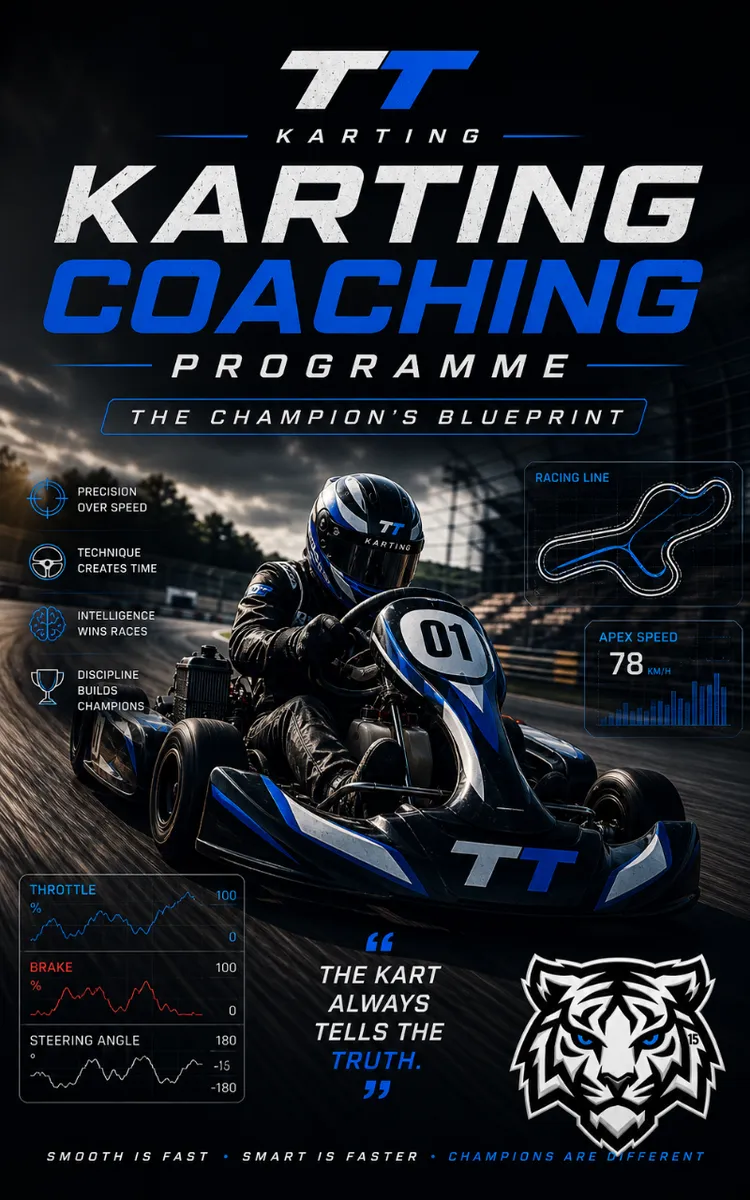
TT Karting Coaching Programme
Created with Inkfluence AI
Advanced karting coaching: braking, lines, telemetry, racecraft
Table of Contents
- 1. Kart Balance and Weight Transfer
- 2. Trail Braking and Brake Pressure Control
- 3. Throttle Application and RPM Management
- 4. Racing Lines, Vision, and Corner Entry
- 5. Racecraft: Overtaking and Defensive Driving
Preview: Kart Balance and Weight Transfer
A short excerpt from “Kart Balance and Weight Transfer”. The full book contains 5 chapters and 11,590 words.
Have you ever watched the leader exit the corner and thought, “How is that kart still so pointy when mine feels lazy”? The answer usually isn’t engine speed or courage-it’s chassis balance and tire loading. The kart that stays balanced through the whole lap keeps the tires in their working window, so steering response stays sharp and traction looks “effortless” instead of fragile.
“The smoothest and smartest drivers are usually the fastest.” That line only becomes real when you can feel and measure weight transfer. In Rotax and championship karting, you don’t win because you brake later once-you win because your kart rotates the same way every lap, and the weight shifts you create put load on the right tires at the right time.
Dario K., 19, Rotax Junior racer, came to us with one problem that sounded small: his lap times were consistent, but his corner entry and mid-corner steering felt different depending on traffic and tire temp. He wasn’t “off” in one place-he was off in the way his kart loaded the tires across phases of the lap. We fixed that using the TT Balance Map Protocol: a driver-and-data method to map where your weight goes, what the tires do, and how you adjust brake and throttle to keep balance repeatable.
What You Need to KnowChassis balance means how the kart’s load sits across the tires and how that load changes as you move the kart through braking, turn-in, mid-corner, and exit. When your balance stays in the right place, the kart turns without fighting you, and it stops “falling in” mid-corner or “pushing” wide on exit.
Weight transfer is the shift in load caused by acceleration, braking, and cornering forces. In plain terms: when you brake, the front tires take more load; when you accelerate, the rear takes more; when you corner, the outside tires take more. The kart doesn’t care about your intentions-it reacts to the load you create.
Tire loading is the actual force the tires carry. Grip doesn’t come from the tires being “good” or “bad”-it comes from keeping the tires loaded in a range where they can generate lateral grip (cornering) and forward grip (exit). Too much load too abruptly can saturate the tire and ruin steering response.
Dynamic balance is chassis balance while the kart is moving and forces keep changing. Static balance (how the kart sits on stands) tells you almost nothing about race performance. Your kart’s race behavior comes from dynamic balance: brake application shape, turn-in timing, and how you roll throttle while the kart is loaded.
TT Balance Map Protocol builds your understanding into a repeatable process. You break the lap into phases, you watch how your brake pressure and throttle inputs line up with steering and kart response, and you compare “what I did” to “what the kart loaded.” The goal: you create weight transfer patterns that stay consistent lap after lap, even when tires cool down or you catch traffic.
Ask yourself a hard question before you touch setup: when you miss a corner, do you miss it because you entered too fast, or because your kart’s load timing changed? If you can’t tell, you’re guessing-and guessing costs more than any jetting change.
Breaking It DownYou’ll build championship-level speed by mastering chassis balance through every phase of the lap. That means you must control when and how fast the load moves, not just how much speed you carry.
Approach and brake onset (load moves forward-shape it).
When you start braking, front load rises quickly. If you stab the brake, you slam load onto the front tires before they’ve stabilized laterally. That creates front lock tendency, unstable rotation, and a steering feel that goes heavy at turn-in.
Do this instead: apply brake pressure with a controlled ramp. Your target is a predictable front load rise that matches your turn-in timing.
Concrete check: watch your brake pressure trace (from your data logger or a kart with brake sensor). If your pressure graph spikes instantly, your front load spike likely does the same. Your hands feel it as “grabby front” or “kart won’t settle.”
Turn-in (you’re asking for rotation while load is shifting).
Turn-in is where most drivers trade steering for speed. If you turn in while front load is peaking and the kart still feels “tied down,” you’ll overload the front outside tire and lose the ability to rotate cleanly.
The fix is not “turn less.” You manage the overlap between braking load and lateral load. You finish your main braking, then you transition into cornering with a brake pressure drop that lets the kart rotate without unloading too abruptly.
Concrete check: ask yourself what your kart does at the moment you commit the steering. If it hesitates, it’s under-rotating; if it snaps and then understeers, you likely forced too much load too quickly on the front.
Mid-corner (hold the balance-don’t fight the tires).
Mid-corner is the phase where the kart should feel calm....
About this book
"TT Karting Coaching Programme" is a how-to guide book by Tony Thompson with 5 chapters and approximately 11,590 words. Advanced karting coaching: braking, lines, telemetry, racecraft.
This book was created using Inkfluence AI, an AI-powered book generation platform that helps authors write, design, and publish complete books. It was made with the AI Ebook Generator.
Frequently Asked Questions
What is "TT Karting Coaching Programme" about?
Advanced karting coaching: braking, lines, telemetry, racecraft
How many chapters are in "TT Karting Coaching Programme"?
The book contains 5 chapters and approximately 11,590 words. Topics covered include Kart Balance and Weight Transfer, Trail Braking and Brake Pressure Control, Throttle Application and RPM Management, Racing Lines, Vision, and Corner Entry, and more.
Who wrote "TT Karting Coaching Programme"?
This book was written by Tony Thompson and created using Inkfluence AI, an AI book generation platform that helps authors write, design, and publish books.
How can I create a similar how-to guide book?
You can create your own how-to guide book using Inkfluence AI. Describe your idea, choose your style, and the AI writes the full book for you. It's free to start.
Write your own how-to guide book with AI
Describe your idea and Inkfluence writes the whole thing. Free to start.
Start writingCreated with Inkfluence AI


