
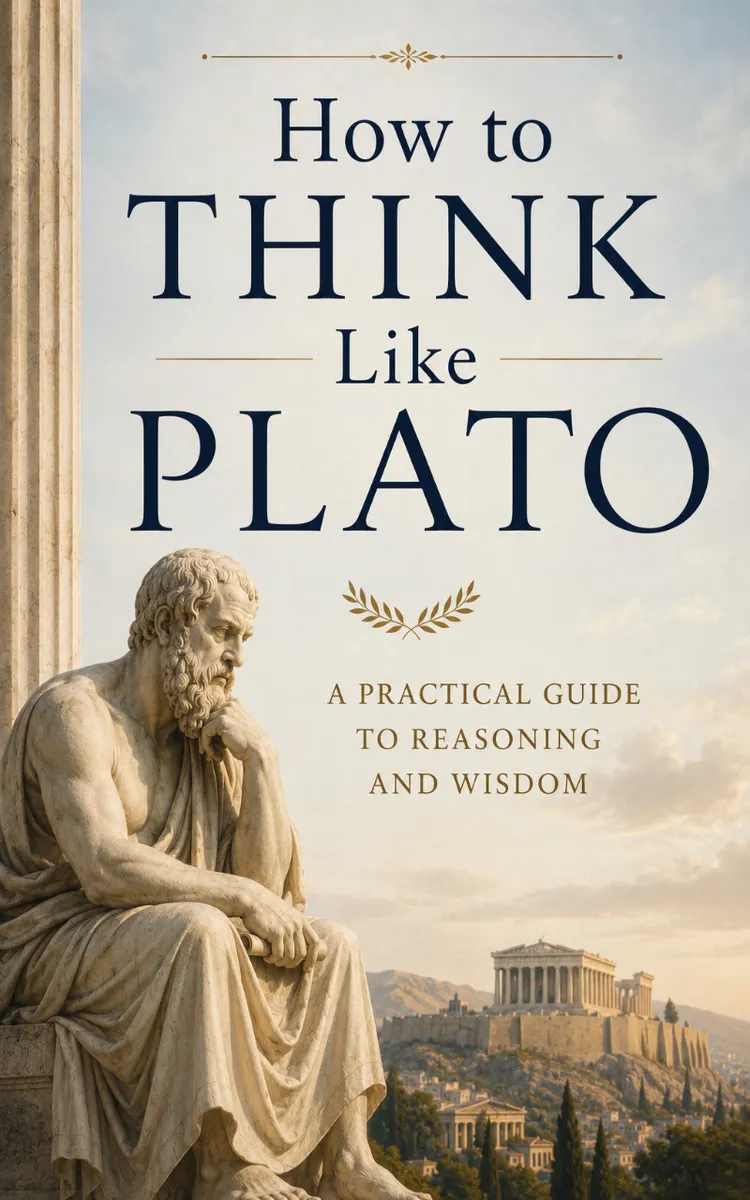
How To Think Like Plato
Created with Inkfluence AI
You do not get stuck because you lack information. You get stuck because you treat what changes as if it stays the same. That is why arguments spiral, decisions stall, and “obvious” conclusions keep failing the moment real life shifts. In How To Think Like Plato, you will learn a crystal-clear process for applying Plato’s philosophy to everyday thinking, starting with the difference between shifting appearances and stable meanings. Then you will use Socratic prompts to question assumptions you never meant to question, climb the Socratic Ladder to reach deeper intent, and define terms before you argue. If you want a practical way to think with less guessing and more clarity, start here.
Table of Contents
- 1. Plato’s Forms in Everyday Life
- 2. Question Assumptions with Socratic Prompts
- 3. Define Terms Before You Argue
- 4. Build Arguments from True Premises
- 5. Spot and Fix Contradictions Fast
- 6. Use Dialectic to Refine Beliefs
- 7. Apply Justice to Real Decisions
- 8. Train Your Mind with Daily Reflection
Preview: Plato’s Forms in Everyday Life
A short excerpt from “Plato’s Forms in Everyday Life”. The full book contains 8 chapters and 14,613 words.
“People don’t get stuck because they lack information. They get stuck because they treat what changes as if it stays the same.” That sentence hits hard when you work with real problems - an angry customer, a messy schedule, a sales pitch that flops. You watch details move around all day, and your mind starts to glue those shifting details to one “truth,” even when the truth is something steadier.
This chapter gives you a daily lens for separating shifting appearances (what you see, hear, and feel in the moment) from stable meanings (what the situation is really about). Plato called those stable meanings Forms - not “forms” like paperwork, but the underlying “what-it-really-is” that doesn’t change just because your mood or circumstances change. After you learn the technique in this chapter, you’ll be able to look at a confusing moment, name what’s changing, name what’s meaning, and choose your next action with less guessing.
The Forms Filter: separating shifting appearances from stable meanings
Plato’s key move is simple to say and hard to do: he separates the things that look different from the things that stay the same in meaning. A customer’s tone changes. A meeting time changes. Your confidence changes. But the question “What did they actually need?” often stays the same. When you mix those together, you end up arguing about the wrong thing - chasing the loudest detail instead of the real issue.
In practical terms, the problem you’ll solve is this: you react to the surface and then wonder why the reaction didn’t fix the root. Maybe you wrote a long reply to a customer when the real need was a clear next step. Maybe you changed your plan because one person sounded upset, even though their actual request didn’t change. You can’t control what shifts, but you can control what you treat as real.
You’ll use a tool called the Forms Filter. It works like a mental “screen.” You run your moment through two categories: Appearance (what shifts right now) and Meaning (what stays the same as the “what-it-really-is”). When you name both clearly, you stop bouncing between emotions and begin choosing actions that match the stable meaning.
Ask yourself as you read: When you feel certain, are you certain about the appearance - or about the meaning? The Forms Filter helps you tell the difference.
Practical takeaway: By the end of this chapter, you’ll know how to label a moment as “appearance” or “meaning,” so you act on the right target instead of the loudest surface detail.
How the Forms Filter works in daily thinking
Plato’s Forms can sound mystical, so we’ll keep it grounded. Think of a Form as the stable “type” of something - its real definition in meaning. For example, “refund request” has a meaning even when the customer’s tone changes. “Repair needed” has a meaning even when the parts list looks different. The appearance varies; the meaning should guide your response.
Here’s the Forms Filter technique you’ll use over and over. Follow it in order. Keep your language plain and concrete.
1. Write the Appearance in one sentence
- Include only what you can point to right now: words said, error messages shown, timing, tone, what changed since yesterday.
- Example: “The customer said, ‘This is unacceptable,’ and requested a credit today.”
2. Name the stable Meaning as a “type”
- Turn the moment into a clear “what this is” category.
- Use a noun phrase: “request for refund,” “request for escalation,” “need for tracking info,” “need for a fix,” “clarification of policy.”
- Example: “This is a request for escalation and a resolution path, not a debate about their feelings.”
3. Ask: what would stay true even if the tone changed?
- If the customer calmed down, what would still be true about the situation?
- This question forces you to stop treating emotion as the main fact.
- Example: If they rewrote their message politely, the stable meaning would still be “they need a resolution today.”
4. Pick one action that matches the Meaning
- Choose an action that would make sense for that stable “type,” even if the appearance changes again.
- Example: “Offer the resolution options and confirm the exact next step and timeline.”
Notice how the action comes last. Many people do the opposite: they react to the appearance, then scramble for a meaning later. The Forms Filter flips that order so your response fits the stable meaning.
What to listen for when you label Meaning
Meaning often shows up as a question you can answer. When you can state the stable meaning as a question, you’re close:
- “What resolution do they need?”
- “What policy applies?”
- “What information do they still lack?”
- “What step happens next?”
If you can’t state a meaning-question, you probably haven’t separated appearance from meaning yet. You may just be stuck in the surface noise.
...
About this book
"How To Think Like Plato" is a how-to guide book by Oliver Quiver with 8 chapters and approximately 14,613 words. You do not get stuck because you lack information. You get stuck because you treat what changes as if it stays the same.
This book was created using Inkfluence AI, an AI-powered book generation platform that helps authors write, design, and publish complete books. It was made with the AI Ebook Generator.
Frequently Asked Questions
What is "How To Think Like Plato" about?
You do not get stuck because you lack information. You get stuck because you treat what changes as if it stays the same. That is why arguments spiral, decisions stall, and “obvious” conclusions keep failing the moment real life shifts. In How To Think Like Plato, you will learn a crystal-clear process for applying Plato’s philosophy to everyday thinking, starting with the difference between shifting appearances and stable meanings. Then you will use Socratic prompts to question assumptions you never meant to question, climb the Socratic Ladder to reach deeper intent, and define terms before you argue. If you want a practical way to think with less guessing and more clarity, start here.
How many chapters are in "How To Think Like Plato"?
The book contains 8 chapters and approximately 14,613 words. Topics covered include Plato’s Forms in Everyday Life, Question Assumptions with Socratic Prompts, Define Terms Before You Argue, Build Arguments from True Premises, and more.
Who wrote "How To Think Like Plato"?
This book was written by Oliver Quiver and created using Inkfluence AI, an AI book generation platform that helps authors write, design, and publish books.
How can I create a similar how-to guide book?
You can create your own how-to guide book using Inkfluence AI. Describe your idea, choose your style, and the AI writes the full book for you. It's free to start.
Write your own how-to guide book with AI
Describe your idea and Inkfluence writes the whole thing. Free to start.
Start writingCreated with Inkfluence AI


