
Read the first chapter
The whole of chapter one, free. About 4 min. Turn the pages with the arrows, your keyboard, or a swipe.
Chapter 1
Classic French Omelette Basics
At a Glance Prep: 10 min | Cook: 3 min | Total: 13 min | Serves: 2 | Difficulty: Easy.
Introduction A classic French omelette is built for control: tender, creamy curds that set gently while the surface stays glossy. The goal is not “scrambled eggs.” The goal is a soft, folded omelette that holds shape when you slide it onto a plate - silky inside, lightly browned outside, with no dry edges.
You’ll master kitchen induction (setting the right heat and responding fast), the essential tools (a nonstick pan and a flexible spatula), and the core safety habits that keep egg work smooth - clean hands, clean bowls, and careful handling around heat. The expected result is a uniform fold with soft curds, a thin layer of butter on the pan, and a clean release when you tip the omelette out.
As you practice, ask yourself a simple question: when you stop cooking, does the omelette look slightly underdone? On induction, the carryover heat is real, and learning that timing is what separates “edible” from “classic.”
Ingredients - Protein - 6 large eggs (about 300 g total) - 20 g unsalted butter, plus extra for the pan if needed - Produce - 1 tsp fresh chives, finely snipped (optional) - Dairy - 2 tbsp (30 ml) crème fraîche or sour cream - 30 g Gruyère cheese, finely grated (optional; use for a richer finish) - Pantry - 1 tsp water (for loosened texture while whisking) - Spices - 1/2 tsp fine salt - 1/4 tsp freshly ground black pepper - Optional add-ons (choose up to 4) - 2 tbsp cooked ham, diced small - 1-2 tbsp sautéed mushrooms, cooled - 1 tbsp chopped parsley - 1 tsp Dijon mustard (for a mild tang)
Takeaway check: If you’re new to omelettes, keep it simple: eggs, salt, pepper, butter, and one optional filling like chives or a little cheese.
Instructions 1. Set up your induction station. Place a nonstick omelette pan (20-24 cm) on the induction hob. Have a bowl for whisking, a whisk, a flexible silicone or heatproof spatula, and a plate ready before the eggs hit the pan. Turn on the fan/ventilation if you have it. 2. Whisk for consistency. Crack eggs into a bowl. Add salt, pepper, water, and crème fraîche. Whisk 30-45 seconds until the mixture looks uniform and slightly airy (no visible streaks). 3. Preheat correctly. Add 20 g butter to the pan. Set induction to medium-high, then watch the butter: it should foam and turn lightly glossy, not brown. If it browns fast, reduce heat immediately. 4. Cook fast, stir gently. Pour in the egg mixture. Let it sit 10-15 seconds, then use the spatula to gently push curds from the edges toward the center. Keep the motion light - think “guiding,” not “scrambling.” 5. Fold at the right doneness. When curds are mostly set but still look slightly soft on top (about 45-70% set), turn the heat down to low. Add any filling (cheese, ham, mushrooms) to one half and fold the omelette in half using the spatula. Cook 20-30 seconds more. 6. Note: If you wait for fully dry eggs, the omelette will overcook. The surface should look glossy and the center should still be tender when you plate. 7. Serve immediately. Slide onto a warm plate. If you want, finish with chives or parsley. 8. Clean as you go (safety + speed). Turn off induction. Wipe the pan while it’s still warm (not hot) and wash the bowl/whisk with hot soapy water to prevent egg residue from sticking.
Pro Tip: For induction, treat heat like a dial you can “reply” to. Start medium-high for butter, then drop to low right before folding - this is how you keep creamy curds without drying the edges.
Chef Notes & Variations Storage is simple: eat a French omelette right away. Eggs firm up quickly as they cool, and reheating usually makes them rubbery. If you must hold it, keep it warm only briefly (low heat, covered) and aim to serve within a few minutes. For cleanup, remove egg solids from the pan promptly - letting them dry on nonstick makes future cooking harder.
Plating matters because the shape is part of the technique. Keep the fold neat and centered, then garnish lightly (a few chives or a dust of pepper). If you used Gruyère, the cheese should melt into the fold, not become separate patches.
Swap It: If you don’t have crème fraîche, use sour cream in the same amount. It changes the tang slightly, but the omelette stays tender because the mixture still adds moisture and fat. For a practical variation, keep the base technique identical and change only the filling: ham and Gruyère for a classic savory fold, or sautéed mushrooms plus parsley for a vegetable-forward omelette.
Takeaway prompt: Before you cook again, ask yourself: did you reduce heat before folding? That one timing decision is the difference between creamy curds and a dry, browned exterior.
Quick Version Whisk 6 eggs with salt, pepper, water, and crème fraîche; melt 20 g butter on a preheated induction nonstick pan, cook eggs gently until mostly set, fold with filling, then finish on low briefly and plate immediately. Add chives or parsley and serve hot.
End of chapter one. 4 more chapters in the full book.
Swipe or use the arrows to turn the page
What's inside: 5 chapters
- 1. Classic French Omelette Basics
- 2. WHO-Style Chicken Salad Bowl
- 3. Umami Mushroom Risotto Theory
- 4. Julienne Chicken Stir-Fry Plating
- 5. Mother Sauce Béchamel Lasagna
About this book
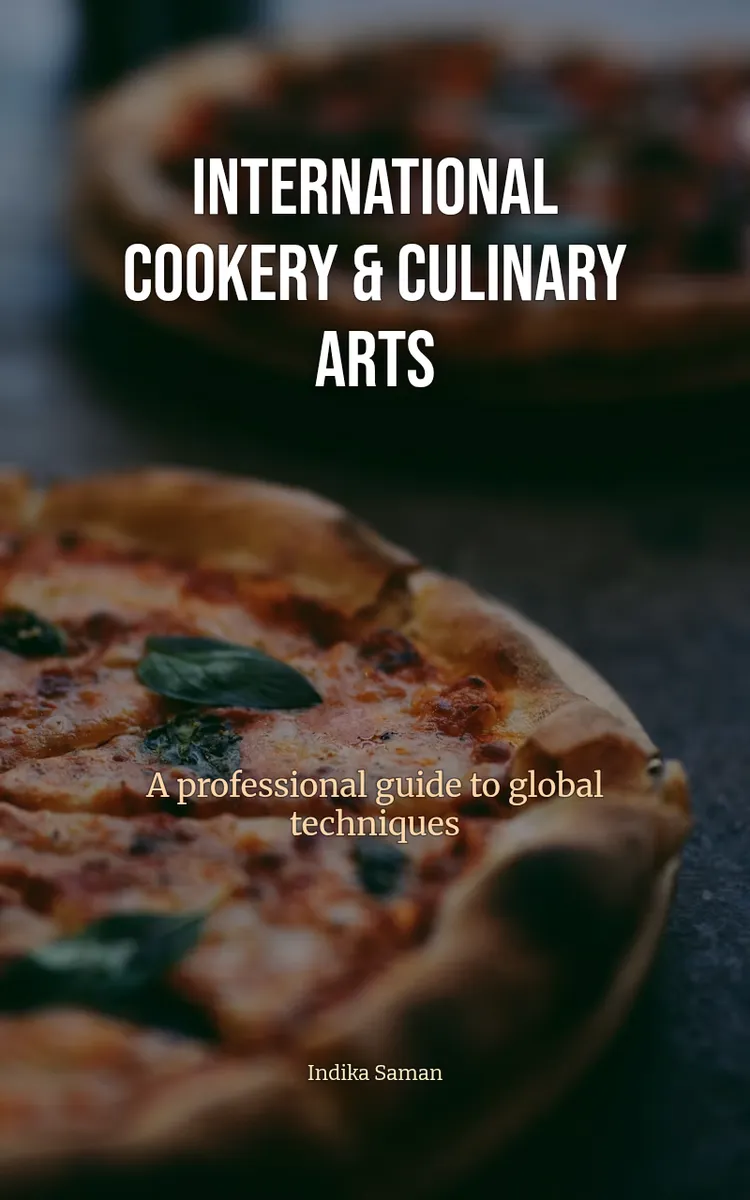
"International Cookery & Culinary Arts" is a cookbook by Indika Saman with 5 chapters and approximately 4,706 words. International cookery textbook covering safety, theory, and core skills.
This book was created using Inkfluence AI, an AI-powered book generation platform that helps authors write, design, and publish complete books. It was made with the AI Cookbook Generator.
Frequently Asked Questions
What is "International Cookery & Culinary Arts" about?
International cookery textbook covering safety, theory, and core skills
How many chapters are in "International Cookery & Culinary Arts"?
The book contains 5 chapters and approximately 4,706 words. Topics covered include Classic French Omelette Basics, WHO-Style Chicken Salad Bowl, Umami Mushroom Risotto Theory, Julienne Chicken Stir-Fry Plating, and more.
Who wrote "International Cookery & Culinary Arts"?
This book was written by Indika Saman and created using Inkfluence AI, an AI book generation platform that helps authors write, design, and publish books.
How can I create a similar cookbook?
You can create your own cookbook using Inkfluence AI. Describe your idea, choose your style, and the AI writes the full book for you. It's free to start.
Write your own cookbook with AI
Describe your idea and Inkfluence writes the whole thing. Free to start.
Start writingCreated with Inkfluence AI


